
Lot 25
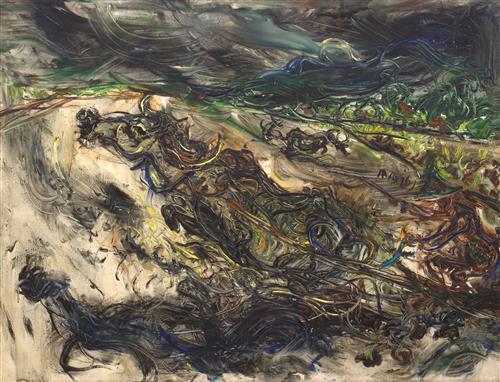
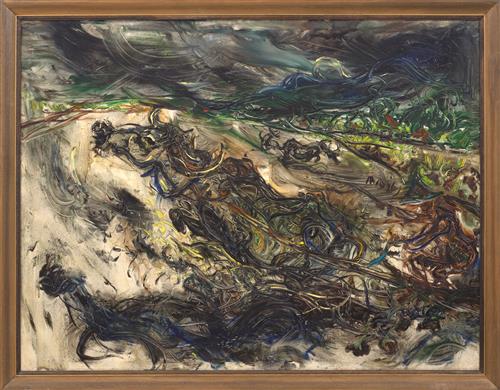
Buffalo Ploughing 1976
oil on canvas
signed with monogram and dated centre right: AF1976
authenticated by The Affandi Museum, Yogyakarta
97 x 128cm
Estimate $70,000 - $90,000
Work is in good condition consistent with age. A substantial amount of dust has settled on the surface, most particularly in the areas where heavy layers of paint have been applied. This can be rectified with a light surface clean.
There is minor paint loss seen in the lower centre area, in a speckled fashion and detected only when inspecting close-up.
Separation of the paint has occurred in a small area upper mid right and in the lower left quarter of the canvas.
Paint and canvas is stable, colours are vibrant and true to their original form. No previous repairs or restoration work. Housed in a late 1970s frame.
The opinions expressed in the condition reports are a guide only and should not be treated as a statement of fact. Prospective buyers are encouraged to inspect articles for sale at our pre-sale viewing where Leonard Joel staff are available for advice.
Leonard Joel makes no guarantee of the originality of mechanical or applied components. Absence of reference to such modifications does not imply that a lot is free from modifications.
Acquired directly from the artist, Indonesia 1976
Private collection, Melbourne
Affandi was perhaps Southeast Asia's foremost expressionist painter of the mid-20th century, renowned for his idiosyncratic, unorthodox style and bold subject matter.
Following Indonesia's colonisation by the Dutch, the formal artistic style promoted the transaction of art and culture between these two nations. This style became known as the 'Beautiful Indies', capturing idyllic depictions of the landscape including volcanoes, mountains, flowers, river valleys and villages emerging in radiating sunshine. Affandi rejected the imposing views of the Beautiful Indies and, along with modernists Sudjojono and Gunawan, painted works that were stylistically and thematically against the Dutch regulations of what was considered agreeable Indonesian art. While Affandi produced no propaganda, his works were symbolically defiant expressing an unadulterated reality of his homeland taking its first halting steps into the modern era.
Before teaching himself to paint at the age of 27, Affandi worked as a teacher, box office clerk, and a house painter resorting to using left over materials from a day's work to supply his own artistic creations. Affandi never restricted himself to prior sketches or drafts and, while he would study a subject matter for a long period of time, the actual painting could take less than an hour to complete. He never learnt how to use a pallet, disliked brushes, and was known to smear the paint directly from the tube onto the canvas, quite often using only his fingers to blend.
'Never do I make any rough sketches in advance, for nature is the quiescence of all my actions and reactions. It is a matter of only of feeling and emotion. As soon as I have my cloth before me, I kneel down unconsciously, thinking of my subject alone, feeling myself fused with this one thing, I cannot explain. I feel emotion and intuition to be oozing from my inner self. Neither am I a rationalist nor an intellectualist for I can live my means of my emotions alone.'
Affandi was famous for depicting imagery that was raw and often confronting. Animals and people alike have been used as subjects in his work to convey emotion and evoke empathy. Buffalo are an integral part of Indonesian culture and also considered to be sacred, escorting the spirits of the dead to the eternal afterlife. The buffalo also exists as a symbol of democracy and the power of the people, as depicted on the Indonesian coat of arms. Affandi here gives pride of place to the buffalo rather than the figure it is tethered to. The dominance of the animal is enhanced through the artist's painterly approach, each stroke or smear of paint reinforcing its power as it ploughs the field. Affandi pours energy into his key subject matter, yet masterfully maintains a softness and restraint in its surrounds. The rich and deep colours further highlight Affandi's dual focus, displaying both the beauty and ugliness of his homeland.
Affandi heroically managed to gain recognition in the western art world, being the first Indonesian artist to have been invited by the Venice Biennale in 1954. While he remained foremost a practicing artist for and within Indonesia, his paintings were desired beyond local shores. In 1976, a young Australian woman travelled to Indonesia to attend her cousin's wedding, a professor at the University of Djokjakarta. Her cousin and his new bride introduced her to Affandi at his bamboo cottage, shortly after which she picked out 'the buffalo painting' describing it as having resonated with her the most. Affandi wrapped the canvas up in a handmade bamboo cylinder case which she clutched carefully in her arms throughout the entire journey back to Australia. This painting has remained in this one private collection since 1976 until its exhibition and auction here at Leonard Joel.
Fine Art
AUCTION
Sale: LJ8344
6:30pm - 17 March 2020
333 Malvern Rd, South Yarra 3141
VIEWING
Viewing in Sydney
Friday 6 - Sunday 8 March, 10am-4pm
Viewing in Melbourne
Wednesday 11 March, 9am-8pm
Thursday 12 - Sunday 15 March, 10am-4pm
Monday 16 March, viewing by appointment
CONTACT
Summer Masters
summer.masters@leonardjoel.com.au
SIMILAR ITEMS
Lot 49
KENNETH JACK (1924-2006) Melbourne 1957 oil on composition board triptych
Estimate: $40,000-50,000
Lot 44
SIDNEY NOLAN (1917-1992) Dam Near Glenrowan 1970 oil on hardboard
Estimate: $35,000-45,000
Lot 64
DEL KATHRYN BARTON (born 1972) Apon the Face of The Waters - She Who Puts Her Love Of Shiny Things Aside and Gives to The Earth 2005...
Estimate: $30,000-40,000
Lot 8
TOM ROBERTS (1856-1931) Happy Cottage, Goulburn Valley 1927 oil on panel
Estimate: $20,000-30,000