Lot 15
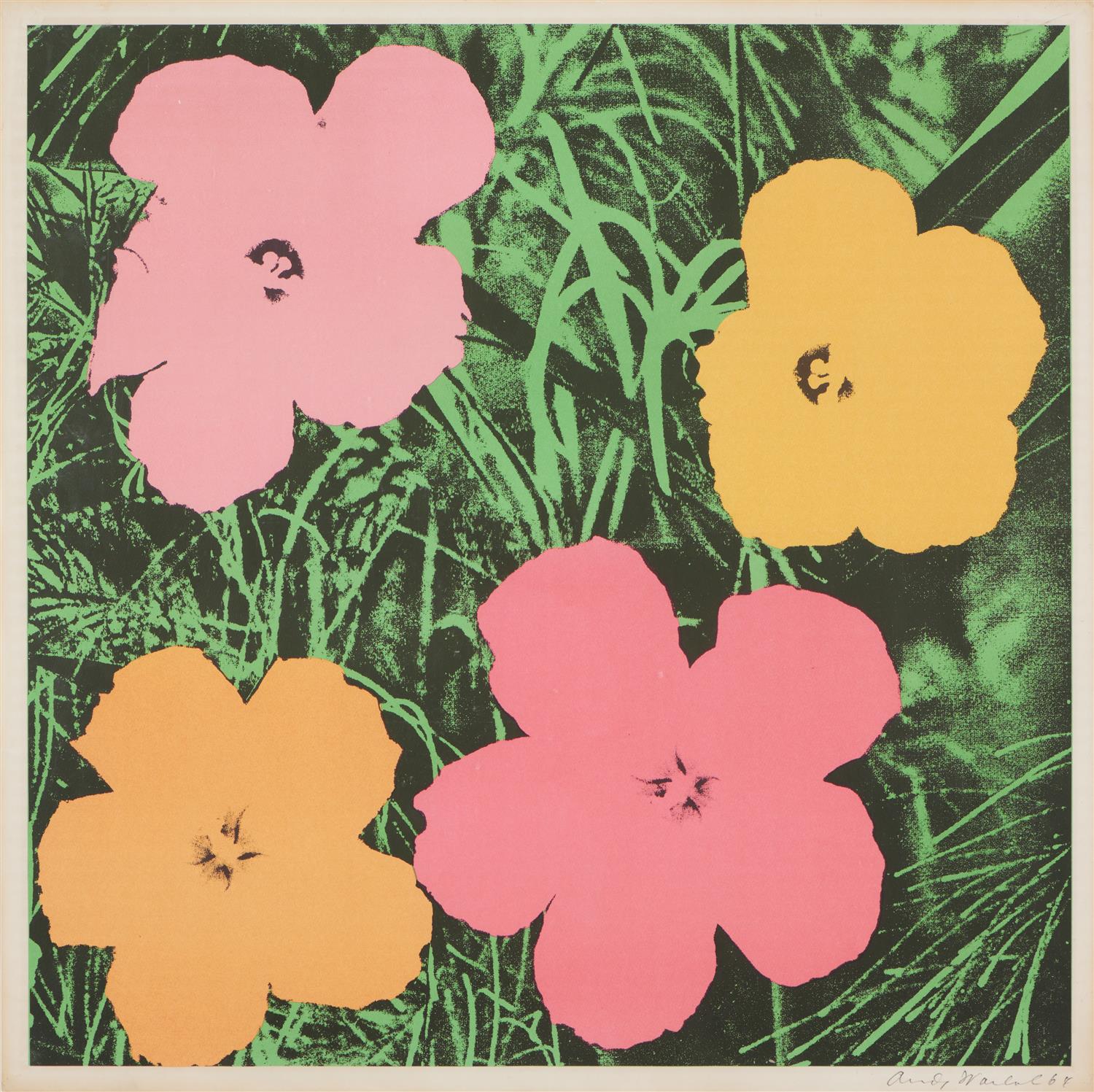
Flowers (Feldman & Schellmann II.6) 1964
offset lithograph, ed. of approximately 300
signed and dated lower right: andy warhol 64
printed by Total Color
published by Leo Castelli, New York
55.5 x 55.5cm
Estimate $40,000 - $50,000
The Collection of Christo and Jeanne-Claude (a gift from Leo Castelli)
Sotheby's, Unwrapped, Part I: The Hidden World of Christo and Jeanne-Claude, Paris, 17 February 2021, lot 17
Private collection, Melbourne
Feldman, F., and Schellmann, J., Andy Warhol Prints: A Catalogue Raisonne 1962-1987, Ronald Feldman Fine Arts, New York, fourth edition, 2003, cat. no. 11.6, p. 60 (illus., another example)
In the world of art, there are certain moments that breathe life into artworks, giving them a deeper meaning than what meets the eye. Andy Warhol's Flowers series, a peak in his artistic journey, represents an important part of the Pop Art movement. While his Campbell's Soup and Marilyn prints had become iconic, they were firmly rooted in a specific time and cultural context. Flowers, in contrast, reinvigorated the movement, becoming timeless and iconic in their own right while transcending pop culture references.
The Flowers series emerged in 1964 when Henry Geldzahler, then curator of the Metropolitan Museum of Art, sought to divert Warhol's focus from deceased icons and tragedies into something different and refreshing. Geldzahler proposed a change, "I looked around the studio and it was all Marilyn and disasters and death. I said, 'Andy, maybe it's enough death for now.' He said, 'What do you mean?' I said, 'Well, how about this?' I opened a magazine to four flowers."(1)
It was at this pivotal moment that Warhol encountered a photographic foldout of hibiscus flowers within the June issue of Modern Photography magazine, an image originally captured by Patricia Caulfield. The magazine layout itself hinted at the artistic potential of these floral images. One side of the foldout presented four variations of the photograph with subtle differences in colours to demonstrate the new Kodak colour processing system, yet also reminiscent of the repetition that Warhol embraced in his own practice.
To bring the Flowers series to life, Warhol undertook a meticulous artistic process. He initially cropped the photograph of flowers to achieve a square format, containing just four blossoms. Once the final composition was established, Warhol collaborated with his studio assistants at the Factory to apply flat areas of colour to each canvas, typically using green as the background and warm vibrant hues for the flowers. Subsequently, they would screenprint to overlay the appropriated photographic image. The fusion of vivid colour with the medium of screenprint instilled the Flowers series with its intended distinctive visual impact.
Warhol's unwavering dedication to the Flowers series throughout 1964 was revealed to the world through his transformative exhibition at Leo Castelli Gallery in New York. The space was enriched with his 24-inch floral screenprints, all densely displayed to enhance the repetition of the motif and highlight the absence of a fixed upright position. To coincide with this exhibition, Warhol published Flowers (11.6). Arthur C. Danto recalls, "I remember the stack of offset lithographs, Flowers (11.6), at the receptionist's desk at Leo Castelli Gallery in 1964, where they cost, in my recollection, five dollars each. I was surprised to learn … that there were only approximately three-hundred of these since everyone I knew bought one or two. That shows the narrow radius of the art world in that era. That they were cheap and unnumbered, printed on ordinary paper by a vernacular shop not especially known for fine art prints, corresponded, I think, with the idea that everyone who wanted one could have one, and that there were no relevant differences from print to print …. Because they were so democratised, on the other hand, those prints were treated as virtually disposable - who thought of them as Art with a capital A? People wrapped packages with them or tacked them up unframed until they became soiled and torn, so that by now they have a rarity and value altogether subversive of artistic intention."(2)
The intimacy of the art world at the time is indicative in the provenance of this lot, whereby Leo Castelli gifted this work to fellow artists Christo and Jeanne-Claude who had newly arrived in New York in 1964. The artists treasured Flowers (11.6) in their personal collection until their momentous auction with Sotheby's Paris in 2021. This provenance not only enhances its historical and artistic value, but also connects two of the art world's great entities whose influence transcended their own artistic realms.
The Flowers series resonates with not only the timelessness of nature's beauty but also Warhol's enduring popularity as an artist and fascination with repetition. More than half a century after their creation, the series continues to signify a turning point within the oeuvre of Warhol's prints. Unlike his iconic representations of brand names or celebrities, the Flowers are free from cultural context yet have remained quintessentially 'Warhol' alongside Marilyn and his Campbell's soup cans.
Hannah Ryan
Prints and Multiples Specialist
(1) Lobel, M., In Transition: Warhol's Flowers, 2012, accessed 18 September 2023: https://www.academia.edu/6606038/In_Transition_Warhols_Flowers
(2) Danto, C. A 2003, 'From Warhol and the Politics of Prints', in Feldman, F., Schellmann, J., Andy Warhol Prints: A Catalogue Raisonnee 1962 - 1987, Distributed Art Publishers, Inc., p. 14
© Andy Warhol Foundation for the Visual Arts, Inc. ARS/Copyright Agency, 2023
Fine Art
AUCTION
Sale: LJ8704
6:00pm - 24 October 2023
333 Malvern Rd, South Yarra 3141
VIEWING
Friday 20 - Sunday 22 October, 10am - 4pm
Monday 23 October, by appointment
333 Malvern Road, South Yarra VIC
CONTACT
Olivia Fuller
olivia.fuller@leonardjoel.com.au
SIMILAR ITEMS
Lot 49
SIDNEY NOLAN (1917-1992) Kate Kelly Pursued by Constable Fitzpatrick c.1945 oil on board 62 x 74.5cm
Estimate: $90,000-120,000
Lot 57
GAETANO CHIERICI (Italian, 1838-1920) (The Happy Family) 1870 oil on canvas 80.5 x 107cm
Estimate: $90,000-120,000
Lot 9
JEFFREY SMART (1921-2013) First Study for Conversation Piece 1997 oil and pastel on canvas 13.5 x 45.5cm
Estimate: $70,000-90,000
Lot 28
TIM STORRIER (born 1949) The Light Line (Evening) oil and rope on canvas 60 x 181.5cm
Estimate: $50,000-70,000