
Lot 15
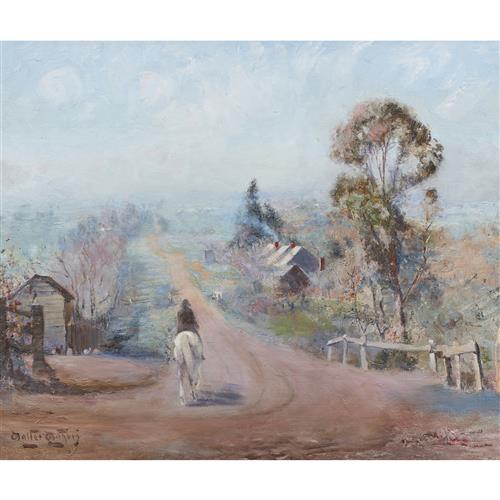
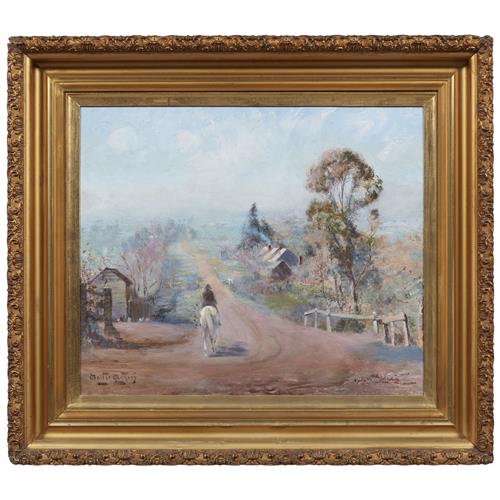
Morning Mist, Eltham
oil on canvas
signed lower left: Walter Withers
artist's name, title and inscriptions on plaque verso: "MORNING MIST"/ ELTHAM/ BY WALTER WITHERS/ PRESENTED TO/ SEYMOUR DAVIES ESQ./ BY A FEW OF HIS FRIENDS IN RECOLLECTION OF MAY PLEASANT YEARS OF BUSINESS RELATIONSHIP./ MELBOURNE. MARCH 1914
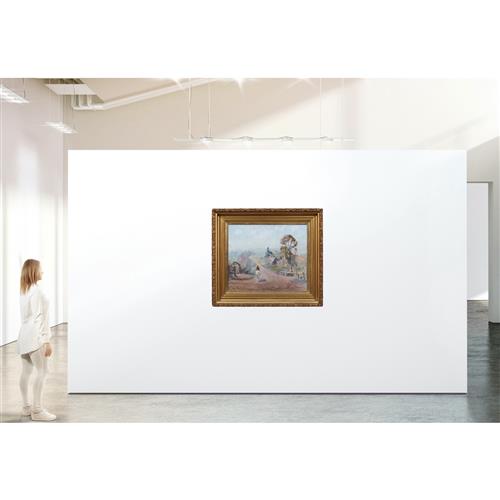
62 x 73.5cm
Estimate $80,000 - $120,000
The Collection of Seymour Davies Esquire, Melbourne 1914 (plaque verso)
Estate of the above
Sotheby's, Melbourne, 26 July 1987, lot 486
The Collection of Mr and Mrs Rene Rivkin, Sydney
Sotheby's, The Collection of Mr & Mrs Rene Rivkin, Sydney, 3 June 2001, lot 64
Gould Galleries, Melbourne & Sydney
Private collection, Western Australia
Walter Withers (1854-1914) occupies an important place within the development of Australian impressionism. A key figure of the Heidelberg School, Withers brought to the movement a quieter, more atmospheric sensibility. Where some of his contemporaries pursued dramatic vistas or expansive sun-lit plains, Withers was drawn to the subtleties of tone, shifting weather, and the soft radiance of morning and evening light. In paintings such as 'Morning Mist, Eltham', his mature style is imbued with delicacy and a deeply personal connection to place.
Born in Warwickshire, England, Withers trained in London and Paris before emigrating to Melbourne in 1888. Finding work as a farm hand on his arrival in Australia, Withers developed a deep connection to rural life, and the slow, contemplative work conducted in natural surrounds. By the early 1890s, he had become closely associated with the artists painting en plein air in the rural outskirts of Melbourne. This circle which included Arthur Streeton, Frederick McCubbin, Charles Condor and Tom Roberts would become to be known as the Heidelberg School. Together, they sought to develop a distinctly Australian vision of the landscape, one grounded in natural light, colour, and direct observation.
During this period Withers lived and worked at Chartersville, a rambling stone homestead in East Ivanhoe that served as a base for several artists from the Heidelberg School. Though often overshadowed by the more extroverted compositions of his peers, Withers' paintings from this period were praised for their tonal harmony and subtle emotion. As the Age reported in 1894, 'His work is characterised by its great charm of colour and by an increased suppleness of execution. He brings before us the evanescent charm of a passing hour and makes us feel the "spirit of the season" in the colour and lighting of his landscapes' (1)
This deep connection to place continued when Withers and his wife Fanny moved to Eltham in 1903. The small rural township north-east of Melbourne offered a rich source of subject matter for an artist attuned to the quieter rhythms of life. Every form of subject was there before him, with the added charm of rural figures at work in the paddocks, tending animals near the homesteads, following cows towards the milking sheds, or riding horses to the creek for water. (2) Fanny Withers wrote with fondness of the family's life in Eltham, 'purchasing a cottage there, with an orchard attached, he built for himself a charming studio, with windows of which open on to a bit of virgin bush, where stand stately white gums of great beauty.' (3)
It was here that he painted 'Morning Mist, Eltham', a quiet contemplative view looking down Brougham Street toward the township, veiled in early morning fog. A lone rider, thought to be mounted on Dolly, the old grey mare owned by the Withers family, makes their way along the road. Cottages emerge faintly through the haze, and the palette is gentle and restrained, with soft mauves, greys, and ochres dissolving into one another.
Withers was known for travelling widely in search of subjects, often by pony and jinker or train, yet many of his finest paintings depict the familiar scenes around his home. He frequently walked or cycled through the countryside with an easel and a prepared canvas over his shoulder, ready to capture fleeting conditions of light and season. His palette was attuned to the subtleties of morning mist, golden afternoons, and the soft silver of winter skies.
Today, Walter Withers is recognised as one of the most accomplished landscape painters of his generation. His works are held in every major Australian public collection, yet it is paintings such as Morning Mist, Eltham that his legacy is most felt. Modest in subject and unassuming in tone, the painting reflects Withers' enduring ability to capture the poetry of the everyday to render the ordinary as something quietly profound.
Hannah Ryan
Senior Art Specialist, Manager of Specialty Auctions
(1) 'Exhibition of Pictures. The Victorian Artists' Society', Age, Melbourne, 25 October 1894, p. 6
(2) Mackenzie, A., Walter Withers: The Forgotten Manuscripts, Mannagum Press, Lilydale, 1987, p. 130
(3) Ibid, p. 27
A Private Collection of Important Australian Art
AUCTION
Sale: LJ8793
6:00pm - 25 August 2025
Hawthorn
VIEWING
SYD: Thur 14 - Sun 17 Aug, 10am - 4pm
The Bond, 36-40 Queen St, Woollahra, NSW
MELB: Thur 21 - Sun 24 Aug, 10am - 4pm
2 Oxley Rd, Hawthorn, VIC
CONTACT
Wiebke Brix
wiebke.brix@leonardjoel.com.au
SIMILAR ITEMS
Lot 10
FREDERICK MCCUBBIN (1855-1917) The Lime Tree (Yarra River from Kensington Road, South Yarra) 1917 oil on canvas 97 x 110cm
Estimate: $600,000-800,000
Lot 20
RUPERT BUNNY (1864-1947) Portrait de Mme B... c.1914 (also known as Portrait of the Artists Wife) oil on canvas 217 x 107.5cm
Estimate: $300,000-400,000
Lot 17
RUPERT BUNNY (1864-1947) The Sonata c.1910 (also known as La Sonate) oil on canvas 80 x 64cm
Estimate: $200,000-300,000
Lot 22
ARTHUR STREETON (1867-1943) Ramparts Face the Ocean 1932 (also known as Southern Ocean) oil on canvas 50 x 75cm
Estimate: $150,000-200,000