Lot 2
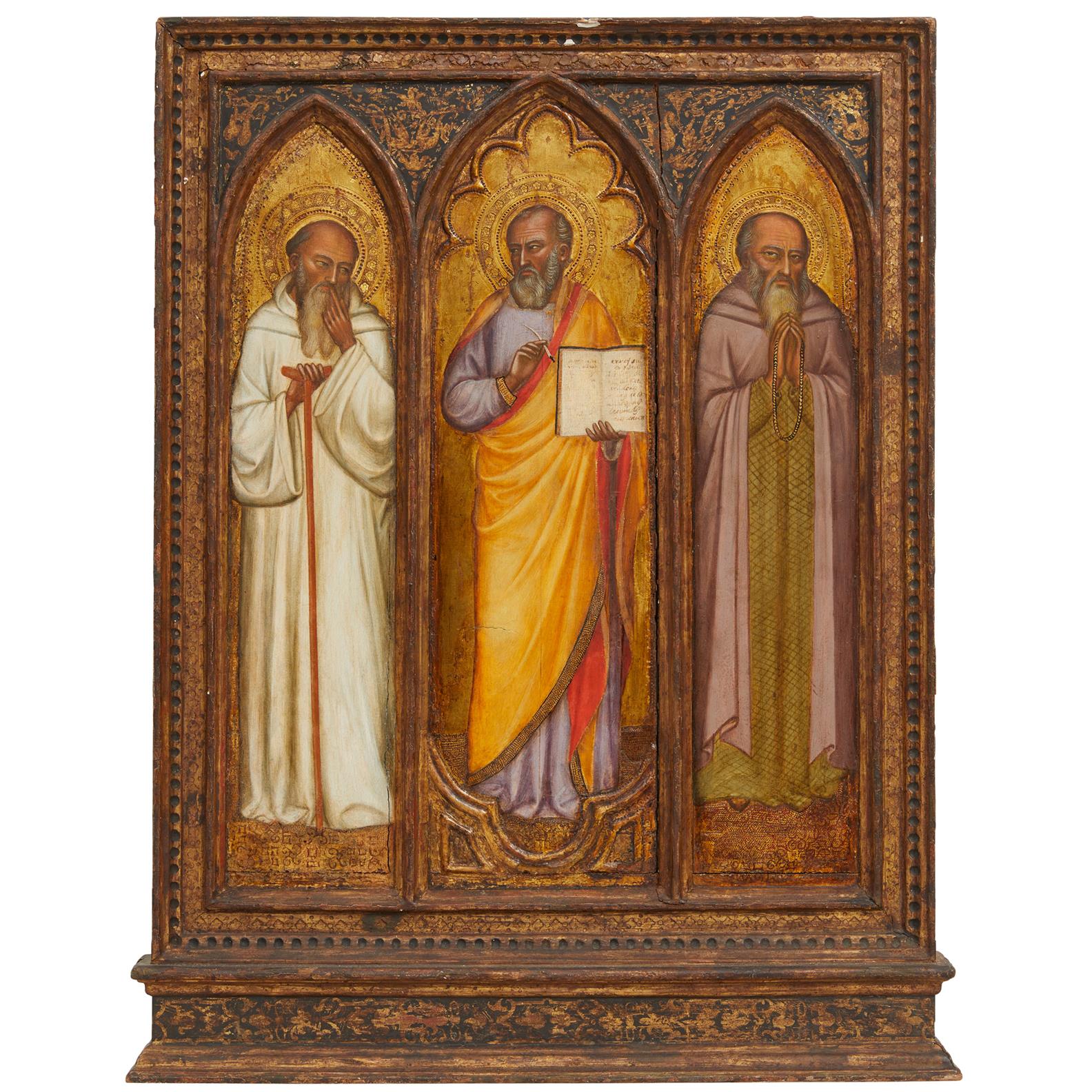
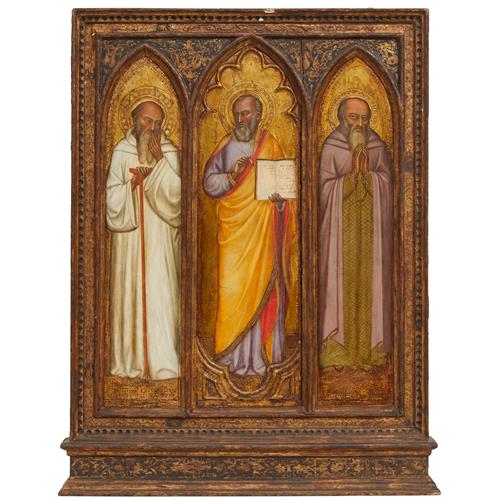
St Romauld (or Beata Jacopo Geri?), St Mark, and St Paul the Hermit
tempera on gold ground panel
63.6 x 49.8cm (overall)
Estimate $100,000 - $145,000
Originally part of a polyptych altarpiece for the High Altar of Santa Maria degli Angeli, Florence, c. 1375.
William Young Ottley (1771-1836), probably acquired in Italy, and by descent to his brother
Warner Ottley (1775-1846), of York Terrace, Regent's Park and Stanwell House, Middlesex, Sold by the Executors of Warner Ottley's Estate, London, Foster, 30 June 1847, lot 23, as 'Jacopo del Casentino', bought by 'Anthony', on behalf of
Revd. J. Fuller Russell (1813-1884), his posthumous sale
Christie's, London, 18 April 1885, lot 89, as Jacopo da Casentino, bought by 'Western', on behalf of
Charles Butler (1821-1910), Warren Wood, Hatfield, his posthumous sale,
(possibly) Christie's, London, 7 July, 1911, where presumably purchased by
Edward Hutton (1874-1969), London, by whom sold in 1923 to
Michael van Gelder (1864-1929), Uccle, Belgium and by decent to his wife
Irma van Gelder (1888-1971)
Phillips, 10 December 1985, lot 29
where presumably purchased by Robert Compton Jones
Waagen, G., Treasures of Art in Great Britain, London, 1854, II, p. 463, as Sienese, identified, along with three other associated saints, incorrectly as 'twelve apostles'.
Offner, R., 'The Mostra del Tesoro di Firenze Sacra' in The Burlington Magazine, 63, 1933: 72-84, p. 84, n. 59, as Jacopo di Cione.
Offner, R. and Steinweg, K., A Critical and Historical Corpus of Florentine Painting: The Fourteenth Century, New York, 1965, Section IV, vol. III, p. 32, pl. 74, as attributed to Jacopo di Cione, and linked to the San Pier Maggiore altarpiece.
Boskovits, M, Pittura Fiorentina alla vigilia del Rinascimento, Florence, 1975, p. 330 as Jacopo di Cione and where he gives the saints as Romuald, John the Evangelist and Paul, and links the panels to the San Pier Maggiore altarpiece.
Huntingdon, A, The Littleton Saints: Six small panels from a lost altarpiece by Jacopo di Cione, unpublished MA dissertation, Courtauld Institute of Art, University of London, 1997, p. 12, where she links them to the Virgin and Child in the Museum of Fine Arts, Budapest.
Kanter, L., Italian Paintings from the Richard L. Feigen Collection, exhibition catalogue Yale University Art Gallery, New Haven and London, 2010, p. 16-18, and n. 6, where he links them to a polyptych altarpiece by Orcagna and his workshop from Santa Maria degli Angeli.
Gordon, D., National Gallery Catalogues: The Italian Paintings before 1400, London, 2011, p. 96-108, n. 28, fig. 8, under NG 3894, as attributed to Jacopo di Cione, where she links them to polyptych Ognissanti Altarpiece in Santa Maria degli Angeli, Florence of c. 1355-65.
Gordon, D., 'The Paintings from the early to the late Gothic Period', in Cristina De Benedictis, et. al. ed., Santa Maria degli Angeli a Firenze, Da monastero camaldolese a biblioteca umanistica, Florence, 2022, p. 202-05, as Jacopo di Cione and Workshop, and part of the lateral where she links the panels to the high altarpiece of Santa Maria degli Angeli c. 1375.
RELATED WORKS:
Andrea di Cione (Orcagna), The Crucifixion, tempera on wood with gold ground, 137.5 x 81.9cm, The Metropolitan Museum, New York, (Robert Lehman Collection, accession no. 1975.1.65)
Possibly Jacopo di Cione, Noli me Tangere, tempera on wood, 56 x 38.2cm, The National Gallery, London (inventory no. NG3894)
Jacopo di Cione, The Littleton Pilaster Saints: Blessed Paola, Blessed Silvestro, Saint Anthony Abbot, Saint John the Evangelist, Saint Luke, Saint Peter Damian, each tempera on panel, The National Gallery, London (on loan from the Rector and Churchwardens of St Mary Magdalene Church, Littleton, inventory no.'s L1080-L1085)
LOT ESSAY:
These exceptional panels depicting three Saints, Romauld (or possibly Beato Jacopo Geri d.1344), Mark and Paul the Hermit, were originally part of the high altarpiece of the monasticchurch of Santa Maria degli Angeli, one of the most important monasteries in the centre ofFlorence. (1) The attribution of this large polyptych altarpiece, whose constituent parts have longago been dispersed and can only now be partially reconstructed, has been the subject of muchresearch and debate over the years. Most scholars regard the altarpiece as a more or less collaborativeundertaking by the most important artists working in Florence during the middleyears of the fourteenth century, Andrea di Cione, known as Orcagna (c. 1308-1368), and histwo younger brothers, Nardo di Cione (1320-1366) and Jacopo di Cione (1325-1390). Most recently Dillian Gordon, who has made an extensive study of the altarpieces in Santa Maria degli Angeli, has identified the probable donor of this altarpiece as Zanobi di Cecco del Frasca, a Florentine banker who died in 1375.(2) Since the money was made as a bequest this would provide a date for the altarpiece of c. 1375, and therefore she regards Jacopo di Cione and his workshop as the most likely artists, although heavily indebted to the work of Nardo di Cione.
In the most recent suggested reconstruction of the altarpiece there would have originally been twelve pilaster Saints, in rows with six on either side (in addition to the three in the present lot, six are now in the National Gallery, London, on loan from the Rector and Churchwardens of the Church of St Mary Magdalene, Littleton, Middlesex (fig. 3); and three others were stolen from the Hutton collection in 1933, known only from photographs). Other surviving elements from this impressive altarpiece include the three pinnacles, variously depicting Noli me tangere (fig. 1) (National Gallery, London, NG 3894); The Crucifixion (fig. 2) (Metropolitan Museum of Art, Robert Lehman Collection, inv. 19751.65, first identified by Kanter, 2010); and The Resurrection (Regello, San Clemente a Sociana). The central predella can be identified as The Man of Sorrows with the Virgin and St John the Evangelist and donor (Denver Art Museum, Colorado, Kress Collection, inv. 1961.154). Scholars have not yet agreed, however, on the
identity of the central panel of the altarpiece, with some favouring the Virgin and Child enthroned surrounded by Angels, attributed to Jacopo di Cione in the Museum of Fine Arts, Budapest.(3) The lateral panels that would have depicted numerous Saints remain untraced to this day.
The present Saints were first identified as by Jacopo di Cione by Richard Offner (1933), and for some time the panels were thought to relate to Jacopo's great altarpiece in the National Gallery, London, known as the San Pier Maggiore Altarpiece (NG 569.1-3 and NG 570-578),(4) before they were correctly identified as belonging to the Church of Santa Maria degli Angeli. The Saint on the left in the present frame, wearing a white robe and holding a tau staff is normally identified as Romauld (d. 1027), the founder of the Camaldolese order, of which Santa Maria degli Angeli was the most important foundation in Florence. Most recently Dillian Gordon has, however, identified this figure with Beata Jacopo Geri (d. c. 1344), a monk from the monastery, known for his exemplary pious life and obedience to the rule, with Romauld more likely to have been depicted in one of the main tier lateral panels of the altarpiece. The other two Saints are more easily identifiable as St Mark and St Paul the First Hermit, and were displayed in the pilasters along with Saints Luke, John the Evangelist, Anthony Abbot, Stephen, Matthew, Peter Damian, Mary Magdalen and two other members of the Camaldolese order, Beato Silvestro and Beata Paola.(5)
These present panels also have a distinguished later provenance. They were purchased by William Young Ottley (1771-1836), one of the greatest collectors of his age, who wasone of the first Englishmen to appreciate and collect early Italian painting. He built up an extensive collection that included works by the great Sienese and Florentine painters such as Ugolino da Siena, Duccio, Ambrogio Lorenzetti, Cimabue, Simone Martini, and Botticelli, and his connoisseurship was fundamental in raising the profile of these artists. The panels were subsequently in several other important 19th century collections, including those of the Revd. Fuller Russell and Charles Butler, before being purchased by Robert Compton Jones. We are very grateful to Professor Laurence Kanter and Dr. Dillian Gordon for their generous help in cataloguing this lot.
Tim Hunter
(1) Kanter, 2010; Gordon, 2022
(2) Gordon, 2022
(3) Huntingdon 1997; Gordon 2011
(4) Offner and Steinweg 1965; Boskovits 1975
(5) see reconstruction in Gordon, 2022
Old Master Paintings from the Robert Compton Jones Collection
AUCTION
Sale: LJ8812
6:00pm - 8 December 2025
36-40 Queen Street, Woollahra
VIEWING
MELB: Friday 21 - Sunday 23 November (Highlights), 10am-4pm, 2 Oxley Rd, Hawthorn, VIC
SYD: Friday 5 - Sunday 7 December, 10am-4pm, The Bond, 36-40 Queen St, Woollahra, NSW
CONTACT
Madeleine Mackenzie
sydney@leonardjoel.com.au
SIMILAR ITEMS
Lot 14
FRANCESCO GUARDI (Venice, 1712-1793) The Island of San Giorgio Maggiore from the West; and View of the Cannaregio, with the Ponte de...
Estimate: $500,000-700,000
Lot 7
LUCA SIGNORELLI (Cortona, c. 1450-1523) Saint Michael c.1502 oil on panel 49.5 x 20.5cm (56.5 x 28.1cm framed)
Estimate: $140,000-180,000
Lot 11
BATTISTA DOSSI (Ferrara, c.1475-1548) The Adoration of the Shepherds oil on panel 74 x 57.5cm (99 x 83.5cm framed)
Estimate: $100,000-150,000
Lot 9
GIROLAMO DI BENVENUTO (Siena, 1470-1524) The Nativity with God the Father above oil on panel 59.5 x 37.5cm (76 x 54cm framed)
Estimate: $80,000-120,000