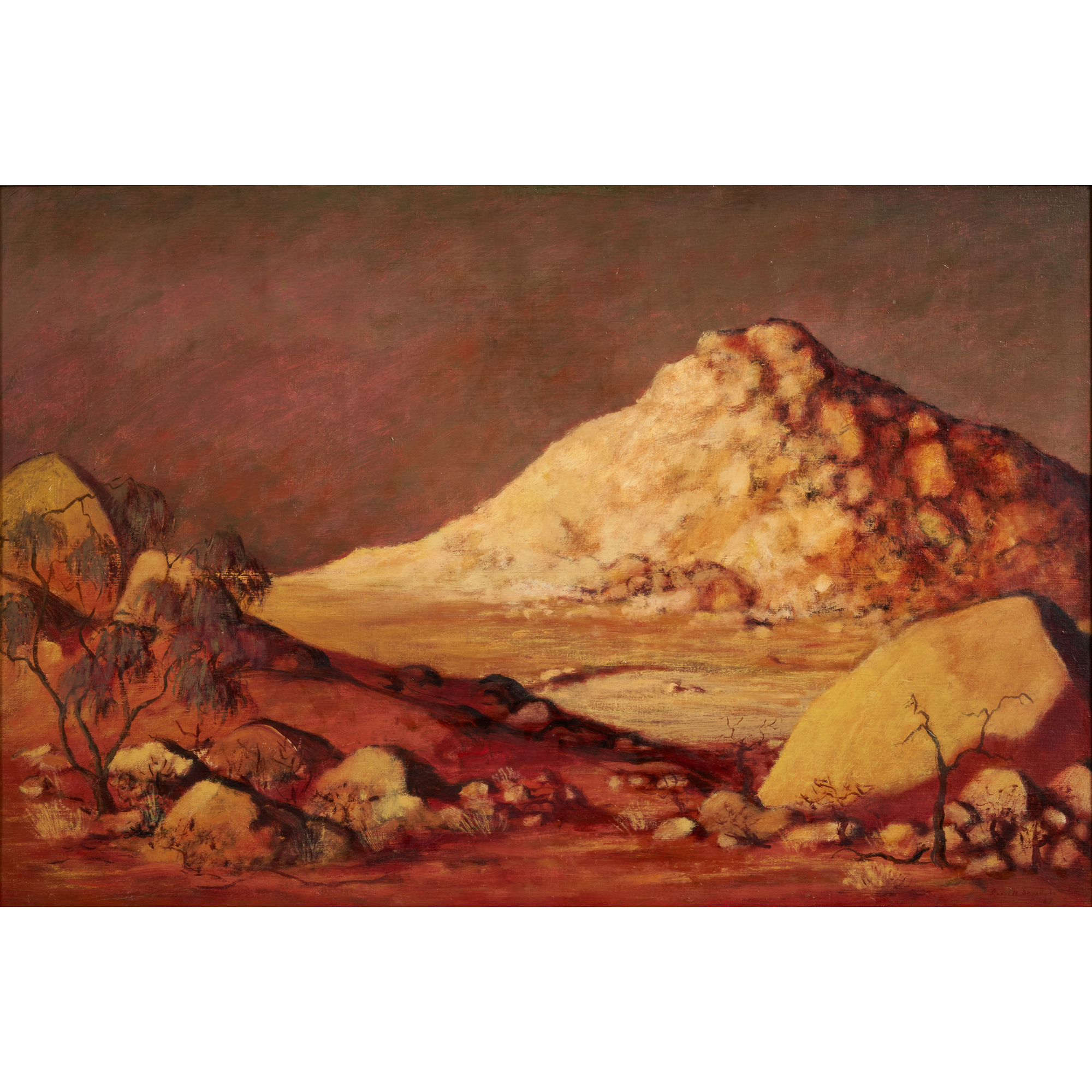
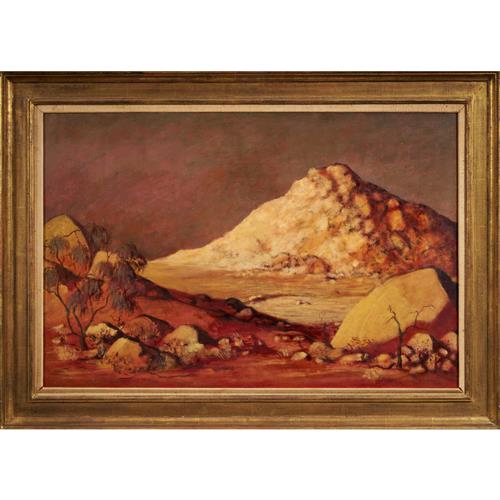
The White Blow 1967
oil on canvas
signed and dated lower right: Russell Drysdale / 67
titled and inscribed verso: "THE WHITE BLOW" – RUSSELL DRYSDALE/ C/O W.J. MCLAUGHLIN/ 46. EDGECLIFF ROAD/ BONDI JUNCTION - SYDNEY
49 x 75cm
Estimate $180,000 - $220,000
The Collection of William J. McLaughlin, Sydney (inscribed verso)
Artarmon Galleries (Artlovers), Sydney 1971 (label verso)
The Collection of Mr. & Mrs. Michael Richards, Sydney
Sotheby's, Modern Australian Paintings and Drawings - The Mr. & Mrs. Michael Richards Collection, Sydney, 13 October 1983, lot 13
The Estate of Judith Barbara Mactaggart, Sydney
Thence by descent
Sir Russell Drysdale was one of the most significant Australian painters of the 20th century - and indeed his award of a knighthood in 1969 was clear recognition of the esteem in which he was held at every level. His paintings sit at the peak of the Australian collector market and are seen to be pure expressions of some 'real' Australia, far removed from the bland urban sprawl that is home for the vast majority of Australians. 'The White Blow' is an exemplar of that genre, an image both desolate and yet compelling at the same moment.
Born in the English seaside resort town of Bognor Regis in 1912 to an established family with Australian pastoral interests, he came to Melbourne in 1923. The young 'Tas', as he was known, was enrolled at Geelong Grammar School, one of the state's most prestigious private schools. Favoured as the school for the sons of Western District grazing families, it held a cohort of students that Drysdale could relate to, especially when in 1926 his father acquired 'Boxwood Park', a Riverina grazing property. Tas was a keen sportsman, but his life took a difficult turn in 1929 when he suffered a detached retina that would see him lose the sight of his left eye. As a form of therapy, he was given drawing lessons five times a week, an activity that would have a profound effect on his outlook and subsequent career. Learning perspective and the formal techniques of drawing were a challenge and Drysdale developed a love for illustration and a considerable skill as a draftsman. In another quirk of fate, the Melbourne surgeon engaged to correct his eye was Julian Smith, a noted photographer and central character in the local art scene. Smith encouraged Drysdale to pursue his art interests and introduced him to George Bell who, with Arnold Shore, would found an art school teaching modernist art in a direct contrast to the entrenched conservatism of the National Gallery Art School, the nation's premier art academy. While Drysdale fitted in well enough with Bell, he wanted more and, thanks to his comfortable family situation, was able to travel to London in 1932 to pursue his art interests. After two years exploring all that was offered at the 'centre' of the art world, he realised that the modernism of Bell, far removed from his original 'traditional' training, was in fact the way art was going and he returned to Australia, and to Bell, to pursue the life of an artist. Three years working with George Bell developed his own personal style and also introduced him to a cohort of enthusiastic young artists, most notably Peter Purves Smith, who would become a close friend and artistic mentor. Newly married, Drysdale returned to London for further experience, but the trip was cut short by the threat of war and he returned to Australia and settled in Sydney just as war broke out.
Drysdale hoped to enlist and do his bit for the nation, but the eye issue blocked any chance of active service and, after the Japanese attacks on Sydney in 1942, he moved to Albury, a safe place on a direct line between Sydney and Melbourne. While he might have been a civilian, he was living in a town that became a staging post for thousands of soldiers who were training in the area before heading off to the conflicts in South East Asia and the Pacific. The works he created depicting the men gathering at the local railway station and the Army camps became unique expressions of the home front. The powerful insights he made into the world of soldiers in uniform led to a life changing opportunity in 1944, when he was commissioned by the 'Sydney Morning Herald' to document the effects of the drought that was devastating inland Australia. As a person well familiar with rural life, Drysdale knew the times of both drought and plenty, but the journey he made took him further and deeper into inland Australia than he'd been before. The works he created sowed the seed for his art for the rest of his life. Dry creek beds, huge rocks, leafless trees, barren plains and dead animals became the subject for paintings and drawings that would be central to his art for the rest of his career.
A friendship with fellow artist Donald Friend, who had served as an Official War Artist in Borneo, took him to a number of remote locations and their 'discovery' of the abandoned towns of Sofala and Hill End opened up a new suite of subject matter that found a broad following around Australia. His painting of the empty main street of Sofala won the Wynne Prize for 1947. The colour and atmosphere, the barren emptiness of a lost community could not have been more different to the 'Australia' of the Heidelberg School, the golden plains of Streeton, the vigorous, engaged human subjects of Tom Roberts and the towering splendour of Heysen's great gum trees. Drysdale produced a series of iconic works that became embedded into the Australian imagination.
As Drysdale continued to travel to the outback and far north, he began to engage with the Aboriginal people and he became acutely aware of the way they had been moved about and disengaged from their own lands as mining and agricultural companies pushed further out into the wilderness. In his later years Drysdale concentrated on landscapes depicting the unique nature of the outback and he sought out areas of visual and geological interest. One outstanding find was a unique rock formation near the gold-mining town of Ravenswood, 55 kilometres east of Charters Towers in North Queensland. 'The White Blow' was created when the covering rock was gradually worn down to expose a pure white quartz 'hill' - a great lure for prospectors and the artist alike.
In creating landscapes like 'The White Blow', Drysdale showed that a painting could verge on the abstract while also being an accurate rendition of the outback. Line, form and colour combine to give the spirit of the barren land. Many perhaps first saw them as works of the imagination, but as time moved on 'driving into the outback' became a pursuit for tens of thousands of Australians and international tourists alike. The availability of rugged new vehicles and outback aircraft made no place unreachable and travellers realised that Drysdale had captured both the appearance and the very spirit of the land. Whether inhabited by a couple of scrawny workers, a group of seemingly lost Aboriginal people or an uninhabited wilderness, he brought to Australian art, and the Australian people, a lasting vision that is treasured today.
Gavin Fry OAM MA MPhil
Gavin Fry is a writer, artist and art historian with more than 60 years experience working in Australian museums, galleries and educational institutions. He has 30 books of Australian art and history to his name and designs and publishes books for other artists and writers.
RELATED WORK:
Russell Drysdale, Broken Mountain 1950, oil on canvas, 66.2 x 102cm, National Gallery of Victoria, Melbourne
Russell Drysdale, Road with Rocks 1949, oil on canvas, 66.6 x 102cm, Art Gallery of New South Wales, Sydney
© Courtesy of The Estate of Russell Drysdale, 2026
Fine Art
AUCTION
Sale: LJ8822
6:00pm - 6 October 2026
Hawthorn
VIEWING
Friday 2 - Sunday 4 October, 11am - 5pm, 2 Oxley Rd, Hawthorn
CONTACT
Wiebke Brix
wiebke.brix@leonardjoel.com.au
SIMILAR ITEMS
Lot 8
WILLIAM DELAFIELD COOK (1936-2015) Hillside, Euroa 1987 synthetic polymer paint on canvas 111 x 281.5cm
Estimate: $200,000-300,000
Lot 25
MARC CHAGALL (Russian-French, 1887-1985) L'Animal Aile 1974 monotype in colours on Japon nacré paper, unique 42 x 32cm (plate); 67 x..
Estimate: $40,000-60,000
Lot 1
ELIOTH GRUNER (1882-1939) She-oaks in France 1924 oil on panel 36 x 44.5cm
Estimate: $30,000-50,000
Lot 14
WILLIAM DOBELL (1899-1970) Creek at Lake Macquarie c.1949 oil on board 24 x 29cm
Estimate: $15,000-25,000