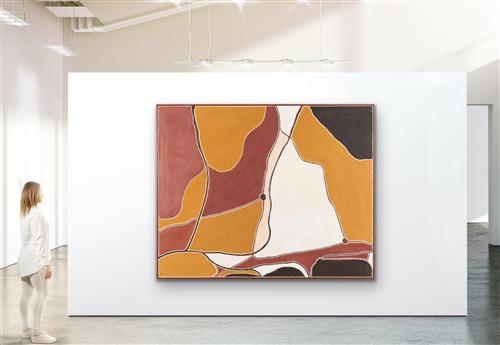
Lot 77
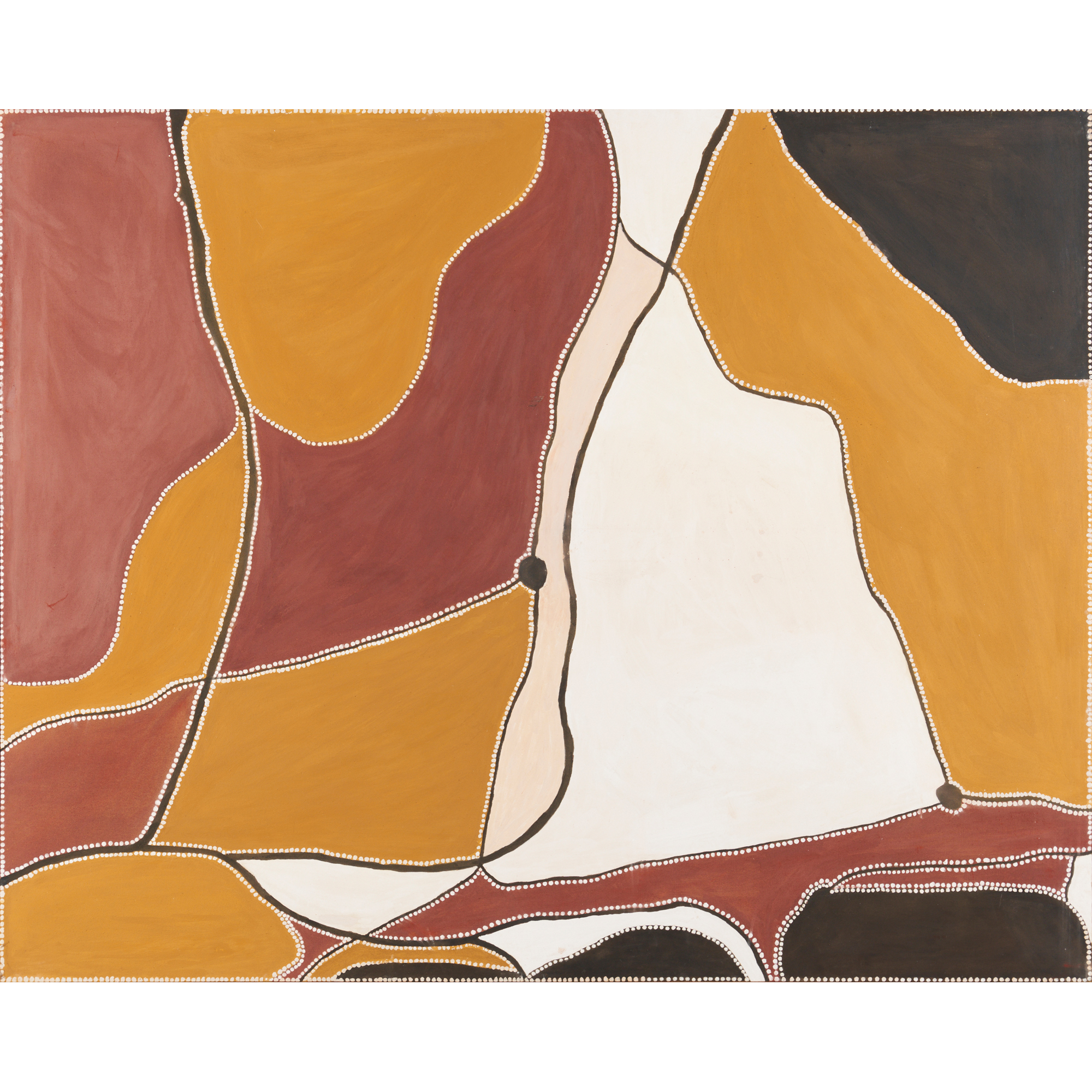
Untitled 1990
natural earth pigments on canvas
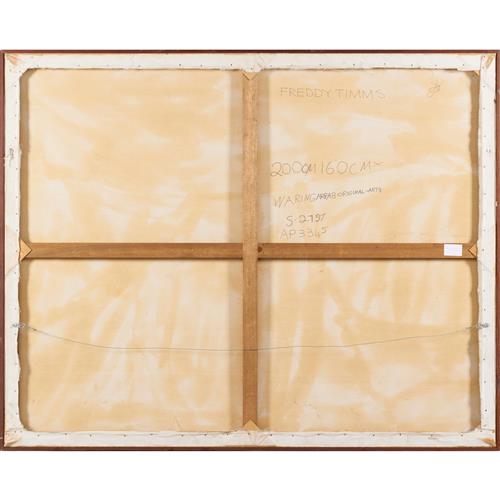
inscribed verso with artist's name and Waringarri Aboriginal Arts cat. no. S-2797/ AP3345
200 x 160cm
Estimate $25,000 - $30,000
Waringarri Aboriginal Arts, Western Australia
Kimberley Art, Melbourne (accompanied by the certificate of authenticity)
Private collection, Melbourne
Freddie Timms, Kimberley Art, Melbourne, 6 - 27 October 1994
"This painting shows country around old Greenvale Station to the west of Violet Valley. It includes the creeks, roads and stock routes, hills and different soil types found (eg Jawoolja country which is sandy soil which becomes very boggy in the wet and Balgang - red soil). Joolabany creek is a dangerous place where the dog pissed in the dreamtime. People cannot go there. In the corner of the painting is the artist's birthplace, Police Hole on Bedford Downs from which the artist takes his bush name - Ngarrmaliny."
As stated on the Kimberly Art certificate of authentication.
Freddie Timms (c.1946-2017) was a distinguished Gija artist whose artworks are known for their abstracted aerial views of the East Kimberley landscape and for reflecting a deep connection to his Country and the narratives embedded within it. This artwork from 1990, exemplifies Timms' ability to synthesise complex cultural knowledge into striking visual forms, employing a modern aesthetic language that resonates with Indigenous and non-Indigenous audiences.
Timms was originally from Ngarrmaliny (Police Hole), located just to the Northwest of Bedford Downs station in the Kimberley region of Western Australia and began painting in the late 1980s, following in the footsteps of his father and uncle, who were also artists. For a period of time during his childhood, Timms lived at Bow River and followed his father in becoming a stockman at Lissadell Station. He later worked as a stockman and fencer on stations throughout the East Kimberley and it was during this time that he met and worked alongside Rover Thomas, while both were employed at Bow River and Texas Downs. Timms' work is inextricably linked to his personal history and the broader cultural and socio-political landscapes of the Kimberley. His paintings often address themes of colonialism, land rights, and the ongoing impact of historical injustices on Aboriginal communities.
In this artwork, Untitled from 1990, Timms employs an evocative palette of ochres, including reds, yellows, blacks, and whites. These colours hold significant cultural importance and are intrinsic to the Kimberley landscape, as they reflect the different soil types found in the region, such as the sandy yellow soil of Jawoolja country and the Balgang, red soil. The earthy hues pay homage to the natural earth pigments traditionally used in Indigenous art, grounding the work in the land it represents.
Timms' painting style aligns with the East Kimberley tradition pioneered by Rover Thomas, yet his distinctive use of flat planes of colour, defined by precise double rows of white dotted lines, sets his work apart as uniquely his own. These lines are not merely decorative; they signify pathways, boundaries, and connections within the land. Timms' use of line work is a form of mapping, a visual representation of the land's contours, and the ancestral narratives that define it, conveying both the physical and spiritual dimensions of the landscape.
The composition of the work is divided into irregular, organic shapes that suggest an aerial perspective-a common feature of Timms' work. This bird's-eye view reflects a distinctly Indigenous way of seeing the land, one that encompasses both the physical terrain and the invisible layers of story that lie beneath the surface. The abstracted forms evoke a sense of movement and change, suggesting the fluid and dynamic nature of the land, as well as the interconnectedness of all things within the landscape.
This work can be interpreted as a meditation on the land and its histories, both ancient and contemporary. The abstract forms represent specific sites of significance, such as waterholes, ceremonial grounds, and places of conflict. The fluid, intersecting lines suggest pathways that have been travelled across generations, both by people and ancestral spirits. In this sense, the painting is a living, breathing map of Country, embedded with layers of meaning that are accessible to those with the knowledge to interpret them.
Timms was a key figure in the emergence of the Kimberley art movement in the late 20th century, a movement that sought to bring Indigenous perspectives and stories to the forefront of Australian art. His work, alongside that of contemporaries such as Rover Thomas and Queenie McKenzie, challenged mainstream perceptions of Indigenous art and expanded the possibilities of what it could convey. Timms' paintings are often seen as a form of resistance, asserting the presence and resilience of Aboriginal culture.
Beyond his artistic contributions, Timms was also an advocate for Indigenous rights and a key figure in the establishment of the Jirrawun Arts group, which provided a platform for Kimberley artists to manage their own careers and maintain control over their cultural heritage. His commitment to his community and to the preservation of Gija culture is evident in his art, making his paintings not just artworks but acts of cultural preservation and assertion.
Freddie Timms' artwork, Untitled from 1990, is a profound testament to the artist's ability to distil the essence of Country into a compelling visual language. Through his use of colour, form, and line, Timms creates a work that is both a celebration of the land and a statement of cultural resilience. The painting invites viewers to look beyond the surface and to consider the deeper connections between land, people, and history. In doing so, it offers a powerful reminder of the enduring significance of the land and the stories it holds. Timms' legacy continues to resonate, not only through his art but through the ongoing efforts to honour and preserve the cultural landscapes of the Kimberley.
Amanda North
Art Specialist
© Freddie Timms/Copyright Agency 2024
Fine Art
AUCTION
Sale: LJ8755
6:00pm - 22 October 2024
Hawthorn
VIEWING
Fri 18 - Sun 20 Oct, 10am - 4pm
Mon 21 Oct, by appointment
2 Oxley Rd, Hawthorn VIC
CONTACT
Wiebke Brix
wiebke.brix@leonardjoel.com.au
SIMILAR ITEMS
Lot 18
JEFFREY SMART (1921-2013) Study II for Bus Terminus 1972-73 synthetic polymer paint and oil on canvasboard 60 x 50cm
Estimate: $140,000-160,000
Lot 33
LI CHEN (Taiwanese, born 1963) Visiting Fairyland 2004 bronze, ed. 8/8 117 x 96 x 60cm
Estimate: $130,000-160,000
Lot 41
TIM STORRIER (born 1949) (Evening Fire and Shooting Star) oil on canvas 91 x 152cm
Estimate: $70,000-90,000
Lot 36
XUE SONG (Chinese, born 1965) Racing Horses 2010 mixed media on canvas 180 x 250cm
Estimate: $50,000-70,000