Lot 200
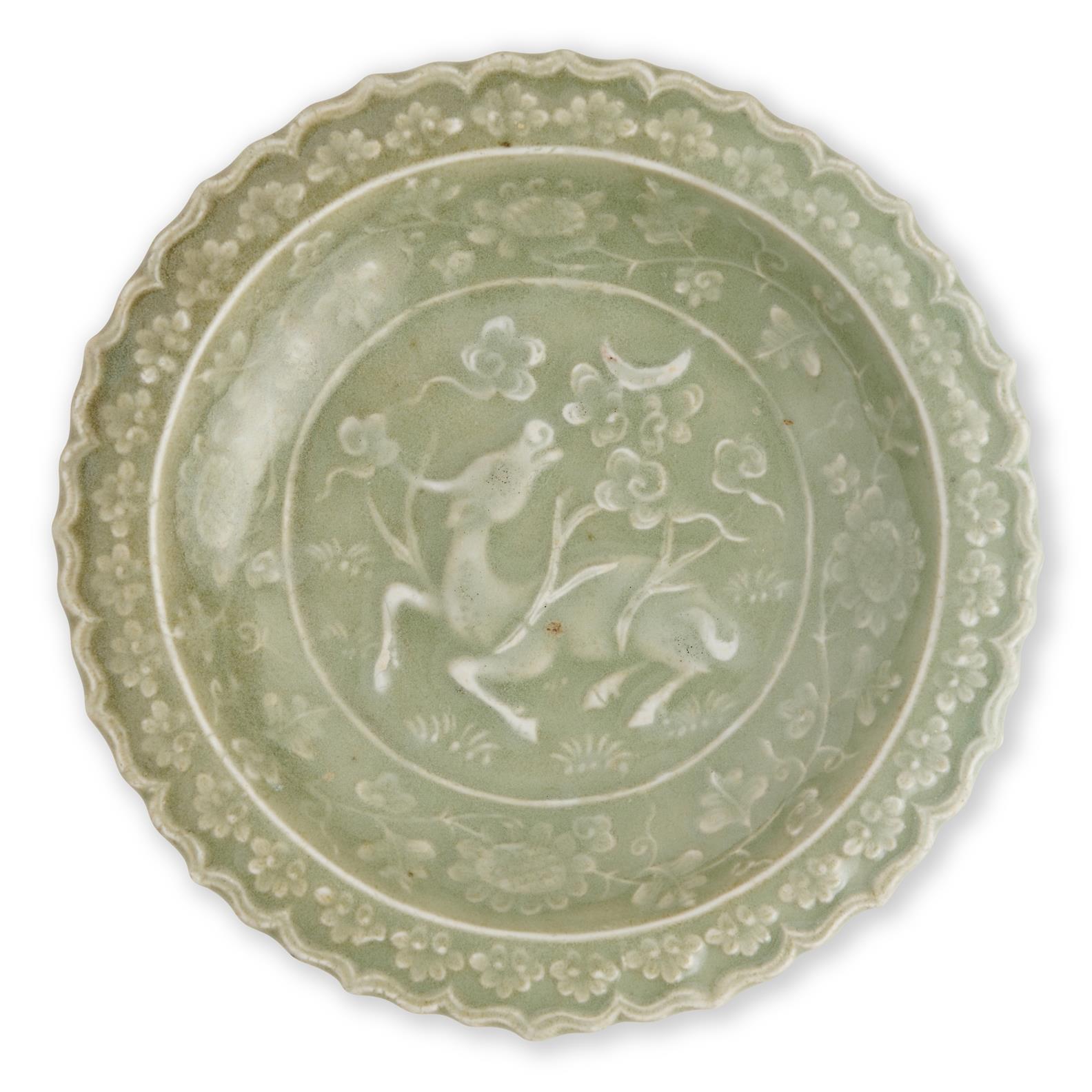
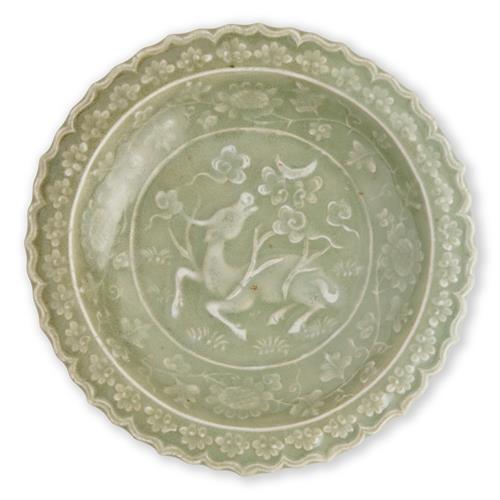
The thickly potted shallow dish crisply moulded with sixteen bracket lobes along the edge of the flattened mouth rim, each lobe framing a pair of florets, the interior centre moulded with a scene of a recumbent mythical creature with a single horn and pinions at its shoulders and haunches, its head turned to face the crescent moon, the cavetto moulded with a scroll of blossoming chrysanthemums, covered overall with a pale green celadon glaze. With a fitted box.
A closely related Longquan celadon dish with this rare design is held in the Art Institute of Chicago, part of the Lucy Maud Buckingham Collection. It is illustrated in Chinese Art Under the Mongols: The Yuan Dynasty (1279-1368) by Lee and Ho (Cleveland, 1968, no. 68). The same dish is also featured in Ice and Green Clouds: Traditions of Chinese Celadon by Mino and Tsiang (Indianapolis, 1986, no. 86, pp. 210¨C211). Another example of this design can be found in the Asian Art Museum of San Francisco and is referenced in He's Chinese Ceramics: The New Standard Guide (London, 1996, no. 509, p. 246).
For a closely comparable example, see J.J. Lally & Co., Chinese Ceramics A.D. 400¨C1400: Selections from an American Collection, March 19¨C31, 2007, no. 24. Additionally, refer to another almost identical dish in Christie's New York sale on 18/9/2003, lot 287.
The motif of a xiniu gazing at the moon first appeared during the Song dynasty and remained popular through the 13th and 14th centuries. This design was commonly featured on Dingyao and Yaozhou ceramics, as well as textiles and other forms of Chinese decorative arts. The theme is thoroughly discussed in Wirgin¡¯s article, Sung Ceramic Designs (Bulletin of the Museum of Far Eastern Antiquities, no. 42, Stockholm, 1970, pp. 196-198).
According to Wirgin, the term xiniu originally referred to the rhinoceros in ancient Chinese texts. However, as rhinoceroses became extinct in post-archaic periods, the xiniu evolved into a legendary creature, known primarily through literary references. The depiction of a xiniu gazing at a crescent moon in Song and Yuan ceramics illustrates the myth that its unique crescent-shaped horn allowed it to "communicate with the sky."
This belief in the magical properties of the rhinoceros horn gained prominence during the Song dynasty and continued into later periods. Rhinoceros horn was attributed with supernatural and medicinal qualities, and was even believed to possess aphrodisiac properties. These attributed powers led to the creation of intricately carved rhinoceros horn bowls and cups, a distinctive category of Chinese decorative art that flourished during the late Ming and Qing dynasties.
元 十四世紀 龍泉青釉模印犀牛望月圖花口盤
15cm diameter
Estimate $20,000 - $30,000
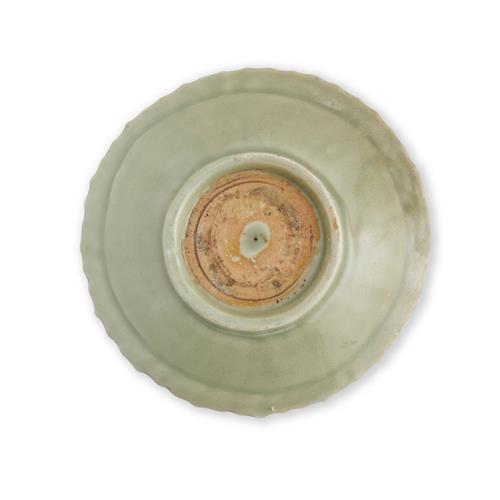
Overall in good condition, a very minute glaze nick to the foot rim which is consistent with age and use.
Please click here to see the detail photos of the whole auction.
The opinions expressed in the condition reports are a guide only and should not be treated as a statement of fact. Prospective buyers are encouraged to seek further information or request additional images during our pre-sale period where Leonard Joel staff are available for advice. Please note condition reports can be amended during the pre-sale period, so we strongly suggest any interested bidders check the published condition report available on the website before the auction commences. Leonard Joel makes no guarantee of the originality of mechanical or applied components. Absence of reference to such modifications does not imply that a lot is free from modifications.
A private collection, Hong Kong.
Fine Chinese and Asian Art
AUCTION
Sale: LJ8763
11:00am - 2 March 2025
Hawthorn
VIEWING
Thurs 27 Feb - Sat 1 Mar, 10am - 4pm
2 Oxley Rd, Hawthorn VIC
CONTACT
Luke Guan
asianart@leonardjoel.com.au
SIMILAR ITEMS
Lot 296
A FINE CHINESE IMPERIAL WHITE JADE CARVED DRAGON SEAL, KANGXI PERIOD (1662-1722)
Estimate: $100,000-200,000
Lot 154
ZHANG DAQIAN (1899-1983)
Estimate: $70,000-90,000
Lot 52
A CHINESE APPLE-GREEN COLOURED JADEITE PENDANT, LATE QING DYNASTY (1644-1911)
Estimate: $50,000-70,000
Lot 94
A VERY RARE CHINESE AUBERGINE-GLAZED MEIPING, QIANLONG INCISED SIX-CHARACTER SEAL MARK AND POSSIBLY OF THE PERIOD (1736-1795)
Estimate: $40,000-60,000