Lot 9
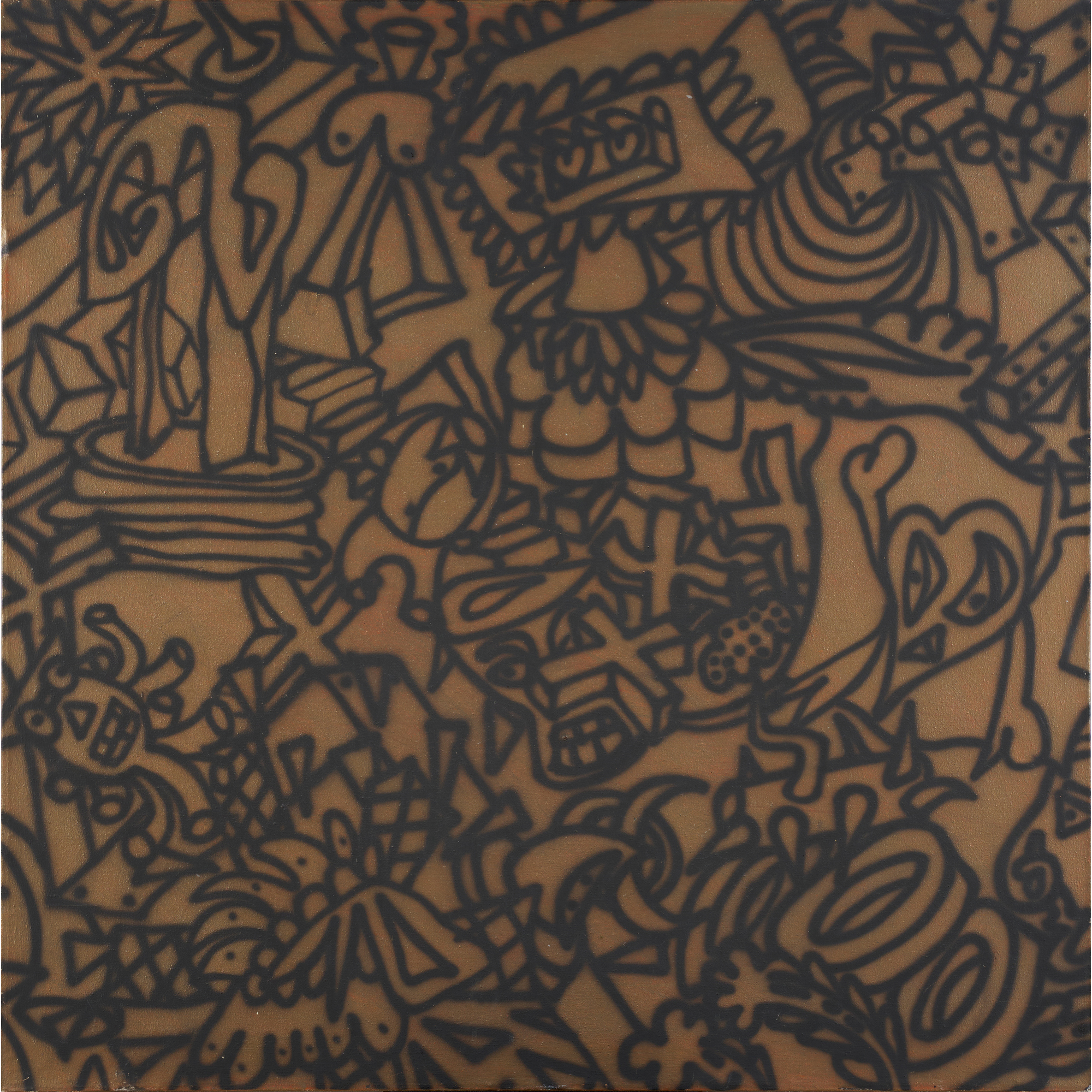
Primitive Gold 1984
synthetic polymer paint on canvas
signed, titled and dated verso: Howard Arkley/ Primitive Gold/ 1984.
artist's name and title on gallery label verso
105.5 x 105.5cm
Estimate $50,000 - $70,000
Gift of the Artist
Private collection, Melbourne
Thence by descent
Howard Arkley: Urban Paintings, Quentin Gallery, Perth, 7 February - 3 March 1985, cat. no. 6 (label verso)
"Primitive Gold" 1984, a characteristic example of Arkley's rapidly evolving style during the first half of the 1980s, was first documented in the artist's "Urban Paintings" exhibition held at the Quentin Gallery in Perth in February-March 1985. It was shown alongside Primitive Silver, also dated 1984, later auctioned by Leonard Joel in November 1994. Both paintings were the latest in a series of sequence of variants of Arkley's remarkable mural-scale drawing, Primitive, installed at the former Prahran College of Advanced Education in July 1981, its title borrowed from a song recorded months earlier by US punk band The Cramps. (1)
Freely sprayed in black air-brushed outline on 20 sheets of paper taped to the wall, Primitive engaged directly with Arkley's everyday and imaginative life in the inner Melbourne suburbs of Prahran and St Kilda, breaking abruptly with the style of his earlier, often meticulously crafted abstract and patterned works. It also initiated a new phase of figurative compositions, dominated by his wiry, energetic sprayed line-work, addressing edgy themes from suburbia to suicide, and referencing various sources including tattooing, billboards, comic books, and the music and street style of the era.
Some years later, as quoted in Ashley Crawford and Ray Edgar's monograph "Spray" (1997), Arkley recalled the creation of Primitive in a single day and night, with the exhibition deadline looming. Allowing for some poetic licence, this account clearly explains several details in the work, a telephone ringing, a knock at the studio door, and so on. Many other motifs, though, were based on the idiosyncratic doodles the artist had sketched in his earlier sketchbooks and visual diaries, tapping his dreams and daydreams in the manner of the "automatic drawing" typical of Surrealism, a key inspiration for Arkley, both in his formative years and later. (2)
In 1982, "Primitive Gold" and "Primitive Silver", two large-scale square canvases developed from the 1981 drawing, were shown in Paul Taylor's influential "Popism" exhibition at the National Gallery of Victoria, adding new details including snatches of text apparently from a letter or conversation.
"Primitive Gold" 1984 and its silver twin clearly echo the 1982 paintings, on a more modest, domestic scale, with some variations. The present canvas reprises several motifs directly from Primitive, such as the large headless figure at top left here, the small grinning creature with tentacles (lower left), the eccentric creature with its eyes in a box and a floral body (top centre), the small headless man nearby, and the prominent distorted skull and crossbones at centre right, suggesting a fluttering "Jolly Roger" pirate flag (compare the same motif towards the right in the 1981 work). A favourite Arkley image, the skull and crossbones recurred in several paradoxically lively versions in the old Mills & Boon novels he used as sketchbooks around 1984, and, a few years later, the skull morphed into the artist's trademark "Zappo Head".
Other details in the present canvas are new to the "Primitive" repertoire, including a stylized female figure on stilts at upper left, and a plant (or is it a dog with multiple teats?) in the lower left corner, a motif clearly related to the cacti and succulents, often ambiguously human or animal in form, at once real and surreal, already beginning to preoccupy the artist by the time Primitive Gold and its twin were exhibited early in 1985. A spiky cactoid form lying on its side in the present canvas, below the pirate flag, also points towards that development, although a number of cacti already appear in Primitive and other late 1970s/early 80s drawings and sketches.
Soon afterwards, with key 1986-87 exhibitions at his home gallery of Tolarno in Melbourne, and Roslyn Oxley9 in Sydney, Arkley turned definitively to the suburban imagery for which he is best known now. By the 1990s, his work had developed far beyond his boisterous, "primitive" early 80s style, marked by increasingly nuanced colour and patterning, a more complex view of the modern city also including factories, freeways and suburban interiors, and a series of stylized heads and faces.
One final point may be made, in relation to the often-voiced view that Arkley's air-brushed line-work is related to graffiti. The artist himself was wary of accepting this idea unreservedly, as he said in a 1989 interview. (3) Even so, the dense black linear forms on a dark gold background, in the present work, do bring to mind graffiti on a masonry wall. Arkley knew the style, of course (he photographed early examples of graffiti while visiting New York in 1977), and was later particularly interested in the related works of Keith Haring, whom he met when the young US artist visited Melbourne early in 1984. (4) Arkley actually used the term in his inscribed title on the 1983 painting Winds of War Graffiti (originally shown as Billboard), featuring various figures and forms sprayed, graffiti-style, directly over a film poster.
John Gregory
(John Gregory taught history and theory of art at Monash University before retiring in 2010. He is the author and administrator of Arkley Works, the online catalogue of Howard Arkley's accepted works.)
(1) For all Arkley works and related details, see the catalogue entries in https://arkleyworks.com. For Primitive, see also Crawford, A. & Edgar R., Spray: The Work of Howard Arkley, Craftsman House, 1997, pp. 6-9, and my own earlier discussions in Carnival in Suburbia: The Art of Howard Arkley, Cambridge University Press, 2006, pp. 165-169, and "Popism, Postpunk and Primitive", in Anthony Fitzpatrick & Victoria Lynn (ed.), Howard Arkley and Friends, Tarra Warra Museum of Art, 2015, pp. 26-28
(2) Gregory, J. Things are never what they seem: Howard Arkley and Surrealism, 18 September 2025, World Art, DOI: 10.1080/21500894.2025.2556652
(3) Brown, R., Spraying the Suburban Dream: Howard Arkley, Tension vol. 18, October 1989, pp. 35-39
(4) Engberg, J. & others, Caterpillars and Computers: Keith Haring in Australia, Melbourne: ACCA, 2012, esp. p. 41
© The Estate of Howard Arkley. Licensed by Kalli Rolfe Contemporary Art, 2026
Centum
AUCTION
Sale: LJ8809
6:00pm - 18 May 2026
Hawthorn
VIEWING
Friday 15 - Sunday 17 May, 11am - 5pm
2 Oxley Road, Hawthorn VIC
CONTACT
Hannah Ryan
hannah.ryan@leonardjoel.com.au
SIMILAR ITEMS
Lot 24
BEN QUILTY (born 1973) Jude (Baby) 2008 oil and aerosol on linen 160 x 150cm
Estimate: $40,000-60,000
Lot 12
DALE FRANK (born 1959) Made in India lived in Nepal died in Moone Ponds 2012 varnish on linen 200 x 300cm
Estimate: $40,000-50,000
Lot 45
ADAM CULLEN (1965-2012) My Great Uncle 2011 acrylic and enamel on linen 213 x 183cm
Estimate: $30,000-40,000
Lot 20
DEL KATHRYN BARTON (born 1972) Dawn 2009 synthetic polymer paint, gouache, watercolour, pen and ink on canvas 85.5 x 63.5cm
Estimate: $25,000-35,000