Back
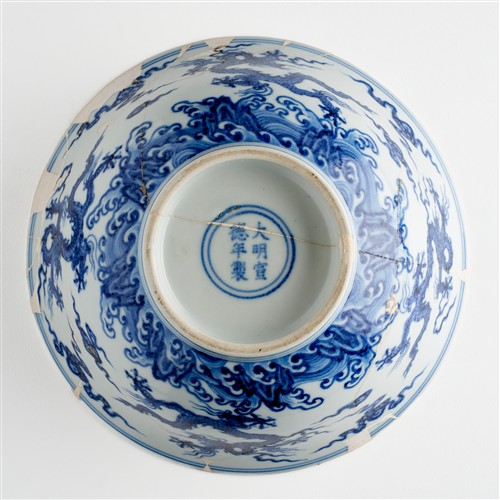
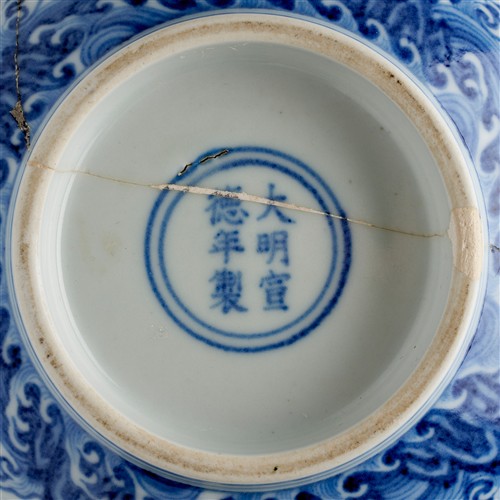
AN IMPORTANT AND RARE IMPERIAL CHINESE BLUE AND WHITE DRAGON BOWL, XUANDE SIX-CHARACTER UNDERGLAZE BLUE MARK AND OF THE PERIOD (1339-1435)
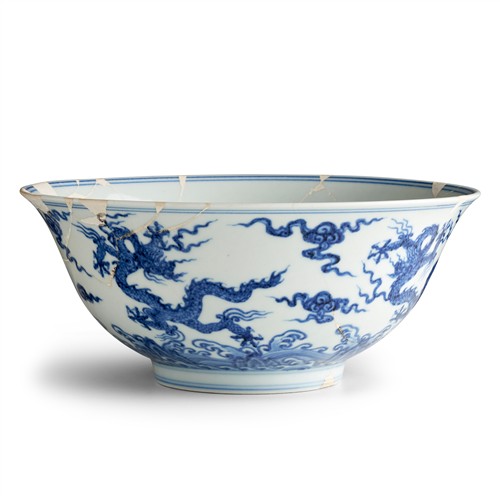
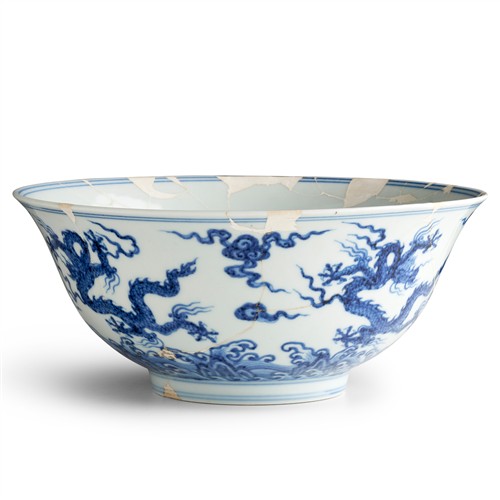
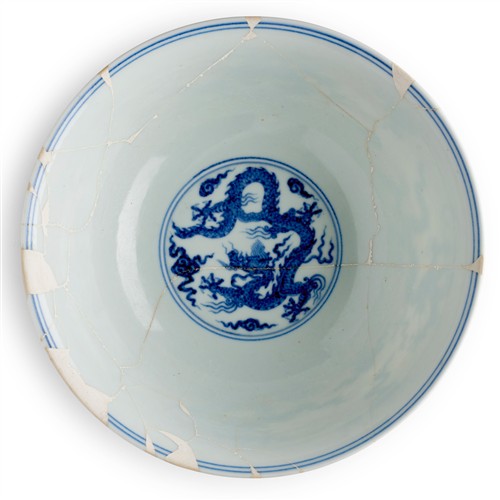
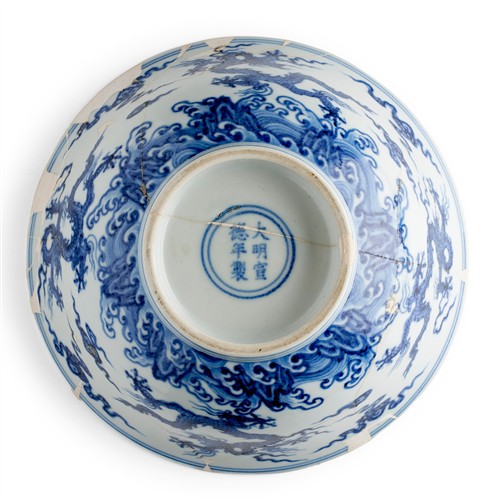
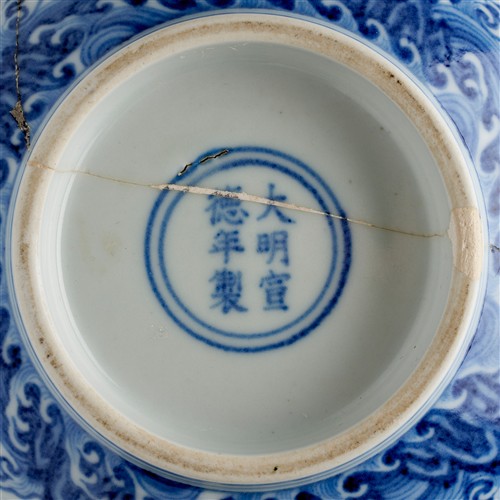
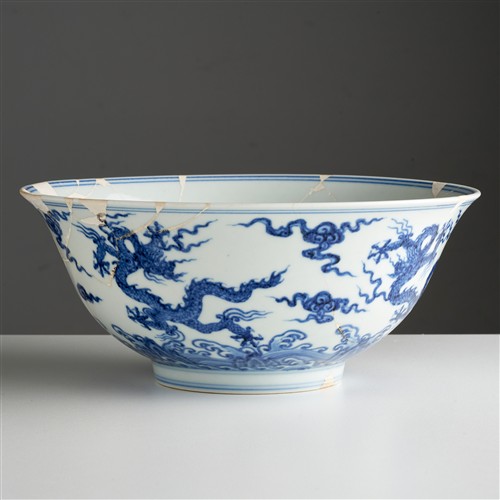
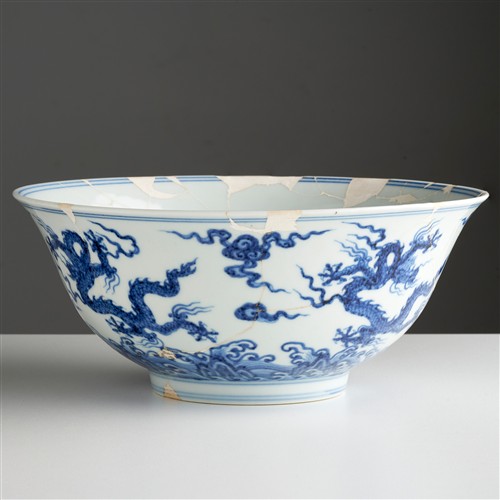
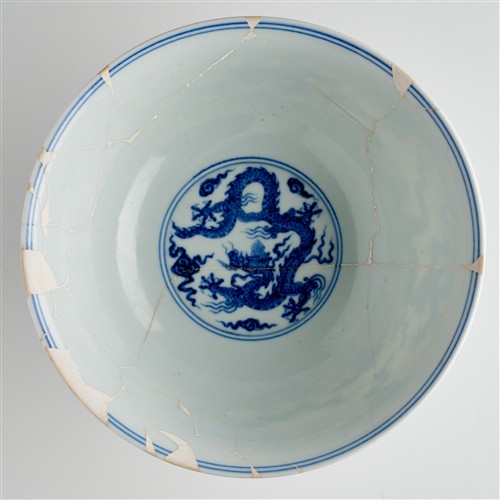
The bowl is finely decorated with a continuous frieze of four five-clawed dragons chasing flaming pearls and surrounded by cloud scrolls, the interior centre with a circular panel enclosing a scaly dragon within blue circles, the base is with a finely written six-character Xuande mark within double blue circles.
This extremely rare bowl represents the finest quality of porcelain produced at the Imperial kilns in the Xuande reign. The design of Imperial five-clawed dragons flying through the clouds and each chasing a flaming pearl is one of the most classic designs of all in Chinese porcelain, but that said this is one of the rarest patterns of the Xuande period. Originating as early as the Hongwu period (1368-1398) as seen on a blue and white and moulded bowl in the Tianminlou collection, illustrated in The Radiant Ming 1368-1644 through the Min Chiu Society Collection, Hong Kong, 2015, p. 18, no. 1. However, it was not until the Yongle period (1426-1435) that this design became standardised. A Yongle blue and white stem bowl of very similar decoration with fitted gold cover and silver stand was found in the tomb of Prince Zhuang of Liang in Zhongxiang city, Hubei province, illustrated in the British Museum, Ming: 50 years that changed China, London, 2014, p. 87, fig. 70. On the Prince Zhuang of Liang example, not only the porcelain stem bowl but also the gold cover and silver stand bear a conforming five-clawed dragon design. It is important to note that an inscription on the gold cover dates it to the second year of Zhengtong (1437). The consistency of this design across precious mediums and different reign periods might suggest that in the early 15th century this design became one of the standard designs supplied by the court to various imperial workshops. Bowls of this type continued to be made in the following periods in the Ming dynasty (1368-1644) such as a Chenghua (1465-1487) example and a Hongzhi (1488-1505) example in the Shanghai Museum, illustrated by Lu Minghua in Porcelain Wares from the Official Kilns of the Ming, Shanghai, 2007, fig. 3-61 and fig. 3-69 respectively. Two Xuande bowls of related design are in the National Palace Museum, Taipei, illustrated in A Panorama of Ceramics in the Collection of the National Palace Museum: Hsuan-te Ware I, Taipei, 2000, nos. 64 and 65. Xuande ‘dragon' bowls of this form also exist in a slightly different version, in which the dragons have three claws and the interiors are decorated with various floral scrolls and sprays in underglaze blue. This group includes four examples in the National Palace Museum, Taipei, illustrated in ibid, nos. 69-73; one in the British Museum, illustrated by Jessica Harrison-Hall, Catalogue of Late Yuan and Ming Ceramics in the British Museum, London, 2001, p. 134, no. 4:26; one in the Matsuoka Art Museum, Tokyo, illustrated in the Toji Taikei (Ceramics of East Asia), vol. 42, Tokyo, 1975, figs. 51 and 52; and the other one sold at Sotheby's Hong Kong, 2 November 1994, lot 36. A band of lappet design around the base of these bowls is more common, instead of the crashing waves seen on this example, making this design exceptionally rare.
明 宣德 六字青花款及本朝 龍紋大盌
23cm diameter, 9.5cm high
Unsold
Lot 18
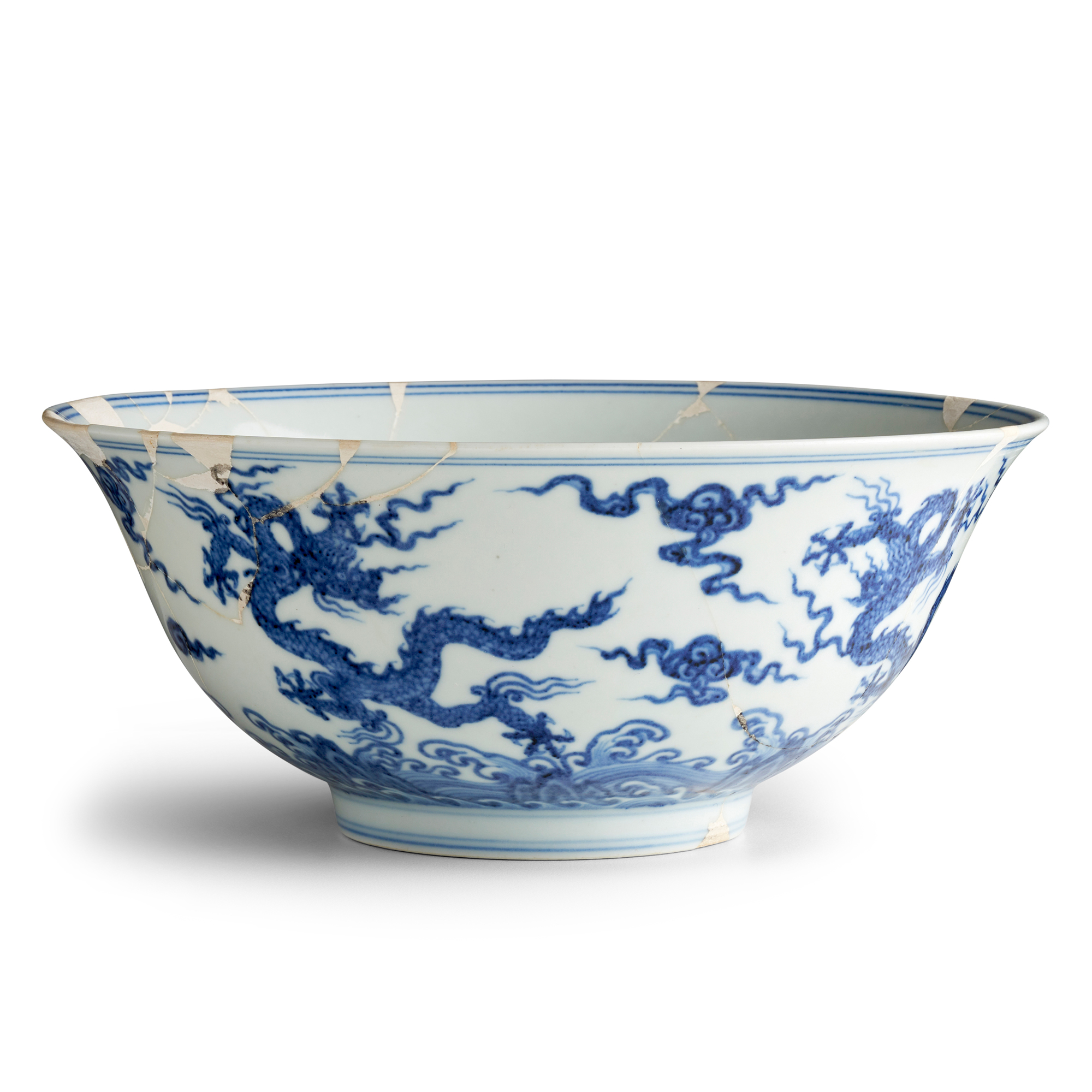
The bowl is finely decorated with a continuous frieze of four five-clawed dragons chasing flaming pearls and surrounded by cloud scrolls, the interior centre with a circular panel enclosing a scaly dragon within blue circles, the base is with a finely written six-character Xuande mark within double blue circles.
This extremely rare bowl represents the finest quality of porcelain produced at the Imperial kilns in the Xuande reign. The design of Imperial five-clawed dragons flying through the clouds and each chasing a flaming pearl is one of the most classic designs of all in Chinese porcelain, but that said this is one of the rarest patterns of the Xuande period. Originating as early as the Hongwu period (1368-1398) as seen on a blue and white and moulded bowl in the Tianminlou collection, illustrated in The Radiant Ming 1368-1644 through the Min Chiu Society Collection, Hong Kong, 2015, p. 18, no. 1. However, it was not until the Yongle period (1426-1435) that this design became standardised. A Yongle blue and white stem bowl of very similar decoration with fitted gold cover and silver stand was found in the tomb of Prince Zhuang of Liang in Zhongxiang city, Hubei province, illustrated in the British Museum, Ming: 50 years that changed China, London, 2014, p. 87, fig. 70. On the Prince Zhuang of Liang example, not only the porcelain stem bowl but also the gold cover and silver stand bear a conforming five-clawed dragon design. It is important to note that an inscription on the gold cover dates it to the second year of Zhengtong (1437). The consistency of this design across precious mediums and different reign periods might suggest that in the early 15th century this design became one of the standard designs supplied by the court to various imperial workshops. Bowls of this type continued to be made in the following periods in the Ming dynasty (1368-1644) such as a Chenghua (1465-1487) example and a Hongzhi (1488-1505) example in the Shanghai Museum, illustrated by Lu Minghua in Porcelain Wares from the Official Kilns of the Ming, Shanghai, 2007, fig. 3-61 and fig. 3-69 respectively. Two Xuande bowls of related design are in the National Palace Museum, Taipei, illustrated in A Panorama of Ceramics in the Collection of the National Palace Museum: Hsuan-te Ware I, Taipei, 2000, nos. 64 and 65. Xuande ‘dragon' bowls of this form also exist in a slightly different version, in which the dragons have three claws and the interiors are decorated with various floral scrolls and sprays in underglaze blue. This group includes four examples in the National Palace Museum, Taipei, illustrated in ibid, nos. 69-73; one in the British Museum, illustrated by Jessica Harrison-Hall, Catalogue of Late Yuan and Ming Ceramics in the British Museum, London, 2001, p. 134, no. 4:26; one in the Matsuoka Art Museum, Tokyo, illustrated in the Toji Taikei (Ceramics of East Asia), vol. 42, Tokyo, 1975, figs. 51 and 52; and the other one sold at Sotheby's Hong Kong, 2 November 1994, lot 36. A band of lappet design around the base of these bowls is more common, instead of the crashing waves seen on this example, making this design exceptionally rare.
明 宣德 六字青花款及本朝 龍紋大盌
23cm diameter, 9.5cm high
Estimate $50,000 - $60,000
Broken into pieces and restored.
CLICK TO SEE DETAIL PHOTOS OF THE WHOLE AUCTION