Lot 21
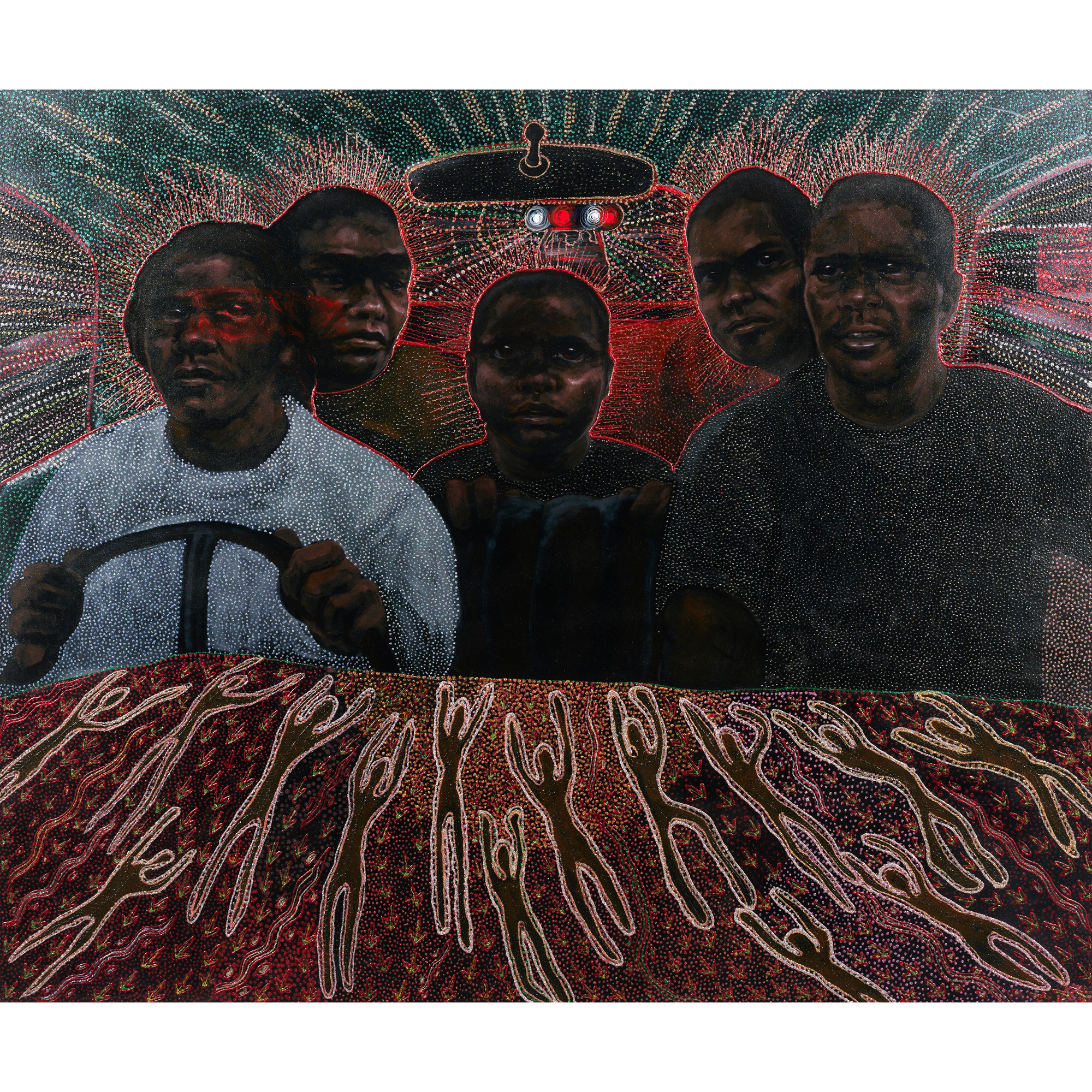
Monarch (Police) 2001
acrylic, red ochre and plastic beads on canvas
signed, titled and inscribed verso: 'Monarch (Police)/ by Julie Dowling/ Acrylic, Red Ochre and/ Plastic on Canvas/ This painting shows/ what happens to our [Nungar]/ men./ Their cars get checked, pulled over/ and then they are harassed by the police./ and when they argue they are put/ in lock up....../ This painting is for all the fellas/ at [Casuanria] Prison and/ the boys at [Longmore] Detention/ Centre in W.A./ 'May you find freedom in/ your heart and soul......"
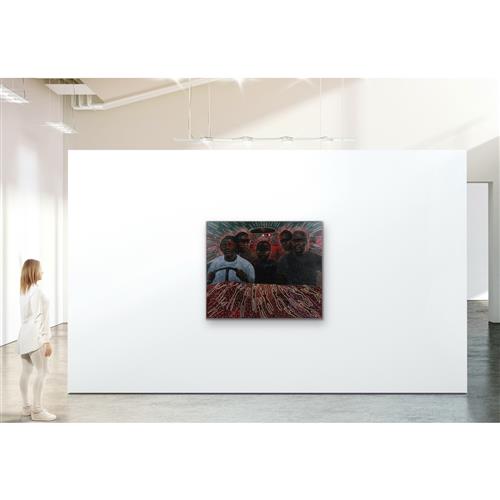
100 x 120cm
Estimate $15,000 - $25,000
Span Galleries, Melbourne
Private collection, Melbourne
Julie Dowling, Melbin, Span Galleries, Melbourne, 19 June - 1 July 2001
The practice of artist Julie Dowling is grounded in portraiture as an act of cultural affirmation and political testimony. A Badimaya First Nation artist and activist from Western Australia, Dowling's artworks are both intimate and challenging, combining detailed figuration with symbolism drawn from Indigenous iconography, European imagery, Christian icons, and art historical traditions. (1) Through this synthesis, Dowling's paintings are "an act of sovereign empowerment", reclaiming representation on her own terms for her own identity and for First Nation people. (2)
Dowling's artworks often centre on individuals, her portraits include family members and community figures, positioned within meticulously detailed environments. These scenes collapse time and spatial boundaries, merging personal memory with collective histories. Her use of dotting, while resonant with Western Desert painting traditions, is reconfigured as a painterly device that builds atmosphere and spiritual charge, rather than adhering to a particular regional style. In this way, Dowling resists homogenising expectations of First Nation art and artists, asserting diversity and distinctiveness. (3)
Dowling's artwork "Monarch (Police)" 2001, exemplifies these concerns with striking clarity. The work depicts a group of Nyoongah men driving in a car at night and in the background, the bright lights of a police car cast an ominous shadow on the scene. Dowling contextualises her artwork where she states: "This landscape is of the city at night. This is where my relatives are usually picked-up by the police the most….This painting shows what happens to our Nyoongah men. Their cars get checked, pulled over and then they are harassed by the police and when they argue they are put in the lock-up…" (4) The carefully rendered faces of the figures emerge from a dense background of dotted markings that radiate outwards in halos of red, white, blue and green. This imagery evokes spiritual icons by suggesting saintly halos, whilst simultaneously, conjuring a more menacing energy that recalls sirens and surveillance.
The stylised police car lights, flashing red and blue which glow with intensity in the background, function as a contemporary "Monarch;" a symbol of authority and control that replaces traditional emblems of sovereignty. Dowling's emphasis on the highlighted police car light motif, acts as a critique on institutional power structures that govern and often endanger Indigenous lives. The title itself underscores this inversion as "Monarch" implies rulership, yet here it is not embodied by a person but by an instrument of state surveillance. The figures are not passive subjects of this authority as their gazes are direct and composed, meeting the viewer with a quiet insistence. The driver illuminated in white clothing, grips the steering wheel, eyes cast towards the rearview mirror with acute awareness of the incoming police. The grouping of figures in this scene, suggests ideas of kinship and collective experience.
Dowling's use of tight dotting intensifies the emotional impact of the artwork, the surface shimmers with colours of red, green, blue and white. Red dominates the upper field, blending into darker tones and outlining and enveloping the figures in a charged atmosphere. This red evokes thoughts of danger, violence, and urgency, while the green, blue and white, introduce moments of contrast, preventing the composition from collapsing into darkness. The effect is unsettling, drawing the viewer into contemplation. The detailed foreground introduces another symbolic layer as the car bonnet is filled with references to Yamatji symbols including the Weitch (Emu) the Jardi (Goanna), and human spirits. These forms, outlined with intricate patterning, recall both ancestral figures and forensic traces, their hands are depicted as reaching out, bearing witness to the scene that is about to unfold. They may also reference the land itself, inscribed with stories and histories that persist despite challenges. Positioned beneath the seated figures, these forms suggest a foundation of cultural continuity and collective memory.
As expressed by Dowling, "Monarch (Police)" 2001 is a response to ongoing issues surrounding policing and Indigenous communities in Australia. Yet, the work resists pure didacticism, instead, it operates through affect and symbolism. The figures are neither victimised nor idealised, they are resolute and undeniably present. The work is a powerful reflection on power, visibility, and resilience. Confronting viewers with the realities of institutional authority, while affirming the enduring presence and dignity of First Nation people. In doing so, Dowling transforms the genre of portraiture into a space of resistance and remembrance.
Amanda Hayward (née North)
Senior Fine Art Specialist
(1) Dowling, Julie., About: Julie Dowling, accessed on 14th April 2026: https://www.juliedowling.art/about
(2) Dowling, Julie., Artist statement, Paintings an act of 'Sovereign empowerment for First Nation people, Curtin University, Perth, 7 December 2022
(3) Perkins, Hetti., One Sun One Moon: Aboriginal Art in Australia, Art Gallery of New South Wales, Sydney, 2007, p. 301
(4) Artist Statement from Hoorn, J., Bearing Witness: The Paintings of Julie Dowling, Essay for Julie Dowling: Melbin, SPAN Galleries, Melbourne, 16 September 2004
© Julie Dowling/Copyright Agency, 2026
Centum
AUCTION
Sale: LJ8809
6:00pm - 18 May 2026
Hawthorn
VIEWING
Friday 15 - Sunday 17 May, 11am - 5pm
2 Oxley Road, Hawthorn VIC
CONTACT
Hannah Ryan
hannah.ryan@leonardjoel.com.au
SIMILAR ITEMS
Lot 9
HOWARD ARKLEY (1951-1999) Primitive Gold 1984 synthetic polymer paint on canvas 105.5 x 105.5cm
Estimate: $50,000-70,000
Lot 24
BEN QUILTY (born 1973) Jude (Baby) 2008 oil and aerosol on linen 160 x 150cm
Estimate: $40,000-60,000
Lot 12
DALE FRANK (born 1959) Made in India lived in Nepal died in Moone Ponds 2012 varnish on linen 200 x 300cm
Estimate: $40,000-50,000
Lot 45
ADAM CULLEN (1965-2012) My Great Uncle 2011 acrylic and enamel on linen 213 x 183cm
Estimate: $30,000-40,000