(Bride over Shoalhaven) c.1982
oil on board
signed lower right: Arthur Boyd
120 x 90cm
Estimate $100,000 - $150,000
(possibly) Art Galleries Schubert, Queensland
Private collection, Melbourne
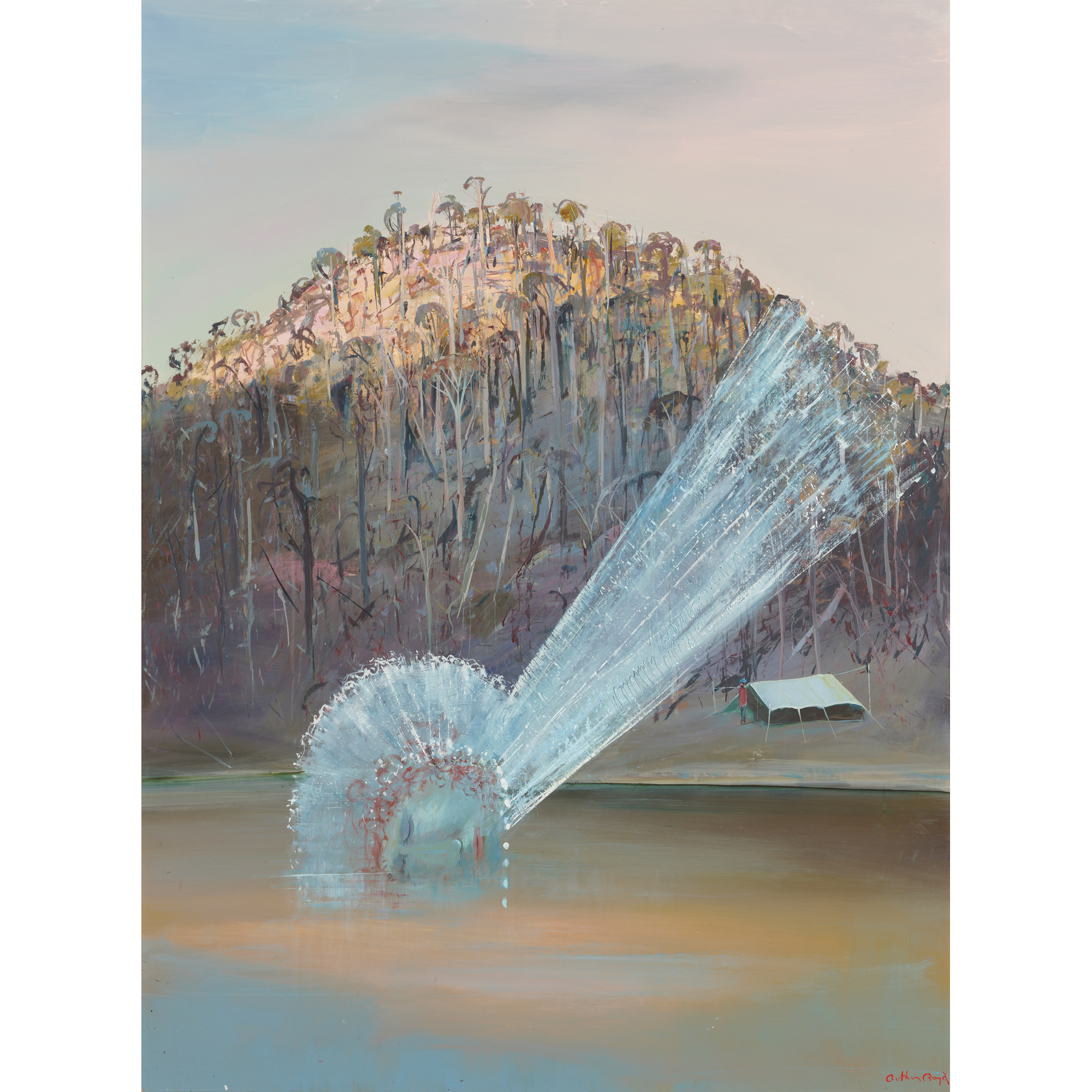
Among the familiar figures that recur throughout Arthur Boyd's long career, none is more evocative than the bride. First conceived during the late 1950s, she would remain within Boyd's imagination for decades, continually reappearing in altered landscapes and assuming new meanings. In the present work, the bride is no longer a conventional human presence. Her body has been transformed into an extraordinary sweep of translucent white paint, at once veil, waterfall and force of nature.
Boyd's original cycle was titled 'Love, Marriage and Death of a Half Caste', although it subsequently became known simply as the Bride series. The series was inspired by Boyd's visit to Central Australia in 1951, where he witnessed the poverty, segregation and social exclusion experienced by First Nations people.
As Barry Pearce writes, Boyd's travels provided a "devastating experience of the state of Aboriginal life in Central Australia," and he subsequently gave "cathartic expression to his feelings in the Bride series." (1)
Painted initially between 1957 and 1960, the series developed an imagined narrative centred upon a First Nations man and his mixed-race bride. Through their frustrated pursuit of love, Boyd addressed the racial divisions embedded within Australian society. The lovers encounter separation, persecution and tragedy, their private suffering becoming an allegory for a wider history of dispossession and prejudice.
The earliest paintings are populated by recognisable protagonists and an elaborate personal vocabulary of flowers, animals and creatures with threatening red eyes. Boyd never presented the story as a coherent sequence. Instead, individual episodes unfold with the uncertain logic of memory, dream or myth. His figures float, dissolve or merge with the surrounding earth, while the Australian landscape becomes an active presence within their unfolding drama. The series was first exhibited at Australian Galleries in Melbourne in 1958 and was expanded for Boyd's exhibition at Zwemmer Gallery in London in 1960. (2) Its combination of social conscience, psychological intensity and bold expression established the bride paintings as an important achievement within Boyd's career.
By the 1960s, however, the bride began to move beyond the original narrative. Boyd had relocated with his family to England in 1959, yet the imagery of Australia continued to exert a powerful hold upon his imagination. Removed from the landscape that had first inspired the paintings, he increasingly transformed it into an internal, poetic landscape. The specific racial and social dimensions of the early series remained part of the bride's history, but her later appearances expanded into more universal meditations upon love, longing, vulnerability and isolation.
This evolution is central to the present painting. The bride's physical identity has been almost entirely absorbed into the landscape. Only the rounded form of her head and the brilliant white expanse of her veil allow her to be recognised. Her dress rises diagonally across the composition, cutting through the muted riverbank and densely wooded escarpment like a sudden shaft of light. Its pale blue and white surface is animated by vigorous strokes, scratches and fine linear marks.
The steep diagonal introduces a sense of movement into an otherwise still landscape. It may be read as a veil caught by the wind, a stream of water, a beam of illumination or the visual trace of a body in flight. Boyd repeatedly exploited such ambiguities. In related paintings, the bride drinks from a river, collapses beside the water or assumes an almost insectlike form, suspended between human figure and natural phenomenon. (3)
The surrounding landscape is rendered with equal imaginative freedom. The hill is built from layered touches of ochre, pink, violet, blue and olive green. Slender trees descend like vertical threads, their forms hovering between observation and calligraphic notation. A small tent and solitary figure appear at the base of the hill, minute in relation to both the bride and the surrounding terrain. These details establish a human scale, but they also deepen the painting's atmosphere of estrangement.
Boyd's return to Australia in 1971 and his subsequent encounter with the Shoalhaven River brought a renewed grandeur and specificity to his landscapes. Yet he did not abandon the symbolic figures of his earlier work. Instead, the bride, the bridegroom and other mythic presences entered these later environments, binding personal memory to observed place. The landscape was never merely descriptive for Boyd. It offered a stage upon which human desire, guilt, violence and redemption could be repeatedly enacted.
Wiebke Brix
Head of Art
(1) Pearce, B., Arthur Boyd: Retrospective, The Beagle Press in conjunction with the Art Gallery of New South Wales, Sydney, 1993, p. 12.
(2) Heide Museum of Modern Art, "Arthur Boyd: Brides", www.heide.com.au/exhibitions/arthur-boyd-brides, accessed 30 August 2026.
(3) Philipp, F., Arthur Boyd, Thames and Hudson, London, 1967.
© Arthur Boyd/Copyright Agency, 2026
Fine Art
AUCTION
Sale: LJ8822
6:00pm - 6 October 2026
Hawthorn
VIEWING
Friday 2 - Sunday 4 October, 11am - 5pm, 2 Oxley Rd, Hawthorn
CONTACT
Wiebke Brix
wiebke.brix@leonardjoel.com.au
SIMILAR ITEMS
Lot 17
ARTHUR STREETON (1867-1943) (Lorne and the Bay) 1921 oil on canvas 50.5 x 76cm
Estimate: $200,000-300,000
Lot 53
EMILY KAM KNGWARRAY (c.1910-1996) (Language group: Anmatyerr) Summer Awelye 1991 synthetic polymer paint on linen 130 x 220cm
Estimate: $200,000-300,000
Lot 24
CHRISTOPHER WOOD (British, 1901-1930) Paris oil on board 37.5 x 45.5cm
Estimate: $80,000-120,000
Lot 2
GRACE COSSINGTON SMITH (1892-1984) Still Life with Lilies oil on board 43.5 x 38.5cm
Estimate: $40,000-60,000