Back
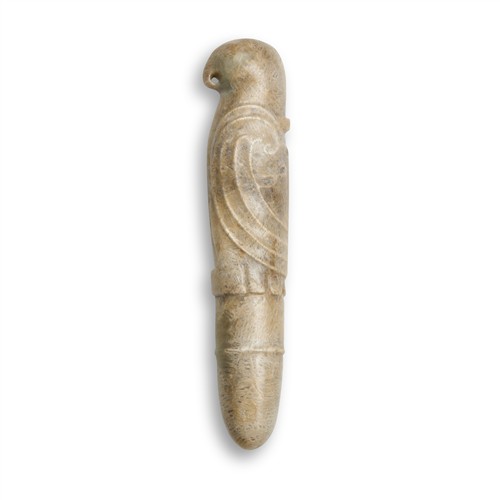
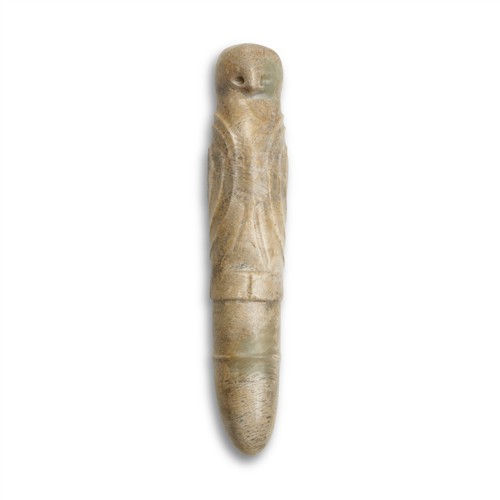
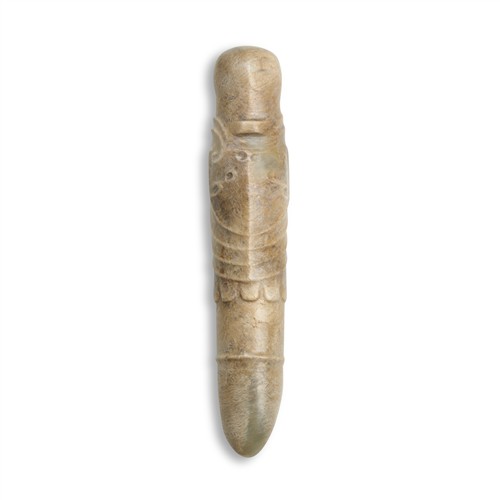
A CHINESE CALCIFIED WHITE JADE BIRD-FORM HAIR ORNAMENT
POSSIBLY POST SHIJIAHE CULTURE, CIRCA 2100-1600 BCE
It is believed hair ornaments of this type were inserted upright into a Shaman¡¯s hair, and probably used as a ritual object to increase Shamans¡¯ powers of communication with heaven. An almost identical hair ornament (11.45 cm.), dating to the late Shijiahe Culture, is in the National Palace Museum Collection (acquisition no. guyu 1082/tian-717- 1-7-14) and illustrated in Art in Quest of Heaven and Truth- Chinese Jades through the Ages, Taipei, 2012, pl. 4-5-11. In the catalogue, it is stated that the Shijiahe people belonged to the bird-worshipping Yi people who moved from the Shandong Peninsula to the middle reach of the Yangzi River. Another very similar but reduced example in the Museum (acquisition no. guyu5821/lv-1804-1) is illustrated ibid., p. 35, pl. 3-3-30. A slightly longer jade ornament of almost identical design (13.6 cm. long) and attributed to Shijiahe Culture was excavated from the Shang dynasty Fu Hao tomb, its line drawing illustrated in Teng Shuping, Collectors' Exhibition of Archaic Chinese Jades, National Palace Museum, Taipei, 1999, p. 30, pl. 21:1.
A larger example (11cm high) sold at the auction see Sotheby's Hong Kong, 21/5/2025, lot 5807; also see a green jade example sold at the same house, 9/10/2023, lot 3706. Also compare to two white jade examples sold at Christie's Hong Kong, 29/11/2017, lot 2721 and 27/11/2019, lot 2753.
7.8cm high
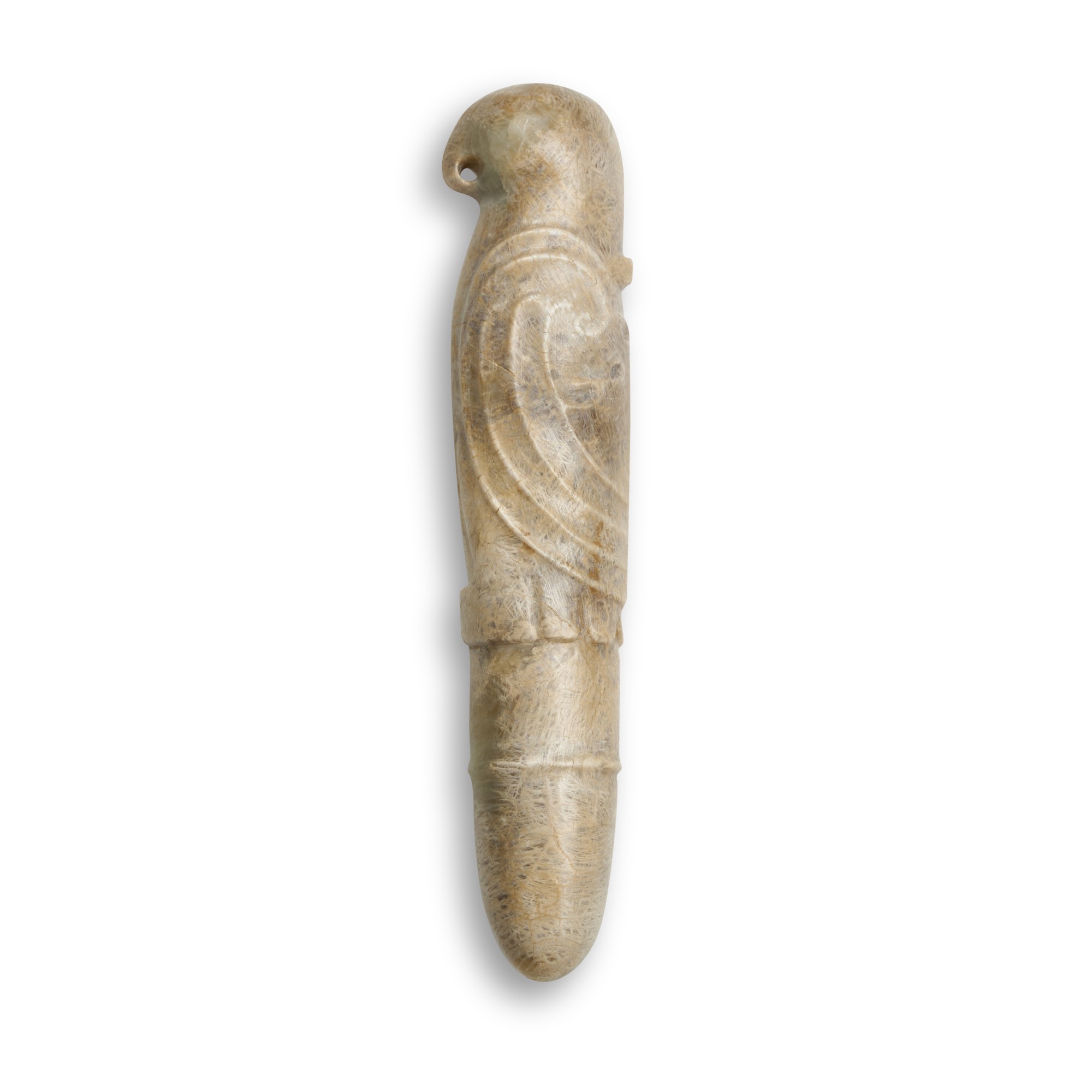
POSSIBLY POST SHIJIAHE CULTURE, CIRCA 2100-1600 BCE
It is believed hair ornaments of this type were inserted upright into a Shaman¡¯s hair, and probably used as a ritual object to increase Shamans¡¯ powers of communication with heaven. An almost identical hair ornament (11.45 cm.), dating to the late Shijiahe Culture, is in the National Palace Museum Collection (acquisition no. guyu 1082/tian-717- 1-7-14) and illustrated in Art in Quest of Heaven and Truth- Chinese Jades through the Ages, Taipei, 2012, pl. 4-5-11. In the catalogue, it is stated that the Shijiahe people belonged to the bird-worshipping Yi people who moved from the Shandong Peninsula to the middle reach of the Yangzi River. Another very similar but reduced example in the Museum (acquisition no. guyu5821/lv-1804-1) is illustrated ibid., p. 35, pl. 3-3-30. A slightly longer jade ornament of almost identical design (13.6 cm. long) and attributed to Shijiahe Culture was excavated from the Shang dynasty Fu Hao tomb, its line drawing illustrated in Teng Shuping, Collectors' Exhibition of Archaic Chinese Jades, National Palace Museum, Taipei, 1999, p. 30, pl. 21:1.
A larger example (11cm high) sold at the auction see Sotheby's Hong Kong, 21/5/2025, lot 5807; also see a green jade example sold at the same house, 9/10/2023, lot 3706. Also compare to two white jade examples sold at Christie's Hong Kong, 29/11/2017, lot 2721 and 27/11/2019, lot 2753.
7.8cm high
Estimate $3,000 - $5,000
A private collection, NSW., acquired in the late 90s.
Important Chinese & Asian Art
AUCTION
Sale: LJ8825
11:00am - 25 October 2026
Hawthorn
VIEWING
Thurs 22 - Sat 24 October, 11am - 5pm
2 Oxley Rd, Hawthorn VIC
CONTACT
Luke Guan
luke.guan@leonardjoel.com.au
SIMILAR ITEMS
Lot 14
A VERY RARE PAIR OF CHINESE FAMILLE ROSE AND GRISAILLE-DECORATED 'LANDSCAPE' STOOLS, YONGZHENG PERIOD (1723 - 1735)
Estimate: $100,000-200,000
Lot 112
A CHINESE HIGH-FIRED WHITE-GLAZED CUP, SUI DYNASTY (581-618)
Estimate: $50,000-80,000
Lot 134
AN EXTREMELY RARE CHINESE HUSHAN WARE OVOID PHOSPHATIC EWER, TANG DYNASTY, 8TH/9TH CENTURY
Estimate: $50,000-70,000
Lot 178
A CHINESE ARCHAIC BRONZE RITUAL VESSEL, ZUN, LATE SHANG/EARLY WESTERN ZHOU DYNASTY, 12TH-10TH CENTURY BCE
Estimate: $50,000-70,000