Summer Awelye 1991
synthetic polymer paint on linen
inscribed verso with artist's name and Delmore Gallery cat. no. 91J21
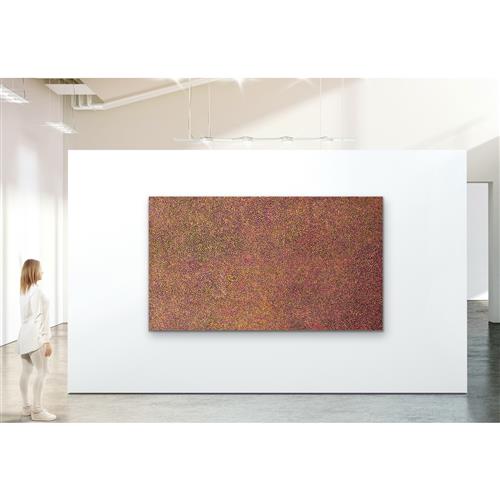
130 x 220cm
Estimate $200,000 - $300,000
Commissioned by Delmore Gallery, Alice Springs
Corporate collection, Sydney
Private collection, New South Wales
The Delmore Collection: Selected Exhibition and Survey of Works 1989-1995, Mary Place Gallery, Sydney, 7 November - 3 December 1995
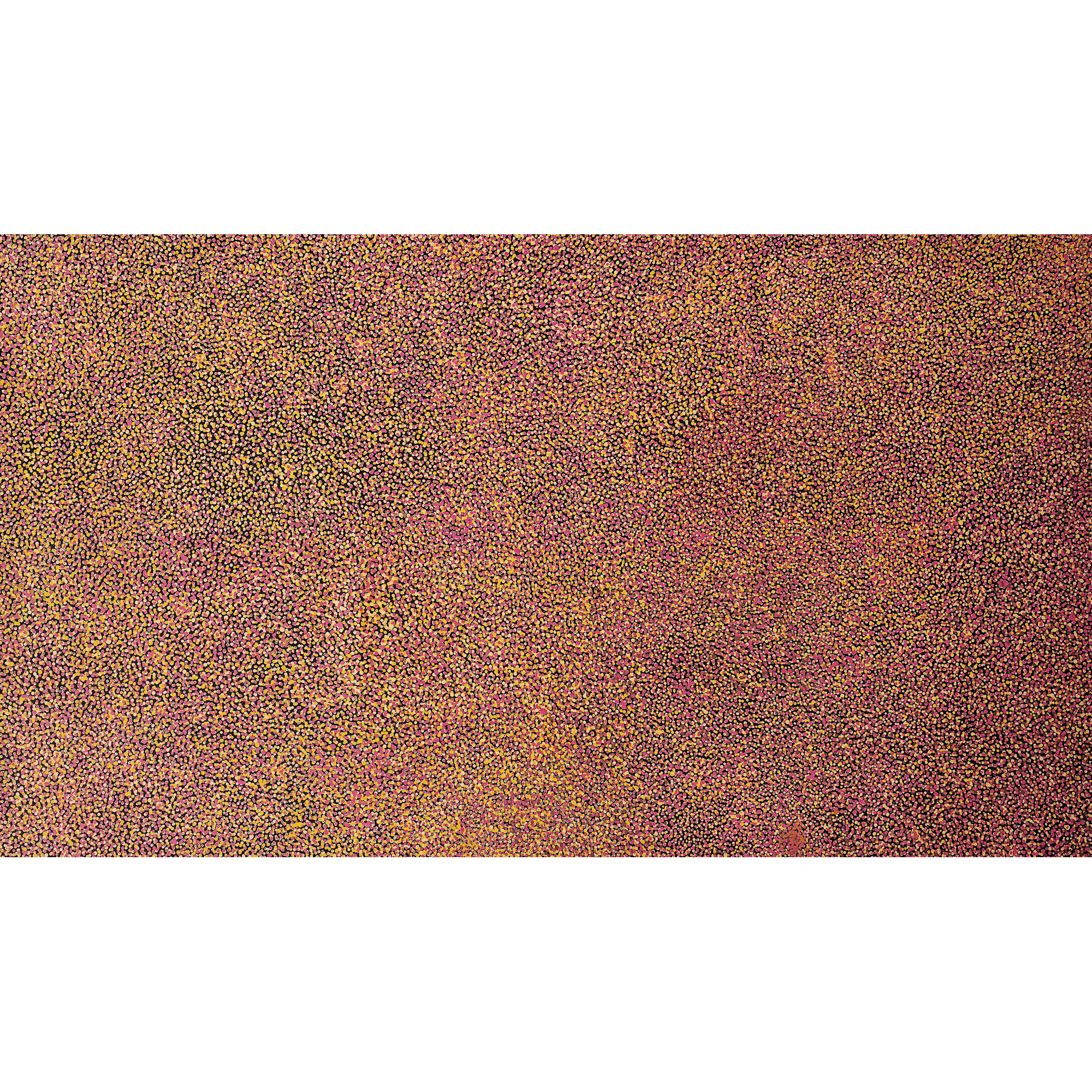
Painted at Delmore Downs in October 1991 and registered as Delmore Gallery cat. no. 91J21, the work belongs to a concentrated period in which Emily Kam Kngwarray was recalibrating the relationship between underlying structure, dot and colour. Kngwarray painted from within a practice already fully formed when she first held a brush to canvas. By the time she produced her first acrylic painting in 1988-1989, she had spent decades as a senior ceremonial leader of the Anmatyerr people, with authority for awelye associated with Alhalker Country and deep knowledge of Altyerre. Her eight-year canvas career was not a departure from that practice. It was its continuation by other means.
Kngwarray's early paintings retained something of the lightness and layered processes of her earlier batik practice. Moving from silk to canvas, she carried forward trailing lines and fields of marks articulating the above- and below-ground life of anwerlarr, the pencil yam associated with her Country at Alhalker. From 1988/89, these elements were transformed through paint. The dot became increasingly powerful as both a structural and expressive device, accumulating across the surface until the lines beneath were, in some works, almost completely obscured.
In 'Summer Awelye', the dense concentration of dots transforms the underlying armature into a conceptual foundation. Hints of sinuous forms emerge beneath the chromatic field, recalling the underground growth of the yam and the interconnected systems of plant, animal and ceremonial life with which Kngwarray's painting was connected. Yet the surface no longer depends on these structures being clearly legible. The dotting asserts a pictorial life of its own. Meaning has not disappeared as the visibility of line diminishes; Kngwarray alters the terms through which it is made present.
Painting at Delmore gave Kngwarray sustained access to materials and opportunities to work on physically ambitious canvases. 'Summer Awelye' is executed with measured focus: a long, slender brush creates rising and falling plumes of pink, red and yellow, while precise dots move across the surface, evoking endlessness.
The work can be precisely located within her production of October 1991. 'Kame Flowers 1', Delmore Gallery cat. no. 91J18, was painted in the same month and registered only three works earlier in the Delmore sequence. While the paintings should not be assumed to carry identical meanings, their formal proximity is striking. Both build dense fields of warm colour over darker underlying structures and demonstrate the increasing independence of the dot from earlier graphic frameworks.
Seen within the works from late 1991, 'Summer Awelye' occupies an important position, foreshadowing a further loosening of the tightly worked dot field that would become increasingly apparent in paintings made into 1992. Within a few months, Kngwarray would push this relationship with the dot even further. In 'Kame-Summer Awelye II', painted in December 1991, the underlying tracery becomes markedly less visible and softer, and larger dots float more freely across the picture plane. The importance of 'Summer Awelye', however, does not rest simply on anticipating what followed. It records Kngwarray altering the balance between line and surface, concealment and disclosure, without severing those forms from the cultural and ceremonial structures from which they emerged.
Kngwarray's practice is better understood as a continual recalibration rather than a succession of discrete styles. Linear structures, fields of dots, expanses of colour and later body-line paintings do not simply replace one another. Across the extraordinary compression of her painting career, Kngwarray repeatedly reconstituted the visual language through which Country, awelye and cultural authority could enter the picture. Increasing visual abstraction did not mean increasing distance from Country.
Recent scholarship has reinforced this reading. The 2023 National Gallery of Australia retrospective, co-curated by Kelli Cole and Hetti Perkins, and its subsequent presentation at Tate Modern in 2025, grounded Kngwarray's practice first in cultural authority, Country and knowledge systems rather than Western abstraction. Her formal achievement cannot be separated from the cultural knowledge, ceremonial responsibility and sustained relationship to Country from which the paintings emerged.
The title 'Summer Awelye' belongs to the Delmore system of naming and recording works rather than to Kngwarray herself in the Western sense of assigning a fixed title. Its October date therefore need not be reconciled literally with the conventional calendar season of summer. More useful is the way the title draws together awelye, the ceremonial domain through which Kngwarray exercised authority for Country, and the seasonal transformations through which that Country changes. Colour here is not a release from Country but one means through which its vitality becomes pictorially present.
Four years after it was painted, 'Summer Awelye' was selected for 'The Delmore Collection: Selected Exhibition and Survey of Works 1989-1995' at Mary Place Gallery in Sydney, 7 November-3 December 1995. By then, Kngwarray had been painting on canvas for several years, yet the formal evolution of the work was already substantial enough to warrant retrospective survey. Its inclusion indicates that the painting had already been identified within Delmore's own account of the changes in her practice since the beginning of Delmore's survey period in 1989.
Mary Place was an important part of that story. Interstate galleries, dealers and curators used the independent Paddington venue for focused exhibitions outside their home cities. Delmore used it for this survey as Kngwarray's reputation was rising, and returned in later years for further presentations of Utopia artists and works retained in the Delmore Collection. The 1995 exhibition thus placed 'Summer Awelye' within an early act of historical reflection, during Kngwarray's lifetime, on a body of work already distinguished by extraordinary speed and transformation.
What makes 'Summer Awelye' compelling is not simply where it falls within that chronology. The painting changes the relationship between what can be seen and what remains embedded within the work. Structure persists beneath colour; awelye and Country remain active without being offered up as readily decipherable signs. The disappearance of visible structure was never the disappearance of meaning. Its significance lies in the remarkable pictorial intelligence with which Kngwarray continually reconstituted the terms of her own painting.
Vaness Merlino
Vanessa Merlino is Curator and Writer, her work is grounded in over two decades of engagement with First Nations art across remote community, commercial gallery, curatorial and research contexts. She has written extensively on Australian First Nations artists and exhibitions, with a particular research interest in the work of senior women artists, including Emily Kam Kngwarray. Her writing and curatorial practice brings close attention to individual artistic careers, the cultural and historical contexts in which works are made, and the place of First Nations artists within broader histories of Australian and international art. Vanessa has authored more than forty exhibition catalogue essays and edited 'Paddy Bedford: Gouache (2024)'. Her curatorial projects have been presented in Melbourne, Sydney, New York and London, including collaborations with Pace Gallery, alongside an ongoing program of artist talks, conversations and public programs.
References
Cole K., Perkins H. and Green J, Emily Kam Kngwarray. National Gallery of Australia, Canberra, 2023.
Isaacs J., Smith T., Ryan J., Holt D. and Holt J., Emily Kngwarreye Paintings. Craftsman House, Sydney, 1998. See Kame Flowers 1, 1991, Delmore Gallery cat. no. 91J18, p. 66, pl. 18.
Margo N. (ed.), Emily Kame Kngwarreye: Alhalkere-Paintings from Utopia. Queensland Art Gallery / Macmillan, Brisbane, 1998.
Sotheby's. Aboriginal Art. Sydney, 29 July 2003, lot 209: Emily Kame Kngwarreye, Summer Awelye, 1991, Delmore Gallery cat. no. 91J21.
Sotheby's. Aboriginal Art. London, 26 September 2018, lot 38: Emily Kame Kngwarreye, Kame-Summer Awelye II, 1991.
The Delmore Collection: Selected Exhibition and Survey of Works 1989-1995. Mary Place Gallery, Sydney, 7 November-3 December 1995.
McDonald J., "Mary Place Gallery." Artist Profile, 8 March 2018.
RELATED WORKS:
Emily Kam Kngwarray, Kame Flowers 1 1991 synthetic polymer paint on linen, 151 x 90cm, Delmore Gallery cat. no. 91J18, Private collection
Emily Kam Kngwarray, Kame-Summer Awelye II, synthetic polymer paint on canvas, 135 x 300cm, Delmore Gallery cat. no. 91L33, Private collection
Emily Kam Kngwarray, Untitled (Alhalker) 1992, synthetic polymer paint on canvas, 166 x 481cm, Art Gallery of New South Wales, Sydney
© Emily Kam Kngwarray/Copyright Agency, 2026
Fine Art
AUCTION
Sale: LJ8822
6:00pm - 6 October 2026
Hawthorn
VIEWING
Friday 2 - Sunday 4 October, 11am - 5pm, 2 Oxley Rd, Hawthorn
CONTACT
Wiebke Brix
wiebke.brix@leonardjoel.com.au
SIMILAR ITEMS
Lot 17
ARTHUR STREETON (1867-1943) (Lorne and the Bay) 1921 oil on canvas 50.5 x 76cm
Estimate: $200,000-300,000
Lot 5
ARTHUR BOYD (1920-1999) (Bride over Shoalhaven) c.1982 oil on board 120 x 90cm
Estimate: $100,000-150,000
Lot 24
CHRISTOPHER WOOD (British, 1901-1930) Paris oil on board 37.5 x 45.5cm
Estimate: $80,000-120,000
Lot 2
GRACE COSSINGTON SMITH (1892-1984) Still Life with Lilies oil on board 43.5 x 38.5cm
Estimate: $40,000-60,000