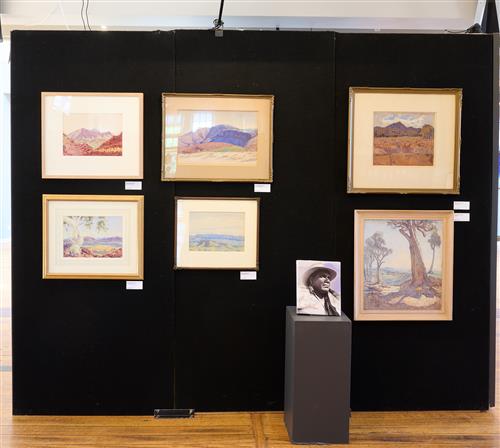
Lot 63
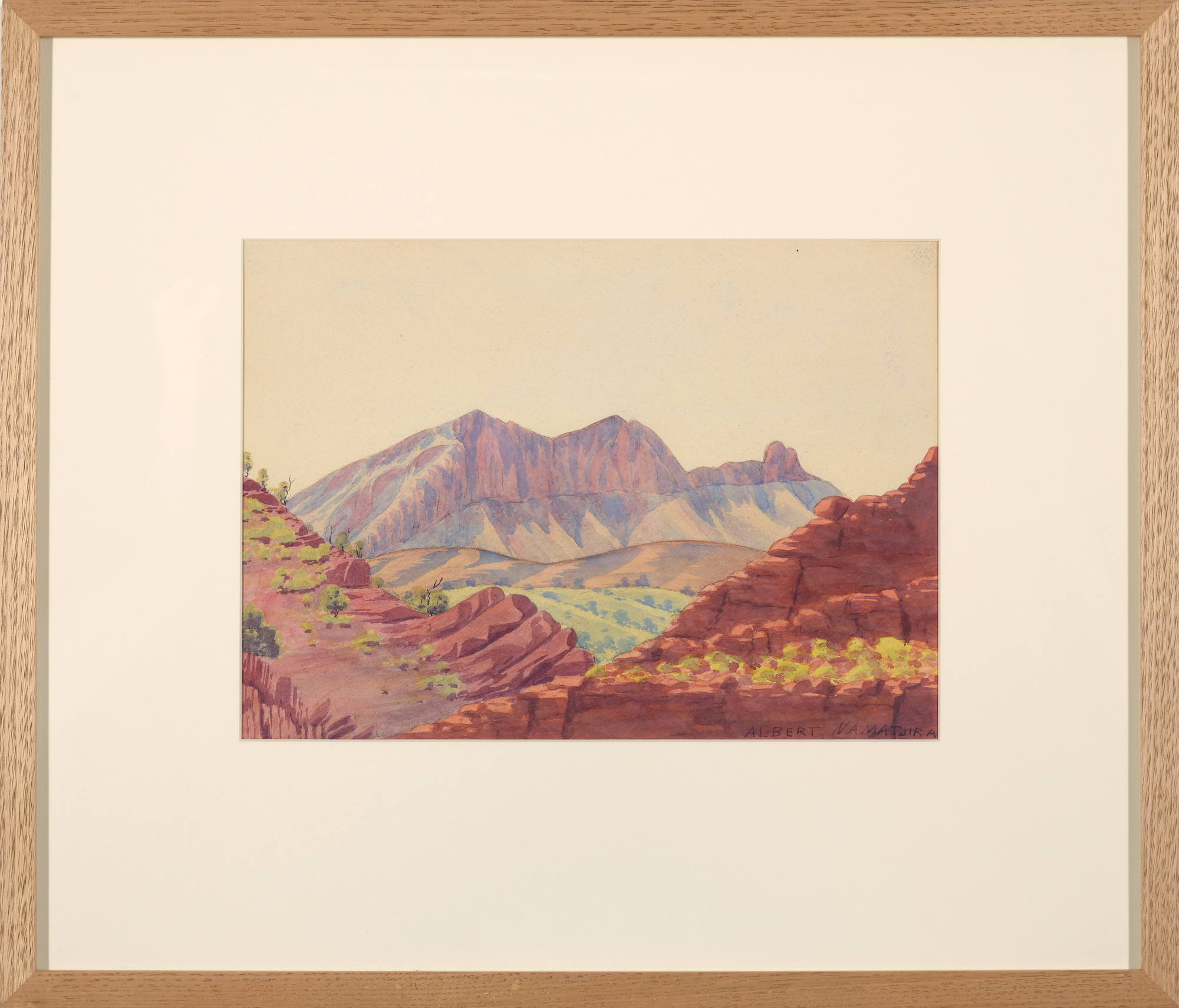
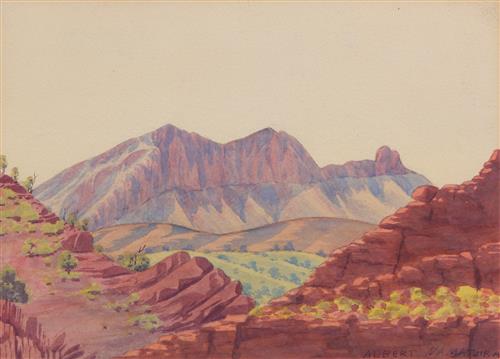
Rutjupma (Mount Sonder) 1940
watercolour and pencil on paper
signed lower right: ALBERT NAMATJIRA
26.5 x 35cm
Estimate $30,000 - $40,000
This work is in good condition consistent with age. The work has been recently reframed, and a photograph of the work unframed can be supplied. Only when viewed outside of its frame can minor discolouration around the far edges (beneath the mount) be seen. The work is laid down onto card. Minor dark spot upper edge, possible inherent.
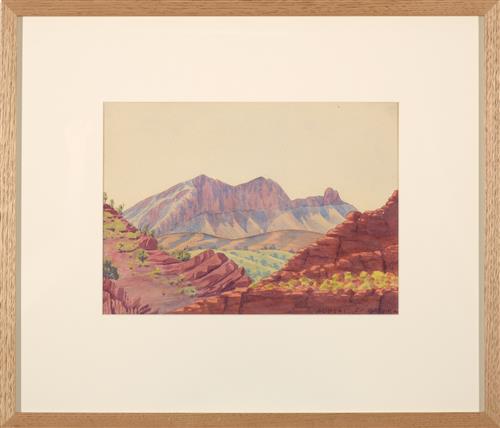
The frame is in excellent new condition, overall size 52.5 x 61.5cm. (LEONARD JOEL DELIVERY SIZE: SMALL)
The opinions expressed in the condition reports are a guide only and should not be treated as a statement of fact. Prospective buyers are encouraged to physically inspect item, or book a virtual viewing or request further images during our pre-sale period where Leonard Joel staff are available for advice.
Please note condition reports can be amended during the pre-sale period, so we strongly suggest any interested bidders check the published condition report available on the website before the auction commences. Leonard Joel makes no guarantee of the originality of mechanical or applied components. Absence of reference to such modifications does not imply that a lot is free from modifications.
Private collection, South Australia
McGregor, K., The Life & Times of Albert Namatjira, Badger Editions, 2021, p. 218 (illus.), 420
The artworks of Albert Namatjira express his relationship with the Arrernte country, particularly the Western Arrernte lands, for which he was a traditional custodian. Ghost gums with glowing white trunks, gorges and mountain ranges are all the classic subjects of the Hermannsburg school and Albert was the artist who mastered the European style of watercolour painting whilst maintaining the sacred stories of his culture.
The Hermannsburg Mission was established by Lutheran missionaries in 1877 near the Finke River, west of Alice Springs. Artists and friends, Rex Battarbee and John Gardner first visited the Hermannsburg Mission in 1932, but it was not until their second visit in December 1934 that they would first meet Albert. Battarbee and Gardner showed their art to the Aranda people in an exhibition in the schoolroom. Albert was one of the visitors and was immediately interested in their work. Albert wanted to earn good money to support his family. After learning that the artists could earn up to fifteen guineas for one piece, he had resolved that he could do the same. It would be another two years from this first meeting before Battarbee would return to the Mission and would begin his first painting lessons with Albert.
In the winter of 1936, Battarbee returned for the third time and Albert offered his services as a cameleer in return for an invitation to accompany Battarbee on his painting expeditions. Albert shared his knowledge of the sacred stories of the land, showing Battarbee sites inaccessible by car, and in return Battarbee showed Albert the mixing of colours and expert handling of watercolour. Albert would paint sitting cross-legged on the ground, supporting the back of the board with his left hand while painting with his right. Battarbee remarked that "…within a fortnight [Albert] had advanced to watercolours and completed his first painting on his own, and then I realised that this man had arrived in the art world". (1)
Albert's talents in art extended beyond his skill with the brush. As Philip Jones comments, "in a society undergoing trauma, in which the traditional power of the old men was being eroded and supplanted by a complex set of new values, Namatjira's actions had a deeper resonance. By mastering the art of landscape painting he was the first Aranda man to take a European cultural item and, in a subversive sense, to make it his own". (2)
Albert's successes, however, were not without consistent obstacles. By 1938, Battarbee attempted to secure Albert a solo show at the Melbourne Fine Art Society. Much to his disappointment, their interest was only in keeping Albert as an "uncivilised" native so as not to disrupt the art world structures of the time. Fortunately for Albert and Battarbee, the Governor and his wife, Lady Huntingfield, had visited Hermannsburg in mid-1938 and greatly encouraged Albert's artistic practice. So much so, that she offered to open his suggested Melbourne exhibition, forcing the Society to change their stance and agree to the exhibition on Battarbee's initial terms - that Albert be offered the same dignity as any other practicing artist. Forty-three works were exhibited, mounted but not framed, including number 35, Mereenie Bluff Range 1938 (lot 62). These works were the first where Albert signed as "Albert Namatjira", previously signing just as "Albert".
By the 1940s, Albert was as accomplished as any other watercolourist in Australia. His reputation grew and he was fortunate enough to meet with visiting dignitaries from around the world, including the Queen of England. It is during these sucessful years he produced Rutjupma (Mount Sonder) 1940 (lot 63) and Illumba Parta c.1952 (lot 64). His exhibitions continued to sell out and Albert shared his skills with his peers, going on to inspire a whole generation of artists including his children.
The ensuing years would bring him much success, albeit within the bounds of the second world war, bureaucracy, and institutionalised racism. Although he became the first Aboriginal person to be granted conditional Australian citizenship in 1957, he still found himself caught between cultures - exhibited as a great Australian veiled with inherent condescension. It is this deeper and darker side of his success story that is still being addressed and acknowledged today.
Olivia Fuller | Head of Art
(1) K. McGregor, The Life & Times of Albert Namatjira, Badger Editions, 2021, p. 48
(2) Philip Jones, "Traveller Between Two Worlds", The Heritage of Namatjira: The Watercolourists of Central Australia, edited by Jane Hardy, J.V.S. Megaw and M. Ruth Megaw, William Heinemann Australia, 1992, pp.111-112
© Namatjira Legacy Trust / Copyright Agency, 2021
Fine Art
AUCTION
Sale: LJ8436
6:00pm - 23 November 2021
333 Malvern Rd, South Yarra 3141
VIEWING
Viewing in Melbourne:
Friday 19 - Sunday 21 November, 10am - 4pm
CONTACT
Olivia Fuller 0388255624
olivia.fuller@leonardjoel.com.au
SIMILAR ITEMS
Lot 30
JOHN OLSEN (born 1928) Billabong 1995 oil on canvas
Estimate: $40,000-50,000
Lot 64
ALBERT NAMATJIRA (1902-1959) Illumba Parta c.1952 watercolour and pencil on paper
Estimate: $35,000-45,000
Lot 84
ETHEL CARRICK FOX (1872-1952) Fish Market in Nice c.1930 oil on canvas
Estimate: $35,000-45,000
Lot 104
ALBERT TUCKER (1914-1999) Ibis in Flight 1968 oil on composition board
Estimate: $28,000-38,000