Lot 7
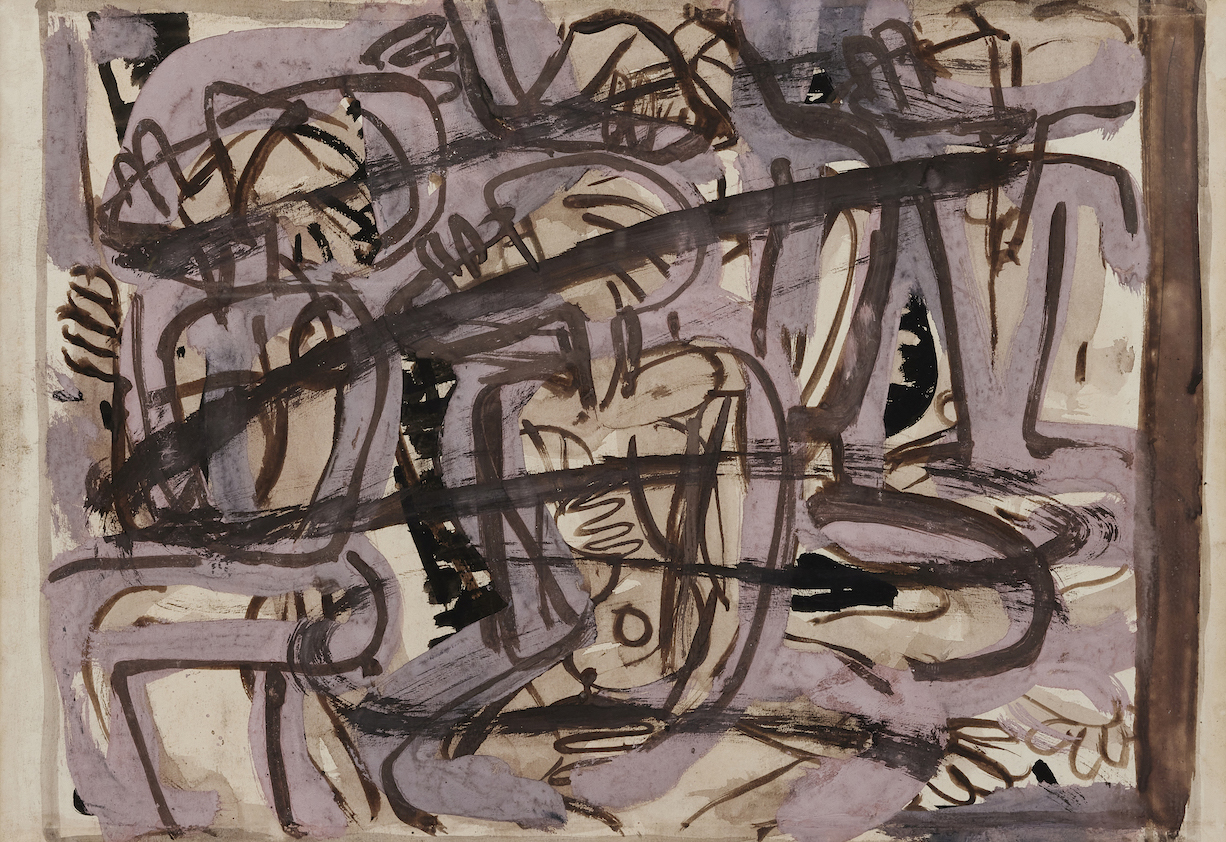
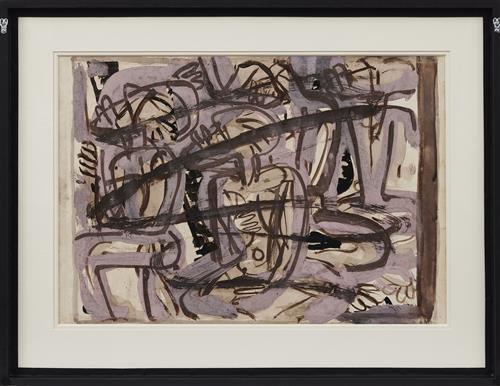
Figure Group c.1950
gouache on paper, double-sided
signed and inscribed lower right in Chinese characters and likely dated: 50
52 x 75cm
Estimate $45,000 - $65,000
Macquarie Galleries, Sydney 1984 (original label retained, accompanied by a copy of purchase receipt)
Private collection, Sydney
© Ian Fairweather/Copyright Agency, 2024
"Painting to me is something of a tightrope act; it is between representation and the other thing - whatever that is. It is difficult to keep one's balance."(1) - Ian Fairweather
In 1929 Ian Fairweather visited China for the first time and its culture, philosophy and imagery continued to inform his artistic practice for the rest of his career. In 1934 he spent two years living in China in poverty and took lessons in calligraphy and Mandarin and studied the teachings of Taoism and Buddhism.
By 1938 Fairweather returned to Australia but took many of these teachings with him. He turned his artistic practice from oil paintings to gouache, often painting on fragile surfaces using a delicate watercolour and gouache on thin cream tissue paper. Drawing with economy and speed, these works on paper often have a fleeting sense of movement and ephemerality to them.
In the present lot this feeling of movement is conveyed by repetitive sweeping curved lines which coalesce into a busy overall graphic. If it weren't for the literal title, the composition may be difficult for a viewer to make sense of. However, with the aid of the title we see these lines coming together to form several figures interwoven in a variety of positions. The image recalls that of Fairweather's work on paper, Pied-à-terre, c.1950, in the Art Gallery of New South Wales. According to the Art Gallery of New South Wales, during the summer of 1950-51, when Fairweather was living in an abandoned patrol boat on the shores of Darwin Harbour, he was at a crossroads both artistically and personally. His art from this period demonstrates that he was wrestling with his identity as an Englishman abroad and an artist whose work was rooted firmly in the Australian landscape. (2)
The compositional elements within Figure Group are characteristic of Fairweather's distinctive style and are present throughout his oeuvre from the mid-century onwards. In these lines we see the influence of Chinese calligraphy, and his appreciation of Chinese language in the signature and inscription in Chinese characters in the lower right corner. In an interview with Craig McGregor in 1968 Fairweather said: The Chinese have quite a different idea of painting from us. The movement, the stroke of the hand counts so much for them. They never draw a straight line. And it's the same for me. It's given me a sensitiveness towards line that I didn't have. (3)
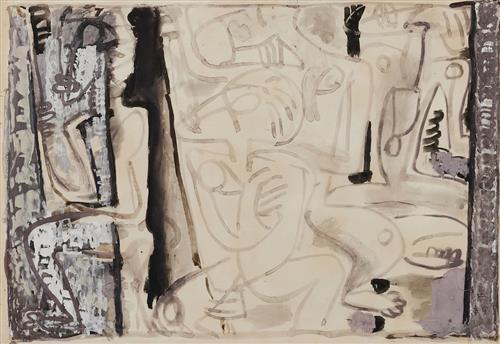
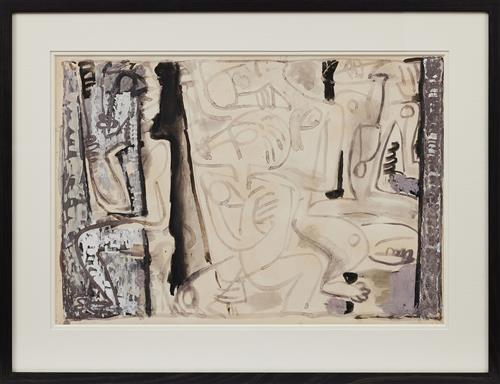
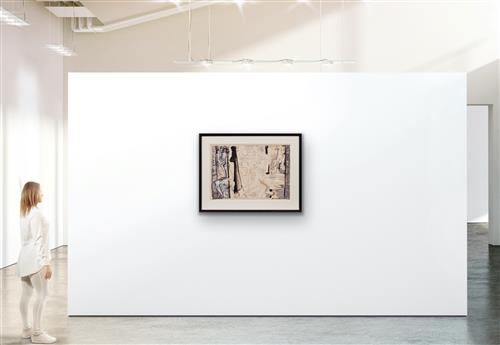
Upon reframing this artwork, it was found to have another previously unknown work on the reverse. This work is unsigned but appears to be a preparatory work for the final piece on the other side. Although the composition appears somewhat complete it seems Fairweather has "crossed out" the image, with several sweeping brush strokes of black ink across the width of the page indicating he was unhappy with its result. It was a surprising discovery which offers a rare insight into the artistic process of one of Australia's most interesting and unique modern painters.
Madeleine Norton
Head of Decorative Arts & Art, Sydney
(1) Ian Fairweather in an interview with Hazel de Berg, National Library of Australia
(2) Australian Art Department, Art Gallery of New South Wales, 2004, Ian Fairweather: Pied-à-terre, https://www.artgallery.nsw.gov.au/collection/works/485.1996/#bibliography
(3) Fairweather, I., 1968, Interview with Craig McGregor, quoted in: Bail, M., Fairweather, Murdoch Books, Sydney, 2009 (revised edition), pp. 269-270
The Art Collector
AUCTION
Sale: LJ8705
6:00pm - 4 December 2023
36-40 Queen Street, Woollahra
VIEWING
Friday 1 - Sunday 3 December, 10am - 4pm
The Bond, 36-40 Queen St, Woollahra NSW
and Dickerson Gallery, 34 Queen St, Woollahra NSW
CONTACT
Madeleine Norton
sydney@leonardjoel.com.au
SIMILAR ITEMS
Lot 5
SIDNEY NOLAN (1917-1992) Mask 1979 oil on canvas 101.5 x 76cm (135 x 109cm framed)
Estimate: $40,000-60,000
Lot 3
JOHN COBURN (1925-2006) The Burning Land 1995 oil on canvas 180 x 160cm (185 x 164cm framed)
Estimate: $40,000-60,000
Lot 13
SIDNEY NOLAN (1917-1992) Mask 1980 oil on canvas 101 x 76cm (135 x 109cm framed)
Estimate: $40,000-60,000
Lot 9
JOHN COBURN (1925-2006) Yellow Landscape with White Bird 2003 oil on canvas 100 x 112cm (104 x 116cm framed)
Estimate: $30,000-40,000