Lot 37
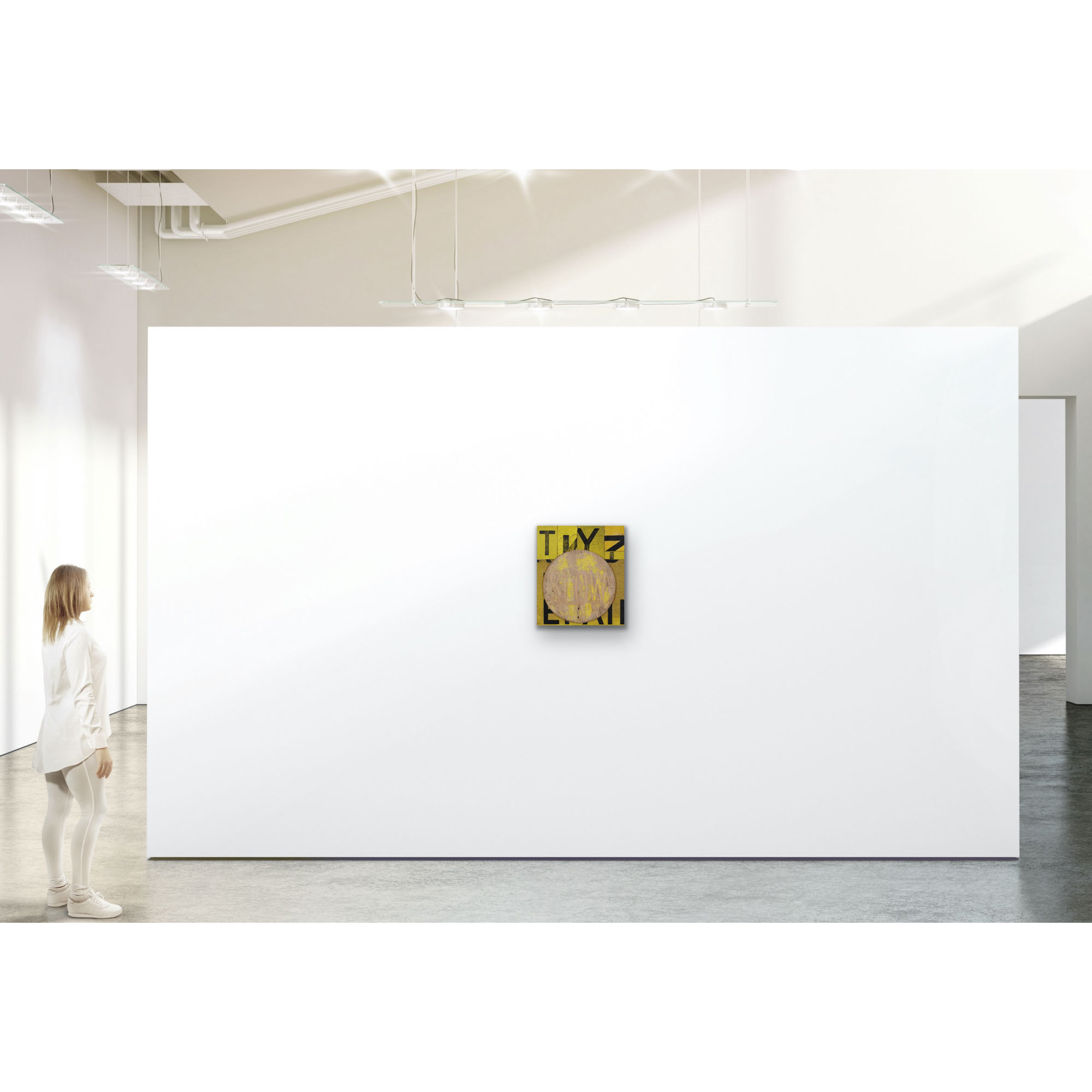
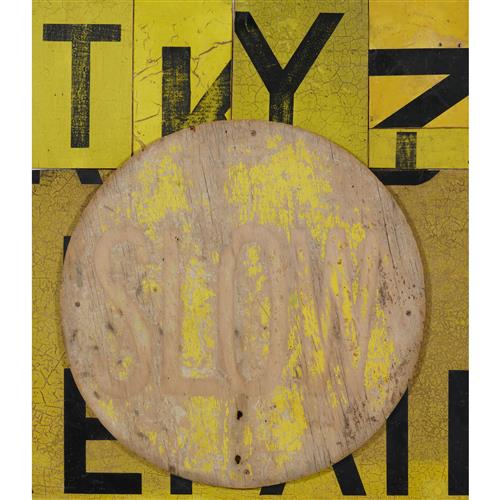
Amber 1992
metal reflective road sign and sawn retroreflective road signs on plywood backing
signed, titled and dated verso: AMBER/ Rosalie Gascoigne/ 1992
62 x 54.5cm
Estimate $30,000 - $50,000
Pinacotheca Gallery, Melbourne
Private collection, Melbourne
Deutscher~Menzies, Sydney, 10 December 1998, lot 26
Private collection, Melbourne
Menzies, Sydney, 24 March 2011, lot 47
Company collection, Melbourne
Menzies, Sydney, 26 March 2015, lot 50
Private collection, Melbourne
Rosalie Gascoigne, Pinacotheca Gallery, Melbourne, 5 - 22 May 1993, cat. no. 8
Gascoigne, M., Rosalie Gascoigne: A Catalogue Raisonné, Australian National University Press, Canberra, 2019, p. 253, cat. no. 424 (illus.)
"My pieces can be looked at in different ways. I try to provide a starting point from which people can let their imaginations wander - what they discover will be the product of their own experience as much as mine. My aim is to be both allusive and elusive." (1) - Rosalie Gascoigne
Rosalie Gascoigne (1917-1999) redefined contemporary assemblage with her innovative use of alternative materials, transforming discarded objects into poetic visual compositions. Drawing inspiration from the Australian landscape, Gascoigne repurposed weathered road signs and timber, corrugated iron, and linoleum, imbuing her works with a raw, yet lyrical sensibility. Gascoigne's signature aesthetic of fragmented text, sun-bleached hues, and rhythmic arrangements, evokes the beauty and desolation of the natural world. Through elevating the everyday into art, she challenges traditional notions of medium and material, cementing her legacy as a pioneering force in Australian contemporary art.
Gascoigne was born in New Zealand in 1917 and moved from Auckland to Canberra in 1943, not long before the outbreak of the second World War. Canberra became a source of great inspiration and it both infused and informed her art over the years to come. Found objects were at the heart of the artist's works; materials such as road signs, sheets of tin, soft drink crates and any discarded materials, were seen as materials of beauty and function to Gascoigne. The artist would spend days searching through local tips and junkyards, foraging for weathered materials she could repurpose for her art. Gascoigne remarked on her process of selecting materials: "I discovered the country dump, which I had been rather prissy about before I started to use anything that looked good to me; you had to have a very selective eye." (2)
From the collected found objects, Gascoigne progressed from working with larger boards, to splitting or sawing the planks of old road signs into strips or small squares and then to assembling panels of these pieces together and gluing them to backing boards, a method evident in this work Amber 1992. The process of her creating, incorporates a dynamic sense of movement, further suggested in her lack of sketches and preplanning - Gascoigne fluidly moved through the artistic process as she prepared and assembled the parts, to create the three-dimensional structures - movement that was an essential part of her act of making.
It was during a visit to one of her local tips that Gascoigne came across the first retroreflective road sign; a material that became synonymous with the artist and one that is present in the artwork Amber. The title of this work, Amber, alludes to the amber traffic signal and the faintly visible words 'SLOW' that are across the middle of the central, circular plywood sign, introduces a subtle play on words and symbolism, reinforcing the meaning and function of the road sign within the composition. The choice of title plays a crucial role in the meaning of Gascoigne's works and she never named a piece until it was complete, allowing time to contemplate with the artwork. This thoughtful process creates a deep connection between the work and its name and invites viewers to engage actively, encouraging personal reflection and imagination.
Gascoigne's artistic practice is rooted in a spiritual connection, using suggestion, metaphor, and association to convey her ideas. Her art is motivated by the formal and evocative power of its material form. (3) Exhibited at Pinacotheca Gallery in Melbourne in 1993, Amber with its sun-bleached assemblage of weathered pieces of yellow, black and retroreflective road signs, feels just as contemporary to viewers today, thirty-two years after its debut.
Gascoigne's artworks capture the essence and sensory experience of the landscape, specifically, the Canberra and Monaro region, which serves as a foundation for her art. While deeply embedded in this environment, her compositions transcend their origins, resonating with broader impressions of the Australian landscape.
Amanda North
Senior Fine Art Specialist
(1)Rosalie Gascoigne: An alternative form of art making, Queensland Art Gallery of Modern Art; https://www.qagoma.qld.gov.au/stories/rosalie-gascoigne-an-alternative-form-of-art-making
(2) Rosalie Gascoigne, cited in Macdonald, V., Rosalie Gascoigne, Regaro, Sydney, p. 28
(3) Edwards, D., Rosalie Gascoigne: Material as Landscape, Art Gallery of New South Wales, Sydney, p. 11
© Rosalie Gascoigne/Copyright Agency, 2025
Centum
AUCTION
Sale: LJ8780
6:00pm - 5 May 2025
Hawthorn
VIEWING
Fri 2 - Sun 4 May, 10am - 4pm
2 Oxley Rd, Hawthorn VIC
CONTACT
Hannah Ryan
hannah.ryan@leonardjoel.com.au
SIMILAR ITEMS
Lot 24
RICK AMOR (born 1948) The City 6am 1989-1990 oil on canvas 129.5 x 162.5cm
Estimate: $80,000-90,000
Lot 53
BEN QUILTY (born 1973) Jm, Humanist, Chairwoman and Rockstar... Keeper of Clarkey 2016 oil on linen 130 x 120cm
Estimate: $35,000-50,000
Lot 49
DALE FRANK (born 1959) Transient Ischemic Attack Painting London 3 (TIAPL3): Sheep get static cling when they rub together: Why are...
Estimate: $35,000-45,000
Lot 34
DEL KATHRYN BARTON (born 1972) Dawn 2009 synthetic polymer paint, gouache, watercolour, pen and ink on canvas 85.5 x 63.5cm
Estimate: $25,000-35,000