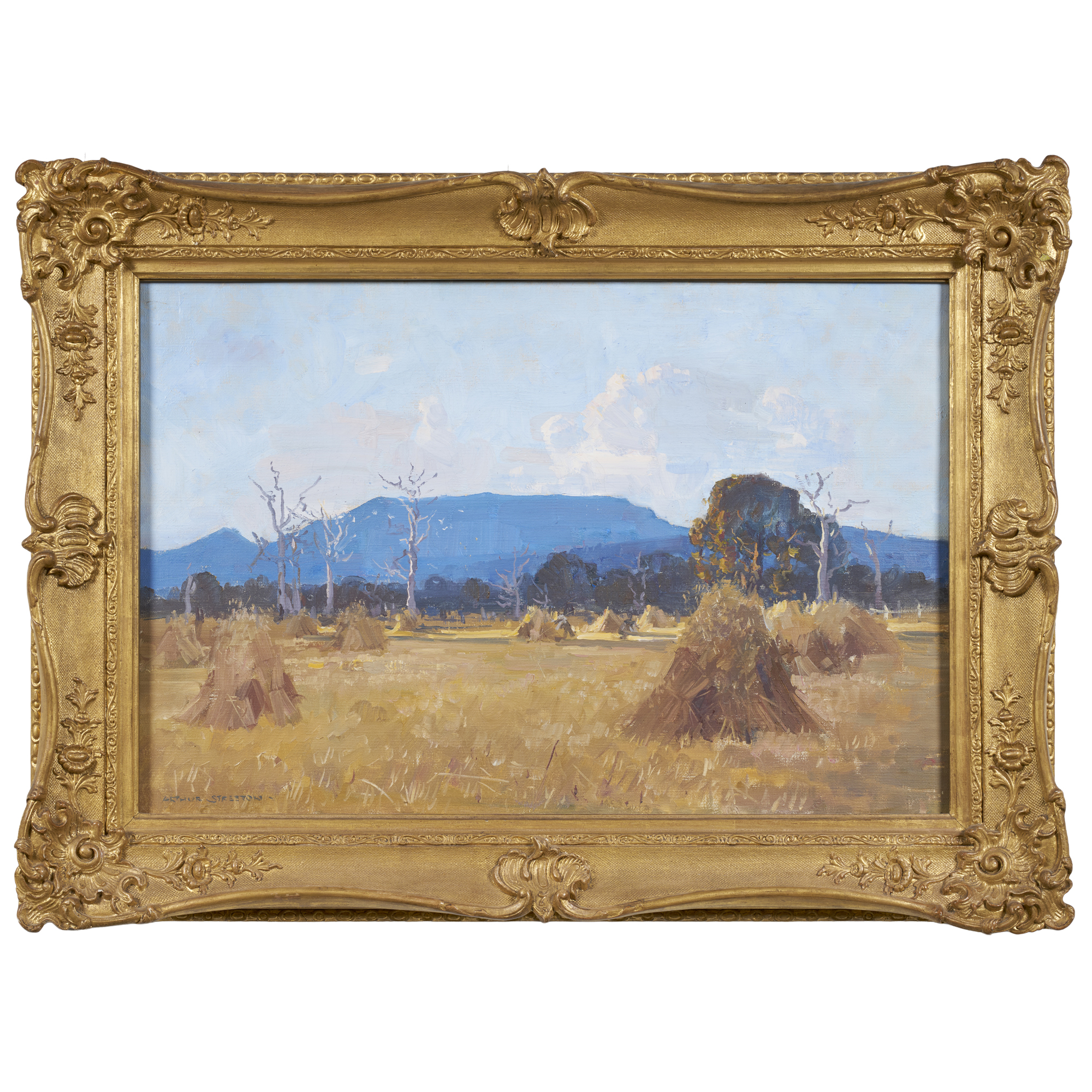
Lot 12
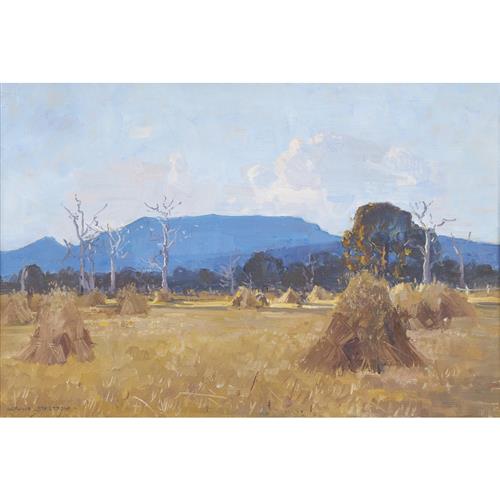
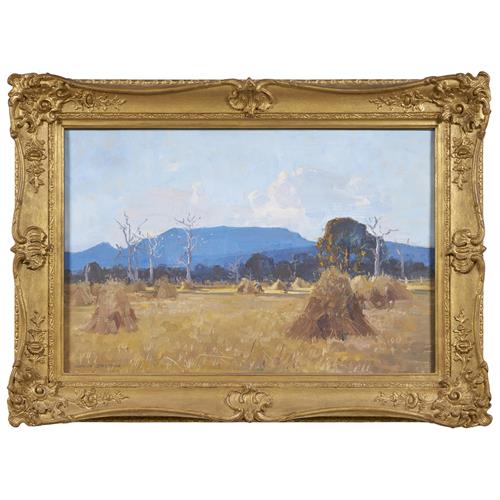
Harvest and Mt. William 1926
oil on canvas
signed lower left: Arthur Streeton
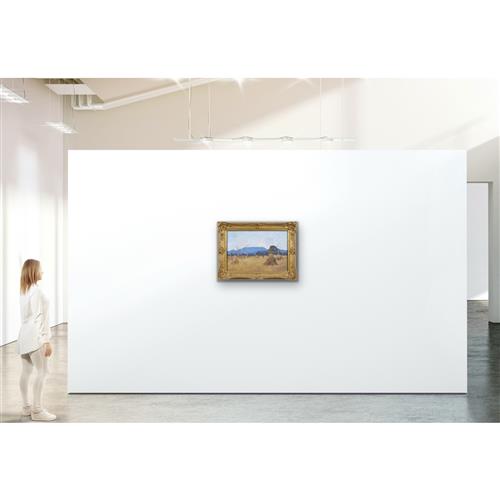
50 x 75cm
Estimate $200,000 - $300,000
The Fine Art Society's Gallery, Melbourne, acquired from the above March 1927 (partial label verso)
The Collection of Mrs. Albert Miller, Melbourne
Thence by descent
Arthur Streeton: An Exhibition of Oil Paintings, The Fine Art Society's Gallery, Melbourne, 15 - 26 March 1927, cat. no. 8
Streeton, A., The Arthur Streeton Catalogue, self published, Melbourne, 1935, cat. no. 900, p.136
RELATED WORKS:
Arthur Streeton, Land of the Golden Fleece 1926, oil on canvas, 49.8 × 75.4cm, the collection of the National Gallery of Victoria
Arthur Streeton, Mt. William (Land of the Golden Fleece) 1926, oil on canvas, 50.6 x 75.9cm, Sotheby's, Sydney, 20 November 2018, lot 33
Arthur Streeton, Oat Harvest, oil on canvas, 62.3 x 75.2cm, Sotheby's, Melbourne, 4 May 2009, lot 3
Arthur Streeton (1867-1943) occupies a central position in the development of Australian landscape painting as both a founding member of the Heidelberg School and as one of the most eloquent interpreters of the pastoral and agricultural environments that came to define Australian national identity in the early twentieth century. Among the most sustained and ambitious phases of his later career are the works inspired by Victoria's Western District. It is this location that Streeton found a subject equal to his mature vision: a landscape shaped by human labour, seasonal rhythms and vast geological presence.
Streeton first engaged deeply with the Western District in the 1920s, a period marked by renewed attention to Australian themes, following his long residence in England and time as a war artist during the First World War. The region's sweeping plains, volcanic soils and dominant ranges, particularly Mount William, provided a setting in which Streeton could merge topographical specificity with symbolic resonance. Artworks from this period frequently celebrated the prosperity and promise of rural Australia, while simultaneously acknowledging the age and endurance of the land. The Western District, with its established pastoral economy and impressive mountain ranges of the Grampians, offered Streeton a landscape encoded with colonial narratives of productivity and improvement. Author Ian Burn wrote about the renewed interest in this subject matter for Australian artist's in the postwar period: "…artists returned to the theme of the Australian landscape with a changed idea of its value and meaning…the war had imbued the landscape with a new power and authority…The masculine ideals of war were used to promote and validate a particular landscape of peace, an ideal of pastoral wealth and national potential".(1) These works acted as a means to reinforce a sense of national pride and identity in Australians, following the suffering experienced as a fallout of the First World War.
Streeton's 'Land of the Golden Fleece' paintings, of which there are three versions (located across the collection of the National Gallery of Victoria in Melbourne, the National Gallery of Australia in Canberra and a private collection in Sydney), represent one of his most explicit engagements with pastoral symbolism. Executed in the early to mid-1920s, these works depict the Western District as a site of abundance and national wealth, drawing upon the classical association between wool production and prosperity. (2) The phrase "golden fleece" itself invokes mythic and economic associations, positioning Australia's wool industry within a heroic narrative of cultivation and reward. The word "fleece" in the title, is both literal, referring to sheep and wool, and symbolic, referring to a settler economy that imagined itself as heroic and future-facing. This reference would have been familiar to an Australian audience who were exposed to the iconic Australian painting by Tom Roberts from 1894 titled 'The Golden Fleece', located in the collection of the Art Gallery of New South Wales.
In these paintings set from the perspective of the Southern end of the Grampians looking towards Mount William, Streeton often adopts elevated viewpoints that allow broad vistas of paddocks, flocks, and distant ranges. His palette is dominated by warm ochres and golds, contrasted by the cool blues and violets of the distant mountains and sky. The brushwork remains broad and confident, favouring atmospheric unity over detailed description, reinforcing a sense of scale and calm authority that characterises Streeton's later style. The use of Mount William as a repeated motif in Streeton's Western District paintings, placed along the horizon line, acts simultaneously as a compositional anchor and a symbolic presence. The mountain's cool tonalities recede gently, enhancing depth while reinforcing the clarity of the Western District light. Its distinctive silhouette, which is low, expansive and fixed, serves as a counterpoint to the changing foregrounds of pasture, harvest and seasonal change. (3) This imagery suggests a mature reconciliation between land and labour: the permanence of nature coexisting with the cyclical nature of agriculture.
The artwork 'Harvest and Mt. William' 1926 (lot 12), exemplifies Streeton's late Western District vision and draws together many of the thematic and formal concerns evident in his Land of the Golden Fleece paintings. The work was included in his show at the Fine Art Society's Gallery in Melbourne in 1927 as catalogue number 8, alongside other key artworks from the Western District, including one of the three versions of 'Land of the Golden Fleece', 'Oat Harvest' and 'Mt. William'. In the work, the composition presents a harvested field scattered with hay stooks, their warm and golden tones dominating the foreground. These forms create a rhythmic pattern across the surface of the canvas, guiding the viewer's eye laterally while reinforcing the sense of abundance and order. Beyond the field, a line of trees, some verdant, others bare, marks the transition between cultivated land and the distant range. The bare trunks of dead trees in the middle ground of the work introduce a melancholic note, subtly complicating the harvest's celebration with a reminder of seasonal change and potential devastation to the land. Mount William rises softly along the horizon, painted in cool blue and violet hues that contrast with the sunlit paddocks below. The sky is expansive and lightly animated with clouds, contributing to the overall sense of clarity and openness that characterises Streeton's Western District artworks.
Visually, Streeton balances solidity and atmosphere: the hay stooks are constructed with firm, textured brushstrokes, while the mountain and sky are treated fluidly, giving the appearance of dissolving gently into light. This contrast in paint application, delineates human presence with the natural, untouched landscape, highlighting the immediate seasonality of paddocks and harvest, whilst drawing attention to the enduring permanence of the mountain and natural landscape. Notably, there are no workers painted among the hay stooks and the absence of these figures does not diminish the sense of labour, rather, the harvested field stands as quiet evidence of human presence and effort.
Whilst championing Mount William, like many of Streeton's Western District paintings, 'Harvest and Mt. William' 1926 (lot 12), differs from the 'Land of the Golden Fleece' paintings by replacing the depiction of a flock of sheep grazing with hay stooks. This substitution is significant through their symbolism of agricultural processes becoming emblematic of national productivity and harmony with the land. Similar motifs appear across his Western District works of the 1920s, where cut fields and stacked hay are presented not as scenes of toil but showing the land at rest between cycles. Streeton reframes the harvest as a visual and symbolic culmination, aligning the rhythms of rural life with the enduring structure of the landscape. The repetition of these motifs suggests not just documentation, but a sustained meditation on Australia's pastoral identity during a period of consolidation and confidence.
Arthur Streeton's Western District paintings represent a significant chapter in his artistic legacy, illuminating a painter deeply engaged with the idea of Australia as both place and promise. Through artworks such as 'Land of the Golden Fleece', his Mount William views, and the present 'Harvest and Mt. William' 1926, Streeton constructs a vision of the land that is expansive, assured, and resonant with cultural meaning. These paintings stand as eloquent affirmations of the Western District's role in shaping both the physical and imaginative landscapes of Australia.
Amanda Hayward (née North)
Senior Fine Art Specialist
1. Burn, I., National Life and Landscapes: Australian Painting 1900 - 1940, Bay Books, Sydney, 1991, pp.79 - 80, quoted in Eagle, M., The Oil Paintings of Arthur Streeton in the National Gallery of Australia, National Gallery of Australia, Canberra, 1994, pp. 186 - 87
2. Galbally, A., Arthur Streeton, Lansdowne Press, Melbourne, 1969, p.72
3. Smith, B., Australian Painting 1788 - 2000, Oxford University Press, Melbourne, 2001
Fine Art
AUCTION
Sale: LJ8806
6:00pm - 17 March 2026
Hawthorn
VIEWING
Fri 13 - Sun 15 March, 11am - 5pm
2 Oxley Rd, Hawthorn VIC
CONTACT
Wiebke Brix
wiebke.brix@leonardjoel.com.au
SIMILAR ITEMS
Lot 30
RUPERT BUNNY (1864-1947) Portrait of Mme B c.1903 oil on canvas 79.5 x 63.5cm
Estimate: $70,000-90,000
Lot 16
NICHOLAS CHEVALIER (1828-1902) Tilling Fields before the Storm 1886 (also known as Storm Clouds Over the Ruhr Valley) oil on canvas...
Estimate: $50,000-70,000
Lot 18
HENRI-EDMOND CROSS (French, 1856-1910) The Bay of Saint-Tropez oil on panel 14 x 23.5cm
Estimate: $50,000-70,000
Lot 27
JOHN OLSEN (1928-2023) Landscape with Lake Rydal 2001 watercolour, pastel and synthetic polymer paint on paper 84 x 95cm
Estimate: $50,000-70,000