Lot 9
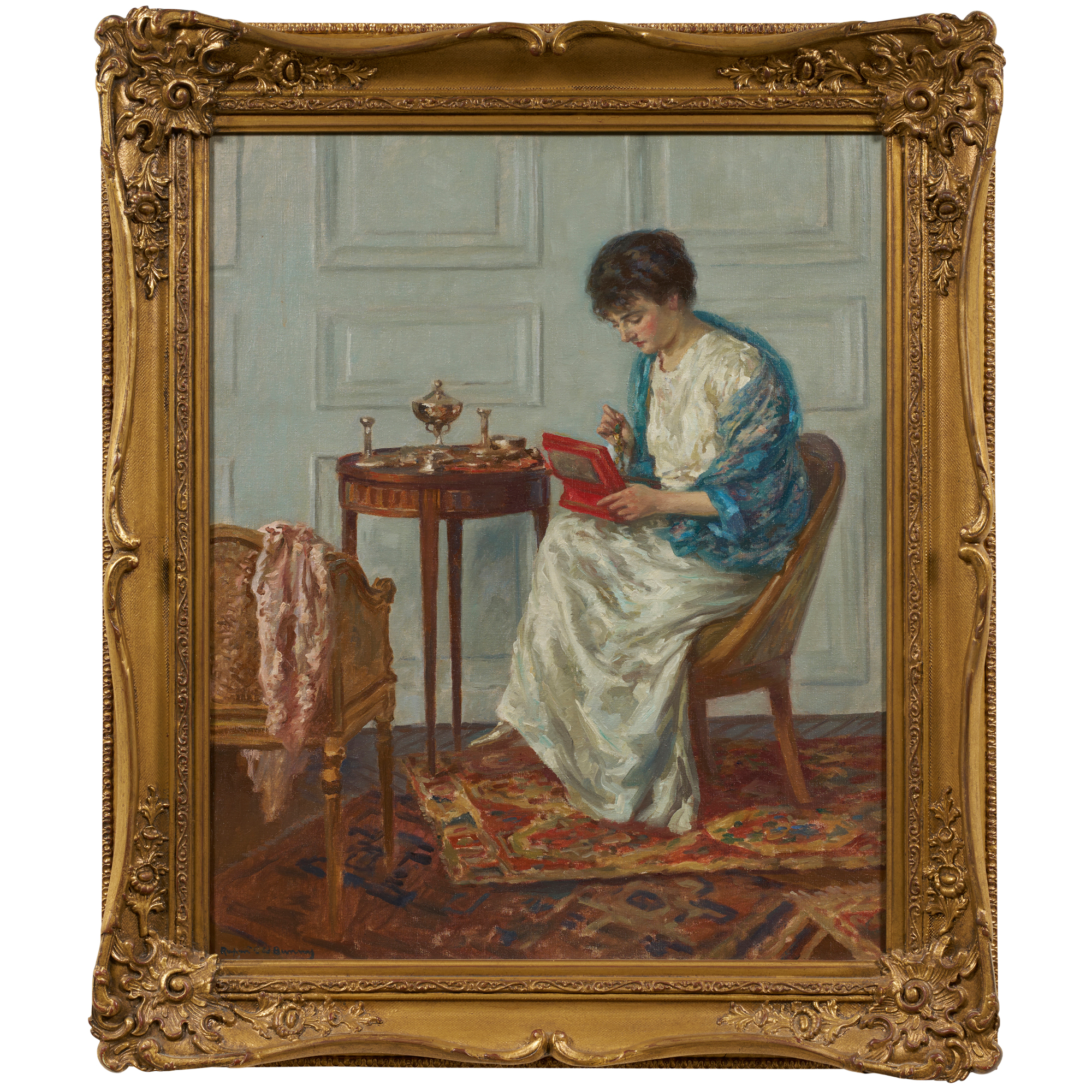
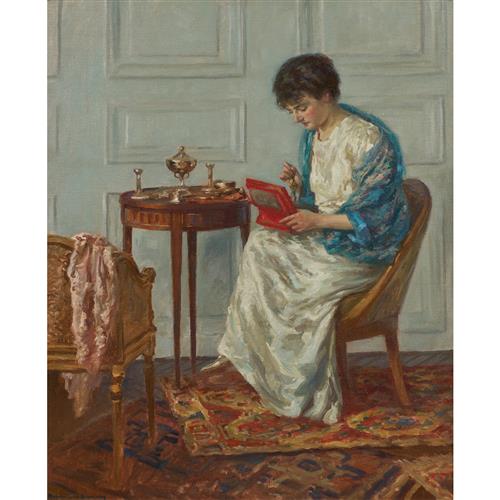
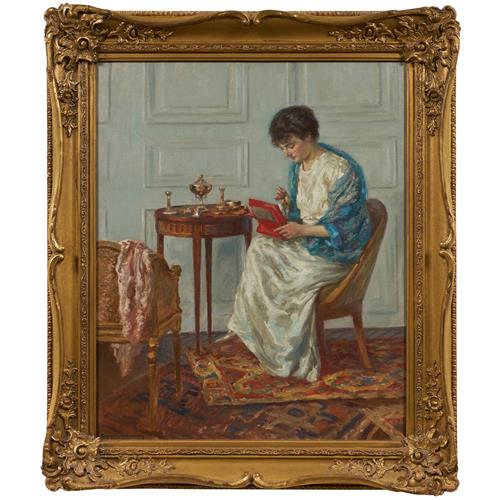
La Cassette (The Casket) 1916
oil on canvas
signed lower left: Rupert C. W. Bunny
73.5 x 60.5cm
Estimate $200,000 - $300,000
The Collection of Dr Robin Sharwood, Melbourne
Joseph Brown Gallery, Melbourne
Private collection, Sydney
Deutscher~Menzies, Melbourne, 25 April 1999, lot 123
Private Collection, Perth
Sotheby's, Melbourne, 20 November 2012, lot 31
Private collection, Adelaide
Rupert C.W. Bunny, Galeries Georges Petit, Paris, 16 - 31 March 1917, cat. no. 42
Exhibition of Paintings by Rupert C.W. Bunny, The Fine Art Society's Gallery, Melbourne, 15 - 27 November 1922, cat. no. 23
An Exhibition of Oil Paintings by Rupert C.W. Bunny, Anthony Hordern & Sons, Sydney, 2-31 May 1923, 50 gns
Thomas, D., Rupert Bunny 1864-1947, Lansdowne Press, Melbourne, 1970, cat. no. O173
-Viewing in Sydney-
Among Australia's most internationally celebrated expatriate artists, Rupert Charles Wulsten Bunny occupied a unique position within art history. While many of his contemporaries sought to capture the changing light and atmosphere of the Australian landscape, Bunny instead established himself within the cosmopolitan world of Paris, becoming one of the few Australian artists to achieve substantial recognition within the French Salon system. His work combined academic refinement with modern sensibilities, producing paintings that are both elegant and psychologically nuanced.
Painted in 1916, 'La Cassette' presents Jeanne Héloïse Morel, Bunny's wife and muse, in a scene of unusual intimacy. Jeanne Morel, whom Bunny met as a fellow art student and later married in March 1902, became a recurring presence in his work from around 1895 onwards. Captivated by her beauty, Bunny portrayed her repeatedly in portraits that range from informal day dress to elegant evening attire, her expressions shifting between dreamy introspection and quiet mystery. (1)
Bunny's close friend and fellow Australian artist John Longstaff who also lived and worked in Paris recalled: "I remember ... the very night they met, and how he fell in love with her at first sight. She was a regular Dresden China girl with a deliciously tip titled nose." (2)
Their meeting appears to have been transformative for both his life, and his art. Jeanne would subsequently become a constant presence throughout Bunny's paintings, appearing in some of his most celebrated compositions. More than simply a model, she became inseparable from his artistic identity.
In 'La Cassette' rather than depicting her as a formal sitter or idealised beauty, Bunny captures her in a private domestic moment, quietly absorbed in the ritual of sorting jewellery and treasured personal possessions. Jeanne sits with her gaze lowered, detached from the viewer and seemingly unaware of observation. The composition therefore moves beyond portraiture and enters a more reflective territory, conveying an atmosphere of stillness and contemplation.
Many of Bunny's earlier depictions of Jeanne present her as an idealised figure, aligning with the artist's fascination with beauty and the decorative aesthetics of the Belle Époque. Works such as 'The Sonata' portray women as dreamlike embodiments of leisure and grace. Yet 'La Cassette' reveals something quieter and more personal. The theatricality and artifice often associated with Salon painting gives way to an intimate domestic setting in which Jeanne appears simply herself.
The decorative sophistication for which Bunny became renowned nevertheless remains evident throughout the work. Pattern and texture unfold across the surface through the richly woven rug, the upholstered chair, the delicate treatment of white fabric and the subtle play of light. As art historian David Hansen has observed, Bunny developed an acclaimed Parisian reputation for depicting elegant women within richly appointed interiors. In 'La Cassette', however, that refinement is balanced by emotional warmth and humanity. Decorative beauty serves not as spectacle, but as a framework for intimacy. (3)
At its heart, 'La Cassette' may be understood as an affectionate portrait of companionship. Rather than presenting Jeanne as an object of admiration alone, Bunny records a quiet moment of everyday life shared between husband and wife. The work reveals a tenderness beneath the polish of his Parisian style and reminds us that some of the most enduring portraits are not those concerned with status or appearance, but those shaped by affection and love.
Wiebke Brix
Head of Art
(1) Thomas, D., Rubert Bunny, Australian Art library, Melbourne, 1970, p. 40.
(2) Murdoch, N., Portrait in Youth of Sir John Longstaff, Angus & Robertson, Sydney, 1948, p. 30.
(3) Hansen, D., Sotheby's, Important Australian & International Art Catalogue, 2012, Melbourne, p. 72.
Fine Art
AUCTION
Sale: LJ8803
6:00pm - 30 June 2026
Hawthorn
VIEWING
SYD (Highlights): Friday 12 - Sunday 14 June, 10am - 4pm
The Bond, 36-40 Queen St, Woollahra NSW
MEL: Fri 26 - Sun 28 June, 11am - 5pm
2 Oxley Rd, Hawthorn VIC
CONTACT
Wiebke Brix
wiebke.brix@leonardjoel.com.au
SIMILAR ITEMS
Lot 8
CLARICE BECKETT (1887-1935) (Mentone Cliffs) c.1932 oil on board 44.5 x 54cm
Estimate: $80,000-100,000
Lot 60
GONKAR GYATSO (Tibetan, born 1961) On First Sunshine 2012 stickers, paper collage and pencil on resin cast sculpture 40 x 46 x 31cm
Estimate: $60,000-90,000
Lot 14
ARTHUR STREETON (1867-1943) Yorkshire 1911 oil on canvas 49.5 x 75cm
Estimate: $60,000-80,000
Lot 19
TOM ROBERTS (1856-1931) Copse in Winter c.1910 oil on canvas on wood panel 35 x 45cm
Estimate: $60,000-80,000