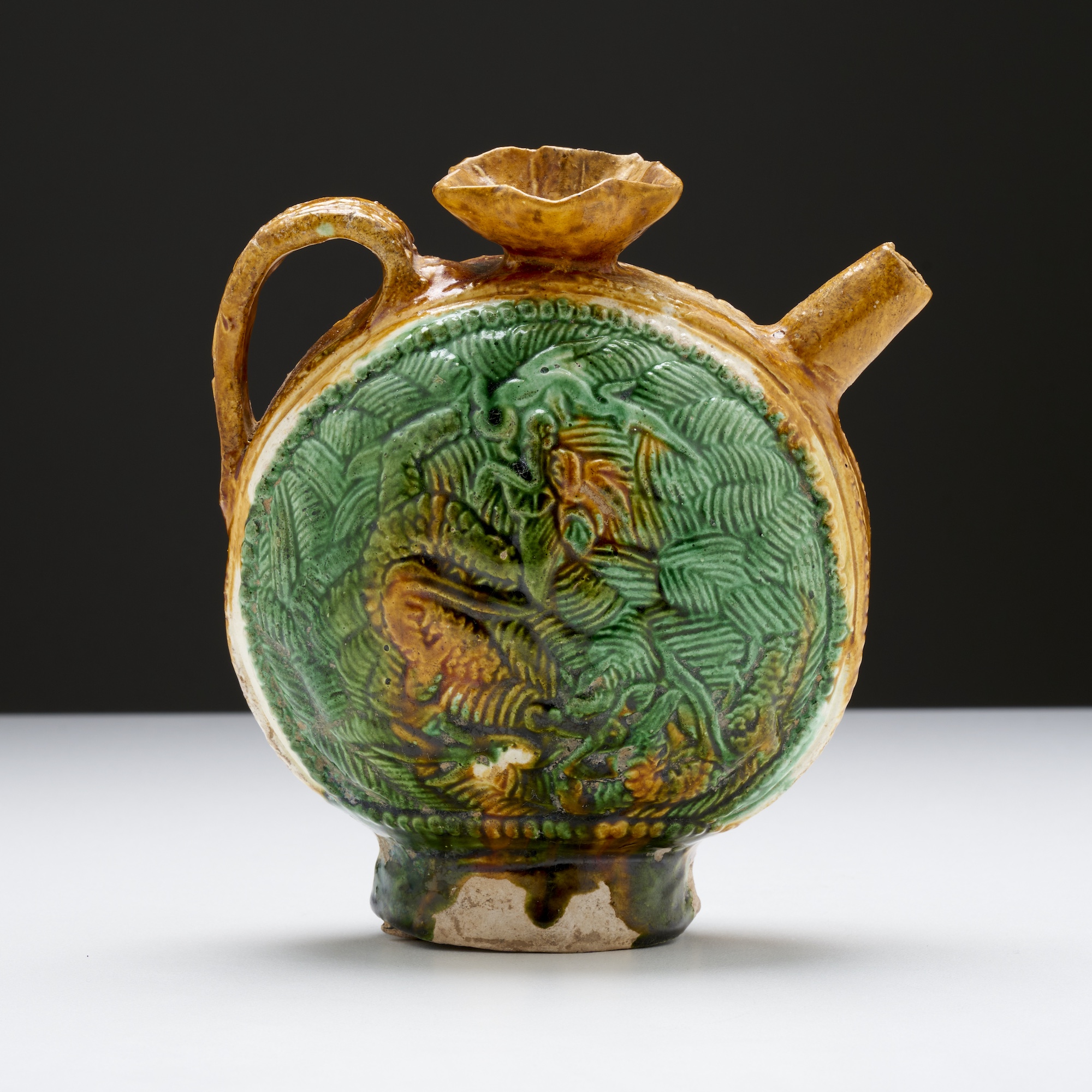
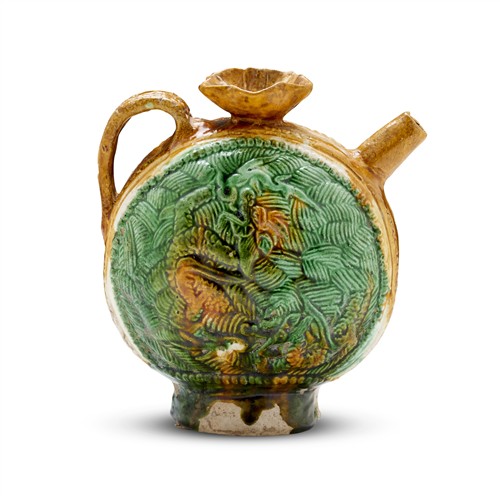
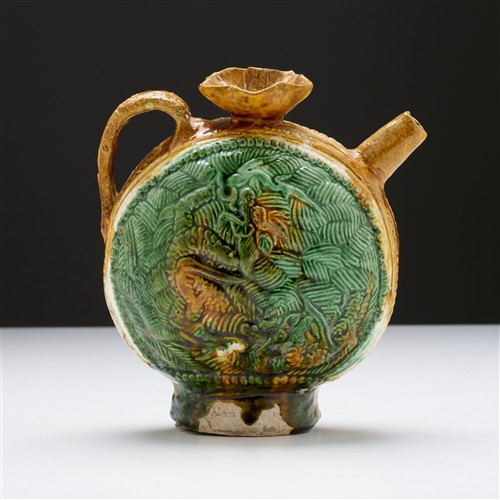
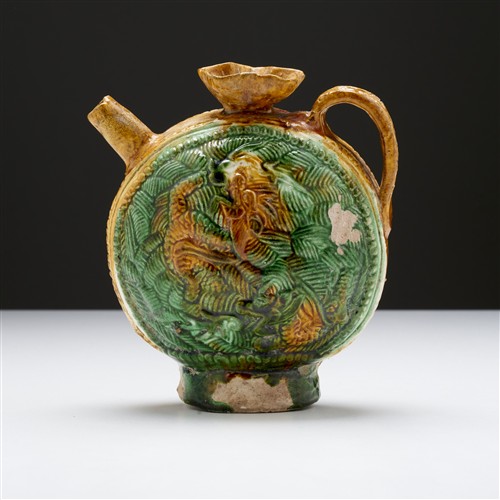
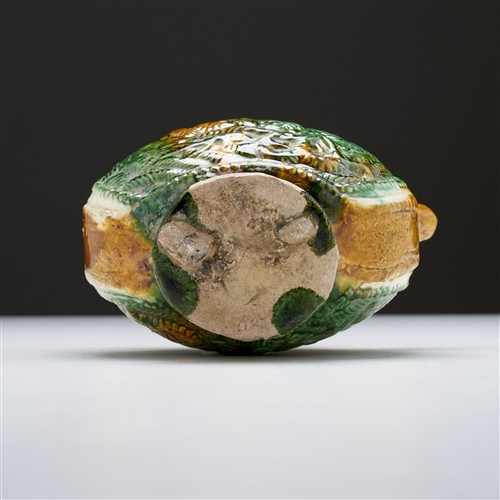
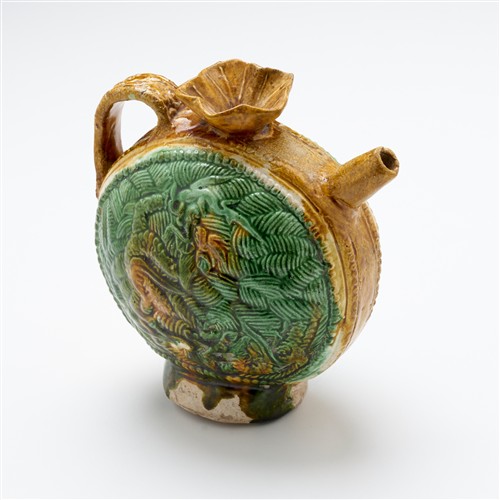
The ewer is modelled with a compressed globular body rising to a flared mouth formed as a lotus leaf with delicately foliate rim. The shoulder is applied with a short spout opposite a strap handle moulded with scrolling foliage. The body is crisply moulded on either side with a pair of lively dragons picked out in amber and green glazes, soaring amidst green-glazed turbulent waves, all framed by double bands of small amber- and green-glazed bosses. A band of upright lotus petals encircles the lower body above the splayed foot. The vibrant sancai glaze falls short of the foot, which is left unglazed in the firing. The ewer is accompanied by a Japanese fitted wooden box, an old photograph, and a collection label from the Hayashibara Museum of Art.
Liao dynasty pottery flasks of this type are rare. A related example decorated in amber and green glazes, but lacking the distinctive lotus leaf-shaped mouth, is preserved in the Liaoning Provincial Museum and illustrated in Zhongguo Taoci Quanji, vol. 9, Shanghai, 2000, pl. 119. Another flask of closely comparable form, similarly embellished with a dragon motif in amber, green and colourless glazes, is illustrated in The Tsui Museum of Art: Chinese Ceramics I, Neolithic to Liao, Hong Kong, 1993, pl. 154. Further examples of this form are held in the collection of the San Antonio Museum of Art, Texas.A related ewer of spherical form, moulded with a comparable dragon-and-lotus design and formerly in the Museum of Chifeng City, was exhibited in Gilded Splendour: Treasures of China's Liao Empire, Asia Society, New York, 2006, cat. no. 91, p. 312. In the accompanying discussion, the author suggests that the iconography may reflect Buddhist influences. For a closely comparable ewer, see the example sold at Sotheby's New York, Chinese Art through the Eye of Sakamoto Goro: Ceramics, 17 March 2015, lot 14.
16.5cm high; 14.5cm wide
Estimate $4,000 - $6,000
The mouth rim has been oversprayed, making it difficult to assess the condition of the underlying area. There is also a firing flaw to one side of the ewer. Otherwise, the piece is in overall good condition.
The opinions expressed in the condition reports are a guide only and should not be treated as a statement of fact. Prospective buyers are encouraged to seek further information or request additional images during our pre-sale period where Leonard Joel staff are available for advice. Please note condition reports can be amended during the pre-sale period, so we strongly suggest any interested bidders check the published condition report available on the website before the auction commences. Leonard Joel makes no guarantee of the originality of mechanical or applied components. Absence of reference to such modifications does not imply that a lot is free from modifications.
Collection of Hayashibara Museum of Art, Okayama.
Important Chinese & Asian Art
AUCTION
Sale: LJ8825
11:00am - 25 October 2026
Hawthorn
VIEWING
Thurs 22 - Sat 24 October, 11am - 5pm
2 Oxley Rd, Hawthorn VIC
CONTACT
Luke Guan
luke.guan@leonardjoel.com.au
SIMILAR ITEMS
Lot 14
A VERY RARE PAIR OF CHINESE FAMILLE ROSE AND GRISAILLE-DECORATED 'LANDSCAPE' STOOLS, YONGZHENG PERIOD (1723 - 1735)
Estimate: $100,000-200,000
Lot 112
A CHINESE HIGH-FIRED WHITE-GLAZED CUP, SUI DYNASTY (581-618)
Estimate: $50,000-80,000
Lot 134
AN EXTREMELY RARE CHINESE HUSHAN WARE OVOID PHOSPHATIC EWER, TANG DYNASTY, 8TH/9TH CENTURY
Estimate: $50,000-70,000
Lot 178
A CHINESE ARCHAIC BRONZE RITUAL VESSEL, ZUN, LATE SHANG/EARLY WESTERN ZHOU DYNASTY, 12TH-10TH CENTURY BCE
Estimate: $50,000-70,000