Lot 128
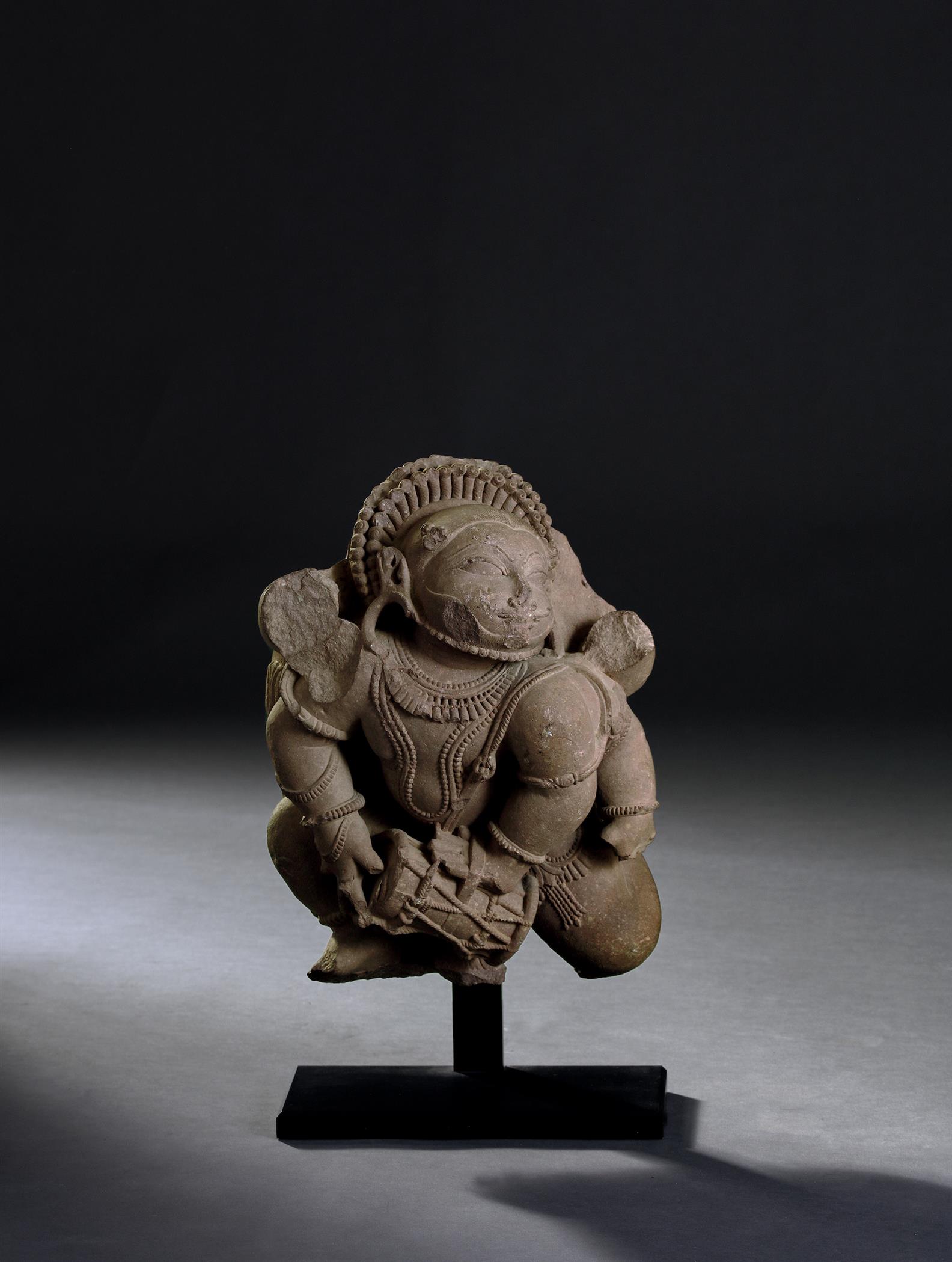
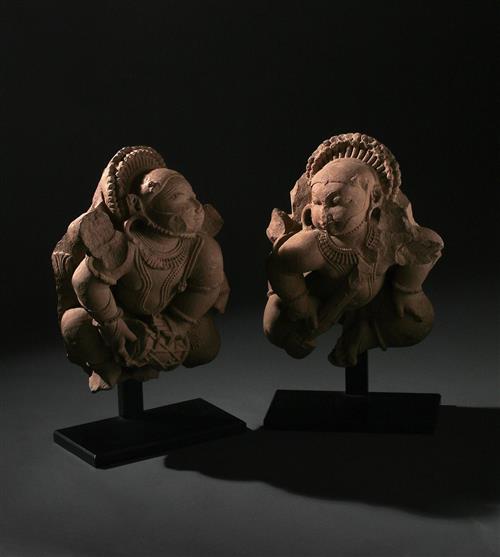
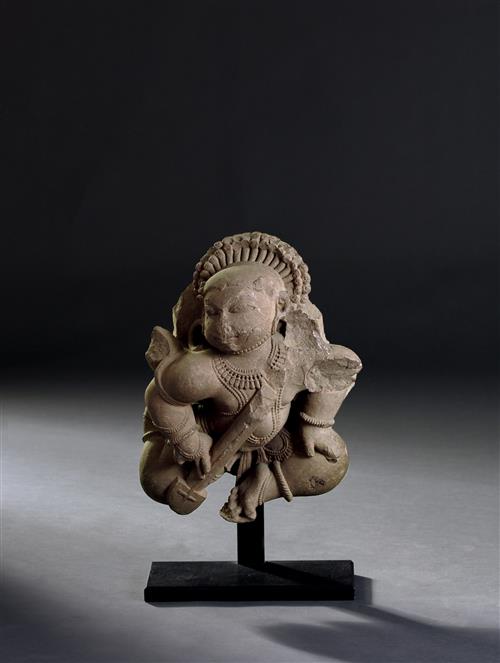
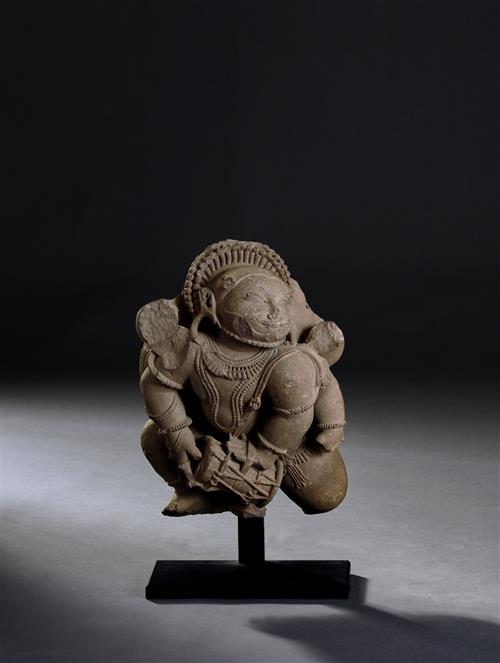
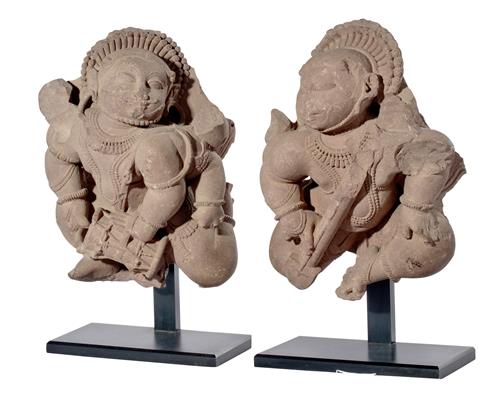
Rajasthan, 12th century, well carved in the round with gently rounded forms, one holding a drum and the other a stringed instrument, both adorned with a festooned belt and multiple necklaces, the faces bearded with large almond-shaped eyes beneath gracefully arched brows, the hair neatly arranged in two rows of spiralling locks.
Height of largest 48cm
Estimate $25,000 - $35,000
Old chips and abrasions throughout, please contact us for further images
The opinions expressed in the condition reports are a guide only and should not be treated as a statement of fact. Prospective buyers are encouraged to physically inspect item, or book a virtual viewing or request further images during our pre-sale period where Leonard Joel staff are available for advice.
Please note condition reports can be amended during the pre-sale period, so we strongly suggest any interested bidders check the published condition report available on the website before the auction commences. Leonard Joel makes no guarantee of the originality of mechanical or applied components. Absence of reference to such modifications does not imply that a lot is free from modifications.
Property from a Private Roman Collection
Christie's New York, Indian and Southeast Asian Art, 21 September 2007 lot 70
These elegant musicians or gandharvas would originally have formed part of the decoration of a Jain or Hindu temple constructed in what is now known as the Solanki style. Between the 11th and 13th centuries the Solanki Dynasty ruled parts of Rajasthan and Gujarat in northwest India and the architecture of temples built at this time was structured with a complex design of repeating projections and recesses, accommodating a multiplicity of sharply carved statues in niches. The display wall and mouldings were adorned with continuous lines of horse riders, elephants, and kirttimukhas. Hardly any segment of the surface was left undecorated.
There are a great many gandharvas in Hindu, Jain and Buddhist mythology and they accompany and entertain the higher gods. The flight of these celestial creatures is suggested by their pose: legs lifted off the ground, knees bent, back legs thrown upward, and the deeply curved bodies billow like sails. One boy is holding a sitar-like stringed instrument; the other, in a similar pose, holds a drum and fragmentary arms suggest that he was part of a larger group. They both wear crisply carved necklaces, armlets and bracelets and their elegant coiffures seem to form halos above their ecstatic faces. Except in the early periods, the Indian sculptor did not use wings to depict flying figures. Instead, he relied upon movement and the posture of the body.
Ronan Sulich | Senior Adviser, Sydney
The Brans Collection
AUCTION
Sale: LJ8444
4:00pm - 21 November 2021
36-40 Queen Street, Woollahra
VIEWING
Viewing in Sydney:
Friday 19 - Saturday 20 November, 10am - 4pm
Sunday 21 November, 10am - 3pm
CONTACT
Madeleine Norton
madeleine.norton@leonardjoel.com.au
SIMILAR ITEMS
Lot 176
*AN ITALIAN ORMOLU-MOUNTED EBONY, ROSEWOOD AND PIETRA DURA INLAID CABINET *CITES permit required for export
Estimate: $200,000-300,000
Lot 34
*A LARGE AUSTRALIAN COLONIAL CEDAR AND ROSE MAHOGANY BREAKFRONT BOOKCASE FOR THE MITCHELL LIBRARY This item is located in Perth, WA...
Estimate: $60,000-80,000
Lot 205
A LIFE-SIZE BRONZE OF THE DRUNKEN SATYR
Estimate: $30,000-50,000
Lot 137
A CHINESE MARBLE SEATED TORSO OF BUDDHA
Estimate: $30,000-40,000