Lot 22
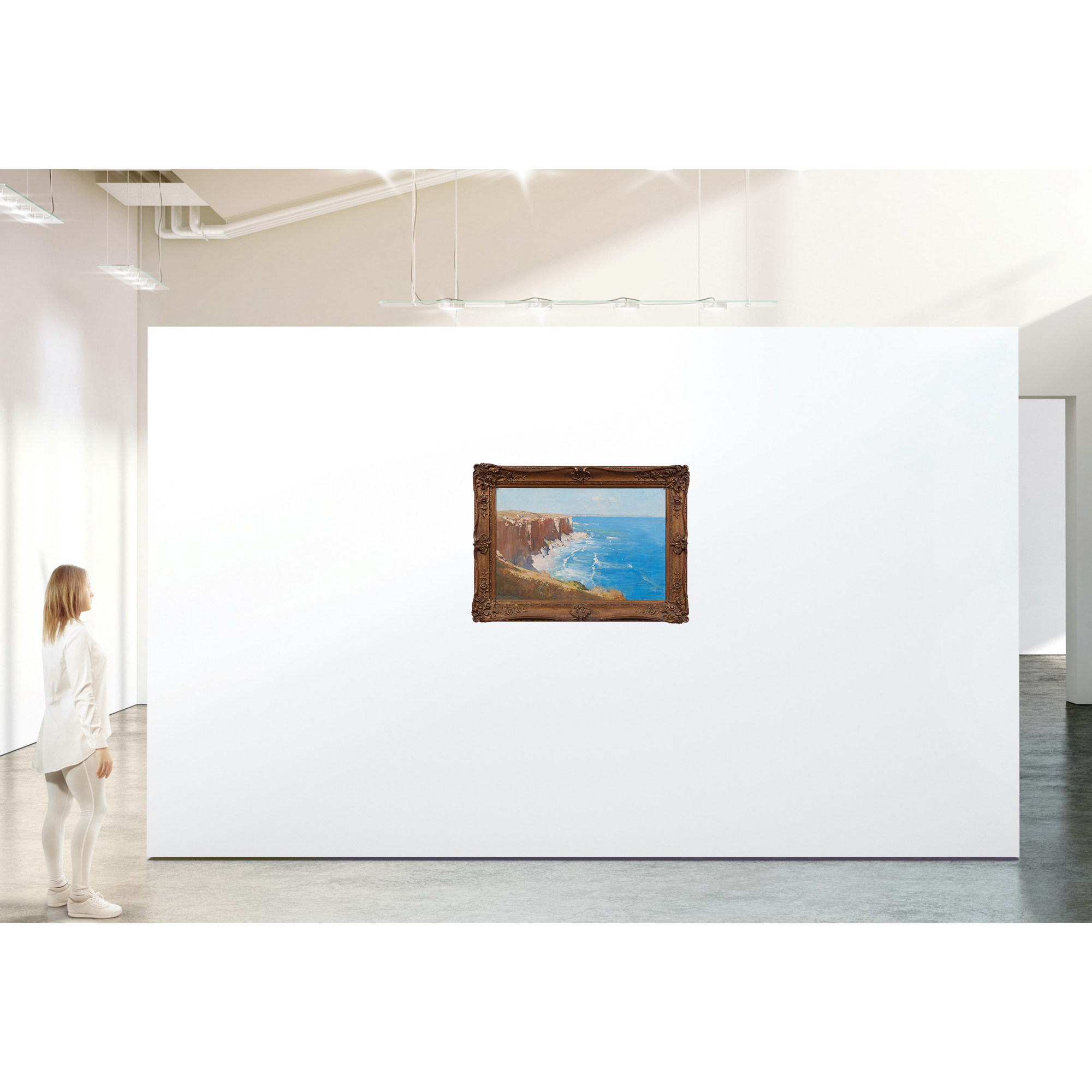
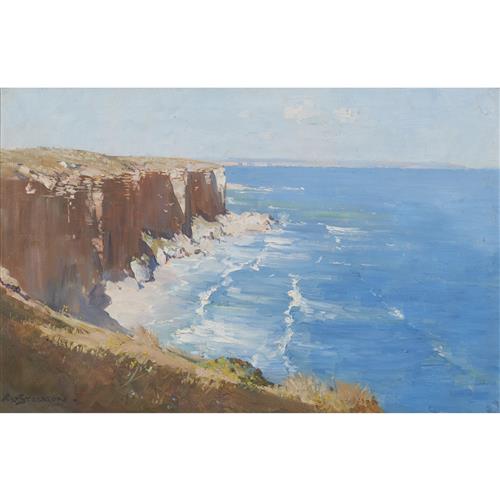
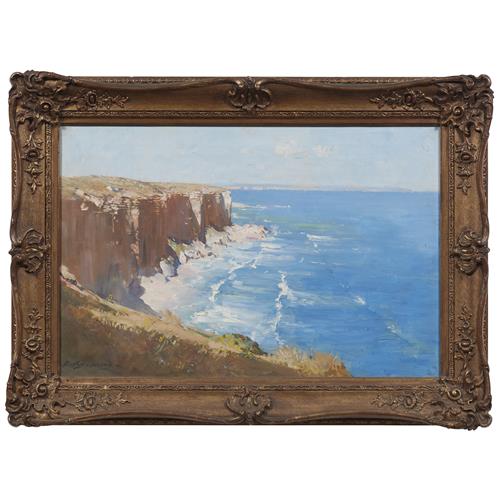
Ramparts Face the Ocean 1932
(also known as Southern Ocean)
oil on canvas
signed lower left: A. STREETON.
inscribed on stretcher bar verso: Southern Ocean Pt. Campbell
inscribed verso: Bill Stephen in appreciation of his services to Lerida
50 x 75cm
Estimate $150,000 - $200,000
David Jones Gallery, Sydney (partial label verso)
Earl Gallery, Geelong 1978
Private collection, Sydney
Sotheby's, Sydney, 15 August 2000, lot 35 (as "Southern Ocean, Port Campbell")
Private collection, Western Australia
Exhibition of Paintings by Arthur Streeton, Fine Arts Gallery, Melbourne, 31 March - 14 April 1932, (as "Ramparts Face the Ocean")
(possibly) A Retrospective Exhibition of Paintings by Arthur Streeton, Athenaeum Gallery, Melbourne, 15 - 26 August 1933, cat. no. 7 (as "Southern Ocean")
Exhibition of Oil Paintings by Arthur Streeton, Athenaeum Gallery, Melbourne, 10 - 22 June 1935, cat. no. 12 (as "Southern Ocean")
Exhibition of Pictures by Sir Arthur Streeton, David Jones Gallery, Sydney, April 1937, cat. no. 10 (as "Southern Ocean")
Arthur Streeton and the Australian Coast, MPRG Mornington Peninsula Regional Gallery, Mornington, 11 December 2004 - 6 March 2005, exhibition curators: Geoffrey Smith and Oliver Streeton, cat. no. 53 (as "Ramparts Face the Ocean")
Land of the Golden Fleece - Arthur Streeton in the Western District, Geelong Gallery, Geelong, 27 February - 13 June 2016, cat. no. 20 (as "Ramparts Face the Ocean")
Streeton, A., The Arthur Streeton Catalogue, self published, Melbourne, 1935, cat. no. 1042 (as "Ramparts Face the Ocean")
Sir Arthur Streeton (1867-1943) is one of Australia's most influential artists, celebrated for his masterly use of tone, colour and light in capturing the atmosphere and mood of the Australian landscape. A prominent figure in Melbourne's 1880s avant-garde, Streeton shaped the visual language of the Australian national imaginary at the dawn of Federation.
Born in Mt Duneed, on the outskirts of Geelong, and raised in Melbourne, Streeton began his career at fifteen when he enrolled in night classes at the National Gallery School, where he studied drawing from 1882 to 1887. Streeton's interest in the temporal qualities of the landscape is evident in his earliest paintings, 'Sandridge' (1884) and 'Harbour Scene' (1884), sketched while captivated by the movement of ships and sailors arriving in Hobson's Bay as he delivered cheques to the docks at Sandridge while working as a young clerk at Rolfe and Co. Ltd.
Without formal training in painting, Streeton's friendships within the bohemian circles of 'Marvellous Melbourne' offered the young artist the critical dialogue and camaraderie essential for his artistic growth. Frederick McCubbin (1855-1917), an instructor at the National Gallery School, became a key mentor to the young artist and was the first to encourage Streeton to start using oil. Both Streeton and McCubbin were members of the Bohemian Sketching Club, which was founded at a Richmond bookstore with artists Louis Abrahams (1852-1903) and Emanuel Phillips-Fox (1865-1915) in 1884. On weekends, the artists would travel to Ivanhoe and Templestowe on the outskirts of Naarm/Melbourne to paint from nature. (1)
Another formative influence was Tom Roberts (1856-1931), who brought the principles of Naturalism and Aestheticism to the colonies after studying at London's Royal Academy. (2) Streeton and Roberts met by chance while painting en plein air at Rickett's Point, Mentone, during the summer of 1886, sparking a lifelong friendship based on shared artistic ambition. Streeton joined Roberts and McCubbin at the Box Hill artists' camp, where he painted 'Settler's Camp' (1888) and 'Pastoral' (1888). The sale of these works allowed Streeton to leave his lithography apprenticeship at Charles Troedel & Co. and focus on painting full-time. (3)
In 1888, Streeton established an artists' camp at Eaglemont, where he was joined by Roberts and the young artist Charles Conder (1868-1901), who had arrived in Naarm/Melbourne from Warrane/Sydney. At Eaglemont, the artists experimented with tone and colour to capture the ephemeral effects of light at dusk. Streeton's deep affection for these formative years in the artists' camps was reflected in a letter to Roberts, written after he relocated to London in 1896:
'… how far back it all seems, yet how clear-every detail and trifle engrained in my brain for life… The Creek, the horehound patch, the black wattle, the messmate, the long open space up to the road, the hurrying up the hill on Sunday evenings with Prof [McCubbin] well to the fore: Heidelberg, the she-oak and sienna dust all over; the straw brown hills; pale Dandenongs… All the loveliness-all a dream!' (4)
It was from these paintings created at the artists' camps in the late 1880s that Streeton, Roberts, Conder, and McCubbin became known as the Heidelberg School. Their experiments culminated in the '9 by 5 Impression Exhibition', held at Buxton's Rooms on Swanston Street in August 1889, after which the close working relationship between the quadrumvirate ended. Conder left for Paris, McCubbin stayed in Melbourne, and Streeton and Roberts joined the Curlew artist colony at Goram Bullagong, where they began their search for a 'national image'. (5)
In Sydney, Streeton's earlier studies of light, characterised by high-key blue and gold tones and thick impasto brushwork, developed into a more monumental style of painting that aligned with the nationalist ideals of pastoral settlerism. As Ian McLean points out, it was in Sydney that Streeton achieved his breakthrough, 'combining the wide, high-horizon format' with a 'vertical movement' that guides the eye up the foreground 'into the glowing band of sky' in the background. (6) Streeton's heroic new style is exemplified in 'The purple noon's transparent might' (1896), which he painted over two days in a 'trance-like state' at the foothills of Colomatta on Dharug Country. (7) In 1916, McCubbin referred to this work as a 'national symbol'. (8)
Following his first solo exhibition in Melbourne, 'The purple noon's transparent might' was acquired by the National Gallery of Victoria in the same year it was painted, providing Streeton the financial means to undertake what had become a rite of passage for many Australian artists of the time: travelling to the 'Centre of the Empire' at age thirty.
Arriving in 1897 after a 5-month visit to Cairo, Streeton's early years in London were 'the most difficult of his life.' (9) Although Streeton had established himself as an Australian painter when Golden Summer, Eaglemont (1889) was exhibited 'on the line' at the Royal Academy in London in 1891, receiving an honourable mention the following year at the Paris Salon, he was eager to outgrow his reputation as a colonial artist. Poor and lonely, he immersed himself in his practice, writing to Roberts: 'I feel convinced that my work hereafter will contain a larger idea and quality than before, after seeing Constable, Turner, Titian, Watts and all the masters.' (10)
Upon discovering that the value of his work had significantly increased over the eight years since he left Australia, his outlook became more optimistic. Streeton returned to Australia in 1906 to build on this momentum, and with the backing of his patron Baldwin Spencer, he organised three successful solo exhibitions in Melbourne and Sydney in 1907. (11) On his return to London via Italy, Streeton began to garner critical attention from local critics. Writing about his Venetian landscapes, a critic in The Observer noted that '...The fact remains that Mr Streeton has caught the opalescence and glitter of the Venetian canals and marble palaces in moments of bright sunshine as few artists have done before him...'(12)
Streeton began building a network of patrons, notably with industrialist Ludwig Mond, who purchased 'The Grand Canal, Venice' (1908) in 1909, and with whom Streeton formed a particularly strong connection. He was introduced to Mond by the Canadian violinist Nora Clench (1867-1938), whom Streeton married in 1908. In May 1913, the Mond family commissioned Streeton to produce a series of twelve to fifteen garden landscapes in Kent, where he travelled with Nora and their young son, Charles Ludwig Oliver Streeton (1911-1977), who was named after the Mond patriarch. (13)
'The Rose Garden' (1913) (Lot 18) belongs to this series, in which Streeton uses the same vertical format characteristic of his monumental bird's-eye-view landscapes. The composition guides the viewer's eye from the garden foreground, through the trees, and into an iridescent, golden-blue sky, reminiscent of the intensity of the Australian heat captured in 'The purple noon's transparent might'. Another work from this series is 'The Lake, Coombe Banks, Surrey' (1913), held by the National Gallery of Victoria.
Streeton stayed in London for 20 years, regularly sending artworks to Australia, before returning permanently in 1923. (14) When he arrived, he was the 'patriarch of national art.' (15) If Streeton's early works, painted in the artists' camps, express the restlessness of youth in his pursuit of a 'national picture', his later works of the Victorian countryside demonstrate his achievements, having cultivated national icons from the expansive plains and vast coastlines.
Free to finally immerse himself in the landscapes he longed for while in England, Streeton travelled across Victoria to paint popular destinations. Critic Noman Lilley described his trip to Port Campbell in early 1932 in the Argus as particularly 'rich in results.' (16) Among the works produced was 'Southern Ocean, Port Campbell' (circa 1932) (Lot 22). Executed in Streeton's characteristic style, with a high horizon line and vivid contrast between the luminous blue ocean and sunlit orange cliffs, the painting reflects Streeton's deep intimacy and affection for coastal landscapes he described in his correspondence with Roberts:
'The ocean is a big wonder, Bulldog. What a great miracle. It's hard to comprehend it, like death and sleep. The slow, immense movement of this expanse moves one very strongly. You're made to clutch the rocks and be delighted, a dreadful heaving and soft eternity.' (17)
Unlike his earlier depictions of the oppressive stillness of drought-affected inland landscapes, 'Southern Ocean, Port Campbell', conveys a sense of optimism and stability that aligns with the mood of regional landscape painting popular during the interwar period. When Streeton exhibited his Port Campbell paintings at the Fine Arts Gallery in April 1932, George Bell praised the 'flowing ease of accomplishment' of his 'sunlit seascapes.' (18) The positive reception was echoed by Harold Herbert, who wrote in The Australasian:
'Technically perfect, they glitter with light and atmosphere. Those red-yellow cliffs of that part of the coast are extremely difficult to paint…Streeton has done it… the undeniable truth remains that Streeton is our greatest landscape painter.' (19)
Alongside his coastal vistas, Streeton exhibited paintings of his beloved gardens at Altadore, his Toorak home and Olinda, his homestead in the Dandenong Ranges. An enthusiastic gardener, Streeton's interest in floral landscapes evolved following his marriage to Nora. (20) Madonnas in a Garden (Lot 3) depicts his garden at Altadore. A row of Madonna lilies, painted with quick brushwork and dappled with sunlight, rise from the lush green foreground into the middle ground. Their white petals contrast with the majestic olive tree, guiding the eye upward to a luminous sky of Streeton's iconic blue, which captures the fleeting brightness of midday light.
In 1929, Streeton became a critic for the Argus and was knighted for his services to art in 1937. For the remainder of his life, he split his time between Altadore and Olinda, nurturing his connection to his home as an artist, tastemaker, and gardener.
Dr Suzannah Henty
Dr Suzannah Henty is the Hugh Ramsay Postdoctoral Fellow at the University of Melbourne, where she also teaches art history.
(1) Ann Galbally, Arthur Streeton (Lansdowne, 1969): 11
(2) David Hansen, 'Naturalism and nationalism: the reception of Arthur Streeton, past and present,' Times Literary Supplement , (no. 6159, 16 April 2021): 14
(3) Galbally, Arthur Streeton, 14
(4) Smith, Australian Painting, 152
(5) Ian McLean, Double Nation: A History Australian Art (Reaktion Books, 2023): 83
(6) McLean, Double Nation, 86
(7) McLean, Double Nation, 83
(8) Frederick McCubbin, The Art of Frederick McCubbin, 1916, in Smith, ed., B., 1975, 274-275
(9) Bernard Smith, Australian Painting 1788-1960 (London: Oxford University Press, 1926): 150
(10) Galbally, Arthur Streeton, 47
(11) The first was held in the Guildhall in Melbourne, April 1907, the second at Market Buildings, Sydney, July 1907; and the final at Bernard's Gallery, Melbourne, October 1907, which sold out in 5 days.
(12) Galbally, Arthur Streeton, 71
(13) Galbally, Arthur Streeton, 76
(14) In 1918, he was appointed as an official war artist, travelling to the Western Front to depict the destruction of war in France and Belgium.
(15) McLean, Double Nation, 124
(16) Norman Lilley, 'Mr Streeton's Mastery: Bush, Sea and Flowers, work of charm exhibited,' The Argus, March 31, 1932, 8
(17) Letter to Tom Roberts, quoted in Croll, R. H., Tom Roberts: Father of Australian Landscape Painting, Robertson and Mullens, Melbourne, 1935, 9
(18) George Bell, 'Sunny Costal Scenes,' The Sun News-Pictorial, 31 March 1932, 11
(19) Harold Herbert, 'Mr Arthur Streeton', The Australasian, 22 June 1935, 16
(20) Streeton loved lilies. In London, he grew Golden-rayed Lily (Lilium auratum) in the small garden of their St John's Wood home, which he painted in Lilium auratum (c.1909), now held in the Art Gallery of New South Wales. After returning to Australia, he continued to grow Madonna Lily (Lilium candidum), Regale Lily (Lilium regale), and Tiger Lily (Lilium lancifolium) in Toorak and Olinda.
A Private Collection of Important Australian Art
AUCTION
Sale: LJ8793
6:00pm - 25 August 2025
Hawthorn
VIEWING
SYD: Thur 14 - Sun 17 Aug, 10am - 4pm
The Bond, 36-40 Queen St, Woollahra, NSW
MELB: Thur 21 - Sun 24 Aug, 10am - 4pm
2 Oxley Rd, Hawthorn, VIC
CONTACT
Wiebke Brix
wiebke.brix@leonardjoel.com.au
SIMILAR ITEMS
Lot 10
FREDERICK MCCUBBIN (1855-1917) The Lime Tree (Yarra River from Kensington Road, South Yarra) 1917 oil on canvas 97 x 110cm
Estimate: $600,000-800,000
Lot 20
RUPERT BUNNY (1864-1947) Portrait de Mme B... c.1914 (also known as Portrait of the Artists Wife) oil on canvas 217 x 107.5cm
Estimate: $300,000-400,000
Lot 17
RUPERT BUNNY (1864-1947) The Sonata c.1910 (also known as La Sonate) oil on canvas 80 x 64cm
Estimate: $200,000-300,000
Lot 23
RUPERT BUNNY (1864-1947) Portrait of Mme B c.1903 oil on canvas 79.5 x 63.5cm
Estimate: $100,000-150,000