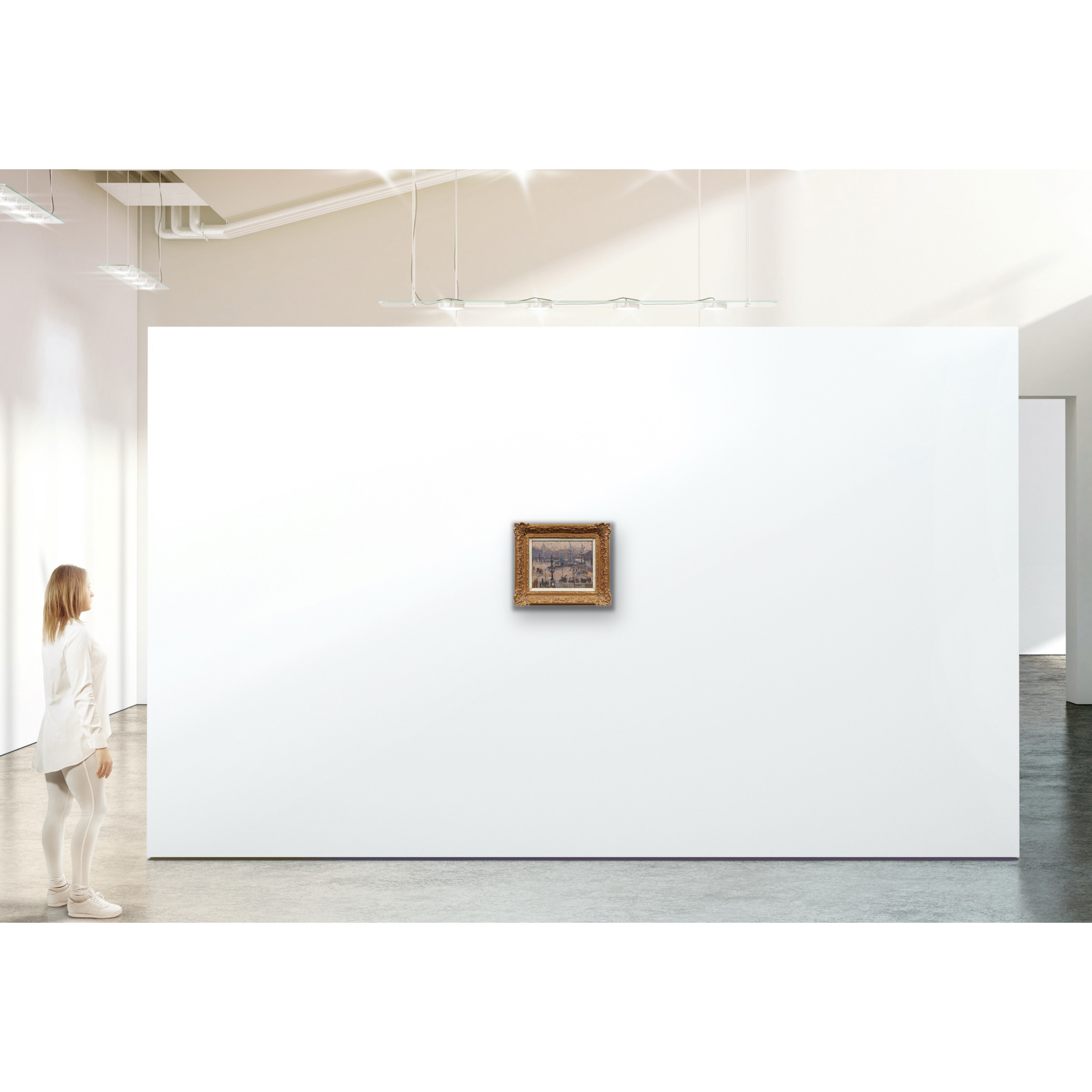
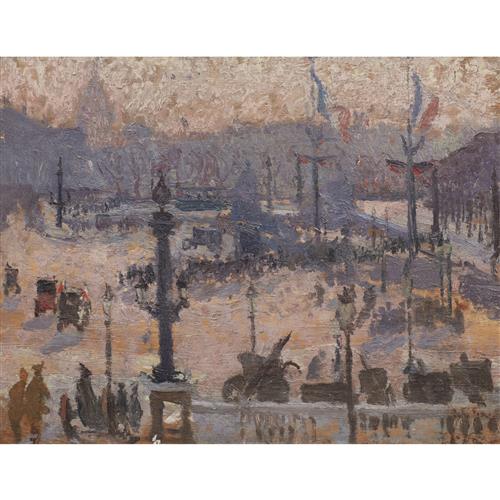
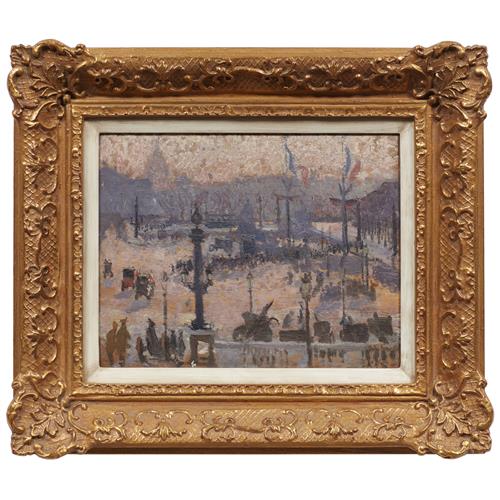
Lot 33
(Place de la Concorde, Paris) c.1918-1919
oil on panel
signed twice indecipherably lower right
26 x 33.5cm
Estimate $30,000 - $40,000
The Collection of John A. Hogan, Melbourne (label verso)
Christie's, Melbourne, 22 August 2000, lot 94 (as "Emanuel Phillips Fox, Place De La Concorde")
Private collection, Western Australia
Spring Exhibition, Kozminsky Galleries, Melbourne, 2000, cat. no. 12 (label verso)
RELATED WORK:
Ethel Carrick Fox, Place de la Concorde c.1918-19, oil on canvas on masonite, private collection and illustrated in Hart, Dr D., (eds), Ethel Carrick 1872-1952, National Gallery Australia, 2024, cat. no. 49, p. 92 (illus.)
Ethel Carrick Fox, The Statue of Strasbourg, Place de la Concorde, Paris 1918, oil on wood panel, private collection and illustrated in Hart, Dr D., (eds), Ethel Carrick 1872-1952, National Gallery Australia, 2024, cat. no. 125, p. 217 (illus.)
Ethel Carrick Fox holds the record for a historic woman artist from settler/European culture in the Australian art auction market, only surpassed by the incomparable Emily Kame Kngwarreye (who has achieved the highest price of any Australian woman artist at auction). (1) Since the expansion of the Australian secondary art market from the 1970s and the slow but steady growth of interest in women artists across the same five decades, individual works by Carrick have consistently attracted attention, yet it was not until 2024-2025 when the NGA presented a transformative career-spanning survey curated by Deborah Hart that the full complexity, richness and coherency of Carrick's diverse oeuvre could be understood. Works were assembled from a multitude of public and private collections across the country and the impact of her long career, and her wide travels became evident.
In the light of this new understanding of Carrick's life and work, the singular importance of her c 1918-1919 view of the Place de la Concorde is now revealed. The picture unites Carrick's personal history of loss and bereavement following the relatively sudden death of her husband in 1915, which came as a shock to friends and family with the larger story of the hardships and privations of civilian life in war-torn France. After organising a major memorial exhibition of her husband's work in Melbourne, Carrick left Australia. Firstly, she spent some time in Britain with a sister who would later lose two sons on the Western Front. At this date Carrick deeply mourned her husband and began her lifelong campaign to promote his art.
Then Carrick moved to Paris, vastly changed from the gracious city of fashion and culture she had left in 1913. Streets and parks of Paris and observing the leisured and wealthy had featured strongly in her pre-war subject matter. Now Parisians faced chronic shortages of fuel and food, coldness and hunger. Carrick replaced her flower garden with potatoes, peas and beans as essential supplies. She also vividly described in the Australian press sheltering from early air raids and bombing attacks with her neighbours. The suffering of civilian and refugee women in Paris were her new reality. She undertook volunteer welfare work and fundraised to provide for women and children, who were displaced and bereaved. Comfort and support of Allied prisoners of war also engaged her energies. Through friends in Australia in both Sydney and Melbourne, including Mrs Herbert Brookes and Ethel Stephens, she sent requests back to Australia for help, goods and funds, for various urgent charities organised out of France. She provided works for Violet Teague's war time fundraising exhibitions in Melbourne and promoted the Allied cause in Australian newspapers, a living witness to the sufferings of the French people. Other Australian artists in Paris such as Rupert Bunny, Bessie Davidson and Etta Phillips were involved in similar voluntary support work for medical and humanitarian needs during the war. (2)
In early 1917 Carrick wrote to Ivy Brookes stating that she had not painted since returning Paris, (3) possibly the combination of personal and public griefs was overwhelming. Yet certainly by 1919 she was again producing work. The war's end was marked by a scene of the statue of Strasbourg bedecked with the French tricolour, celebrating the return of the city to French governance. A light and sun-filled scene of the Place de La Concorde is assumed to represent the upswing of joy and hope at the end of the war. These remarkable scenes of Paris after the armistice are held in private collections and less known to the public than her prewar images.
Amongst these Parisian street scenes, some images with a more sombre gloomy and claustrophobic light, often a slightly yellow smoke-stained fog, would appear to date from before the war's end. A street scene with autumn leaves and a solitary French soldier, immediately recognisable in his horizon blue uniform, suggests September October in either 1917 or 1918 before the war's end. The sober, even melancholy, mood suggests immersion in a war that in 1917 still remained in a stalemate. Likewise, this view of the Place de la Concorde, whilst directly linked to this series of Parisian views, does not suggest the celebration of peace and newly restored territories, but a city under the privations of active defence mobilisation with the range of artillery parked in what in peacetime was a grand plaza in the heart of the city. At least one figure in uniform is clearly recognisable.
This work demonstrates Carrick's love of painting public spaces and public life though broad and rapid brushstrokes. Her brief and economical style equally offers details of form and colour which also capture specific mood and action within the given scene. Carrick is rightly famed for her buoyant, lively scenes of parks and markets, of people relaxed and at play. In presenting a vastly different moment of Parisian life, Carrick shows a depth and empathy, as well as a sense of the historical moment that is unfamiliar. This sense of intentionally recording a historic moment also appears in her writings on her experience in Paris during the war.
Whilst this work has traded previously as a scene of Paris by her husband from c 1890, the profiles of the vehicles and the massed artillery indicate that the painting dates from after Fox's last recorded residence in Paris in 1913. The palette and handling tie in perfectly with the remarkable series of wartime and postwar scenes of Paris produced by Carrick.
Dr Juliette Peers
Dr Juliette Peers is a leading scholar of Australian women artists, with extensive research and publications spanning the period from the 1880s to the 1960s. She taught design history at RMIT University from 1994 to 2019 and has curated projects with public galleries across Australia, Europe, Britain and North America, including roles at the National Gallery of Victoria and McClelland Gallery. An associate curator at Gippsland Art Gallery, she serves on the editorial advisory board of Artlink magazine and has an ongoing collaboration with the Sheila Foundation. Her recent publications include essays for Lesley Dumbrell: Thrum (AGNSW, 2024), Ethel Carrick (NGA, 2024-25), Turner and Australia (Gippsland Art Gallery, 2025), and Keeping Things Together: 50 Years of the Women's Art Register (2025).
1. Jenna Price "Australia's top 12 bestselling women artists - and their biggest sales" Sydney Morning Herald 13 November 2020 Australia's top 12 bestselling women artists - and their biggest sales viewed February 2026
2. Commentaries on Carrick's life during World War One may be found in Deborah Hart "Ethel Carrick's life and art" pp 90-94, Juliette Peers "Friend, Mentor, Inspiration: Carrick's impact on Australian Women" pp226-237 in Deborah Hart ed. Ethel Carrick Canberra: National Gallery of Australia. Juliette Peers Ethel Stephens in Sheila Foundation Into the Light donations 2021 Into the Light: Donor Circle Acquisitions: 2021 - Sheila Foundation
3. Quoted in Catherine Speck "Sorrow and service: Carrick Across the two world wars" in Hart ed p 219
Fine Art
AUCTION
Sale: LJ8806
6:00pm - 17 March 2026
Hawthorn
VIEWING
Fri 13 - Sun 15 March, 11am - 5pm
2 Oxley Rd, Hawthorn VIC
CONTACT
Wiebke Brix
wiebke.brix@leonardjoel.com.au
SIMILAR ITEMS
Lot 12
ARTHUR STREETON (1867-1943) Harvest and Mt. William 1926 oil on canvas 50 x 75cm
Estimate: $200,000-300,000
Lot 30
RUPERT BUNNY (1864-1947) Portrait of Mme B c.1903 oil on canvas 79.5 x 63.5cm
Estimate: $70,000-90,000
Lot 16
NICHOLAS CHEVALIER (1828-1902) Tilling Fields before the Storm 1886 (also known as Storm Clouds Over the Ruhr Valley) oil on canvas...
Estimate: $50,000-70,000
Lot 18
HENRI-EDMOND CROSS (French, 1856-1910) The Bay of Saint-Tropez oil on panel 14 x 23.5cm
Estimate: $50,000-70,000