Lot 12
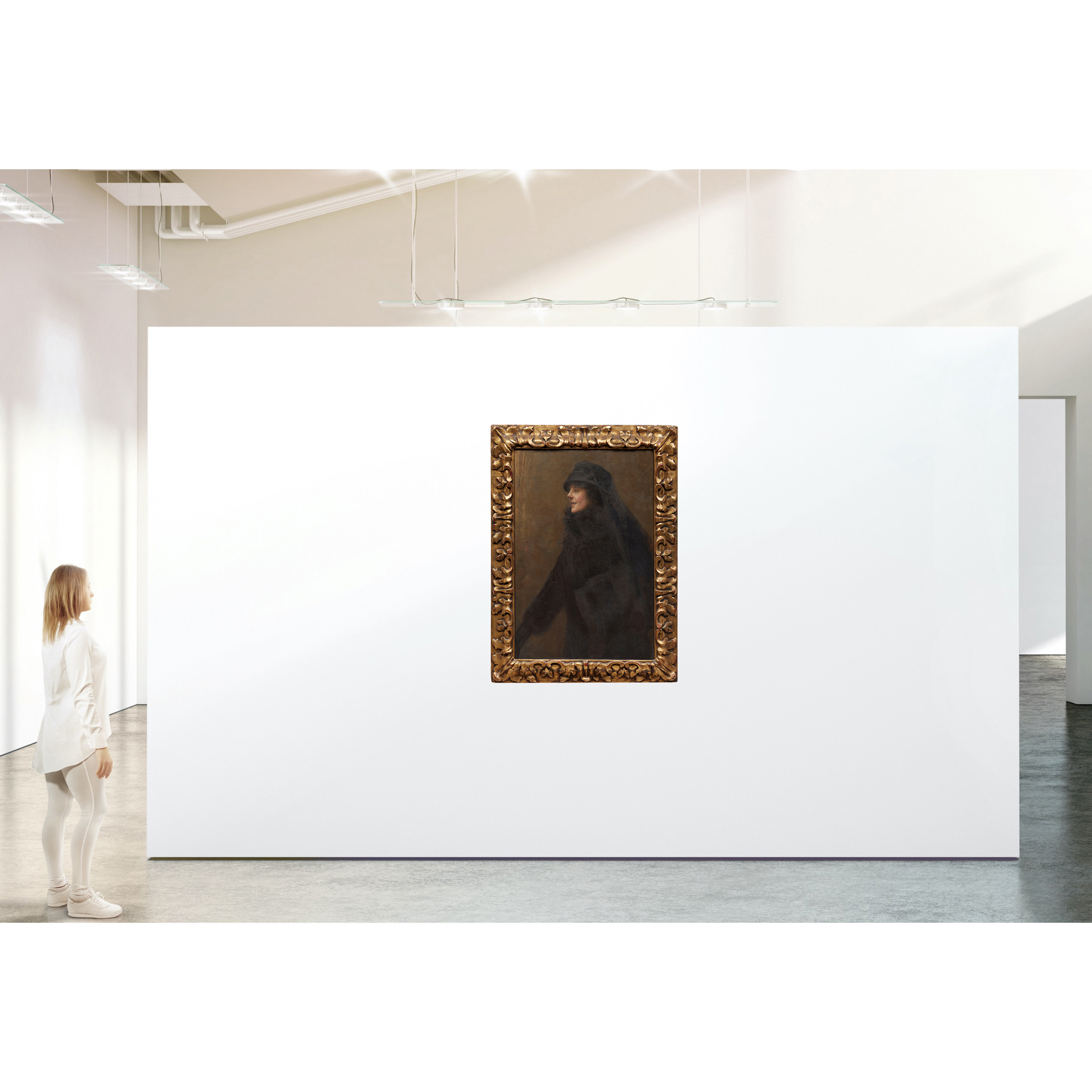
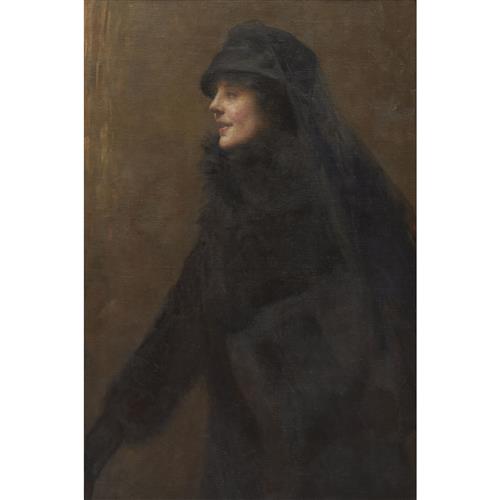
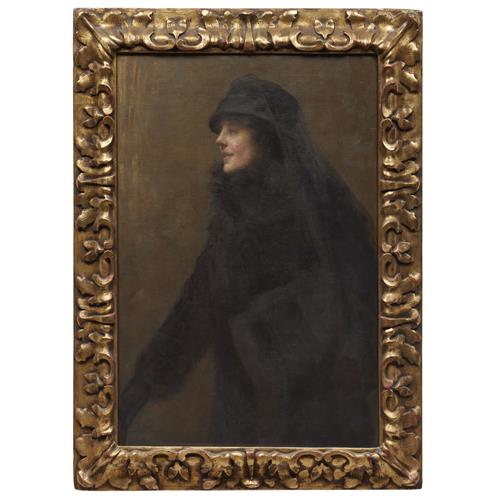
Portrait of Lady Coghlan 1919
(also known as Untitled, Portrait of a Lady)
oil on canvas
in the original Lillie Williamson frame
signed and dated lower left: Tom Roberts 19.
92.5 x 61cm
Estimate $30,000 - $50,000
The Collection of Sir Timothy Coghlan, London
Thence by descent to his son, Austin Coghlan, London
Christie's, Melbourne, 6 March 1970, lot 36
Private collection, Melbourne
Private collection, Western Australia
Topliss, H., Tom Roberts 1856–1931: A Catalogue Raisonné, Oxford University Press, Melbourne, 1985, vol. I, p. 190; vol. II, cat. no. 468, pl. 196 (illus.) (as "Untitled, Portrait of a Lady")
Tom Roberts (1856-1931), his wife Lillie and son Caleb journeyed to London in 1903 accompanied by Roberts's unfinished opus to commemorate the opening of the first federal parliament. Reconnecting with many expat friends, the family remained immersed in the "old country" for many years, Roberts also believing there was greater opportunity for sales of his work. Also present in London were members of his extended family, the demure study of 'Violet Bancroft' (Lot 27) one of a series of portraits of the Bancroft family to whom Roberts was related courtesy of cousin Matilda Iles.
Matilda had married the gregarious Captain Henson Bancroft in 1871 in Melbourne, babies following in quick succession prior to a return to England in 1879 where Violet was born in 1880. Roberts had maintained his association with his cousin's family during his studies at the Royal Academy in the 1880s and welcomed the renewed friendship when he again arrived in London.
It would not have been an easy and cheerful relationship. In 1908 Captain Bancroft died from poisoning after successive bouts of alcoholism, the ignominy of newspaper articles devouring the sordid details leaving his widow and children mortified. In defiance of such shame and to show the strength of family, in 1914 Roberts embarked upon a series of portraits of Matilda and her four daughters. Trauma is variously inscribed upon the faces of the women, Matilda enclosed in black, appearing encumbered by the life and death of her husband.
For the portrait of Violet, rather than continue the theme of mourning he had employed for her mother, Roberts chooses to present her dressed for a social gathering. A slight tilt forward of the head, gleaming hair clip, delicate string of pearls and white flower pinned upon filmic black chiffon, all enhanced by blushing cheeks, are the accoutrements for a joyous society portrait. But Violet's eyes cannot escape Roberts's probing brush, sadness beset within the distant gaze, the daughter reflecting the mother's trauma. It is an intriguing portrait.
The mood shifts dramatically with the 'Portrait of Lady Coghlan' 1919 (née Helena (Lena) Donnelly) whereby Roberts returns to one of his favourite motifs of situating women in urban spaces as a sign of modernity. Lady Coghlan wears a most fashionable black walking costume defined by a luxurious high-collared fur coat, black, according to Robert Leong, 'a sartorial talisman for negotiating the shifting labyrinths of the city.' (1) Her costume is complete with a stylish winter hat and veil, a sign of her standing within London society, while her luminous skin glistens in the cold London air against Roberts's taupe shaded background.
Lady Coghlan was one of 13 children born into a long-serving Australian political family. She was the daughter of Cowra MLA Denis Donnelly and his wife Ellen, while Ellen's father, William Cummings, was a member of the NSW parliament. The Irish Denis arrived in Australia to seek his fortune during the goldrush, spending time in Ballarat, that association influencing the later choice of Loreto's Mary Mount for his daughters' schooling. Established to provide a rounded education for girls, it was a perfect start for Lena Donnelly. While two of her sisters joined the Loreto order, she returned to the Cowra district and entered society.
Lena Donnelly's marriage to the government statistician, Timothy Coghlan, a principled and forthright public servant, was recorded in the local society pages, but with his appointment as Australia's agent general in 1905, she was projected into the bustle of twentieth century London. Roberts and Lillie became part of the Coghlan's social circle, were regularly documented as attending their soirees and luncheon parties, and Timothy provided space for Roberts's Sloane Street studio.
Lady Coghlan's support for the broader acknowledgement of Australian artists was boundless and she used every opportunity to promote and showcase their work. She presided over the committee to organise the London version of the 1907 Australian Women's Work Exhibition, Lillie exhibiting her gilded frames with one fortuitously purchased by Princess Louise (daughter of Queen Victoria). The purchase was widely discussed and initiated a period of increased patronage of her work.
As a thank you to their friendship during the war years, Roberts painted portraits of Sir Timothy and Lady Coghlan in 1919, the portrait of Timothy a conservative though relaxed portrait of a treasured friend. For his portrait of Lady Coghlan, Roberts embraces his love of costume and employs it to convey context and movement, her autonomy suggesting she has no time for a studio sitting. Indeed, in later years Lady Coghlan promoted a sense of freedom, the aeroplane as a means of transport her favourite, and she encouraged women to see the world. Roberts makes clear that her engagement with the external world equates to a masculine-styled flâneur, harking back to his pastel portraits of walking women from the late nineteenth century. He also draws upon his love of the profile portrait, The Paris Hat (New England Regional Art Museum, 1892) and Eileen (Art Gallery of NSW, 1892) typical of his use of the device to convey friendship and the interior reflection of a woman.
The 'Portrait of Lady Coghlan' 1919 is bordered by an extraordinary gilded and hand carved frame by Lillie. The spectacular art nouveau frame creates a truly alluring picture, the tenderness of the portrait and richly decorated frame an incomparable present for a treasured friend. Although smaller in size, the frame is not dissimilar to the one carved for Roberts's Penelope (1919) held in the National Gallery of Victoria, the only frame by Lillie held in the collection.
With the end of the war, Roberts journeyed back to Australia for a year in 1919 and was again drawn to the countryside, beginning a body of work brought to fruition when he and Lillie returned permanently in 1923. They bought a house in the Dandenong Ranges, and Roberts commenced studies of his surrounds, gradually bringing to light the drama of sparsely vegetated majestic hills and lush gorges. They are quiet reflective pictures, 'Dandenongs Landscape' (Lot 6) typical of Roberts's ability to convey his deep respect for the defining motifs of the Australian bush. Two lurching gum trees dominate the composition while the remainder of the canvas is governed by his favoured palette of muted tones. Dotted with the occasional tree, bleached hills stream towards the sky, his work at the time described by Jessie Traill as
"thought-out gentle landscapes - they seemed removed from hurry; they had a joy and love in them."(2) Indeed, it could be considered that love, respect and commitment are the abiding themes of all three of the works by Roberts.
Dr Julie Cotter
Dr Julie Cotter is the author of three books, has worked as a lecturer and in public policy roles, written and presented documentaries, is widely published in a range of journals, magazines and catalogues and has been a member of many public art and grant committees. Her book, Tom Roberts and the Art of Portraiture (Thames & Hudson 2015), was shortlisted for the 2016 Prime Minister's Literary Award for nonfiction. Her most recent book is Portia Geach: Portrait of an Activist (Joyce Press 2024). It tells the story of the first Australian woman to be admitted to the Royal Academy of the Arts.
(1) Leong R, "Black and the City," in Robert Leong, et al., Black in fashion: Mourning to Night, Melbourne, Trustees of the National Gallery of Victoria, p.40.
(2) Robert Henderson Croll, Tom Roberts: Father of Australian Landscape Painting, Melbourne, Robertson & Mullens Ltd, 1935, p.123.
OTHER NOTES - FRAME
The frame surrounding 'Portrait of Lady Coghlan' 1919 is a rare example of early twentieth-century Australian frame-making and one of the few that can be attributed to Elizabeth ('Lillie') Williamson, Tom Roberts's wife.
Williamson, whose contribution to Australian and British frame-making has only recently begun to be acknowledged, was carving frames for Roberts as early as the 1890s. During their years in London, she became a highly respected craftswoman, exhibiting widely.
This carved, richly ornamented frame exemplifies the English Arts and Crafts aesthetic, with organic forms, beautiful ornamentation, and balanced proportions the frame stands out to be made in a very distinctive and unique manner. It not only enhances the visual harmony of the portrait it surrounds but also reflects the collaborative relationship between Roberts and Williamson. It occurs that the portrait and frame are also chosen in gratitude to the sitter Lady Lena and her husband Timothy Coghlan who were great supporters of the arts and Tom Roberts. This beautiful collaboration is as a sign of deep friendship between the philanthropists and artists.
© Tom Roberts/Copyright Agency 2025
A Private Collection of Important Australian Art
AUCTION
Sale: LJ8793
6:00pm - 25 August 2025
Hawthorn
VIEWING
SYD: Thur 14 - Sun 17 Aug, 10am - 4pm
The Bond, 36-40 Queen St, Woollahra, NSW
MELB: Thur 21 - Sun 24 Aug, 10am - 4pm
2 Oxley Rd, Hawthorn, VIC
CONTACT
Wiebke Brix
wiebke.brix@leonardjoel.com.au
SIMILAR ITEMS
Lot 10
FREDERICK MCCUBBIN (1855-1917) The Lime Tree (Yarra River from Kensington Road, South Yarra) 1917 oil on canvas 97 x 110cm
Estimate: $600,000-800,000
Lot 20
RUPERT BUNNY (1864-1947) Portrait de Mme B... c.1914 (also known as Portrait of the Artists Wife) oil on canvas 217 x 107.5cm
Estimate: $300,000-400,000
Lot 17
RUPERT BUNNY (1864-1947) The Sonata c.1910 (also known as La Sonate) oil on canvas 80 x 64cm
Estimate: $200,000-300,000
Lot 22
ARTHUR STREETON (1867-1943) Ramparts Face the Ocean 1932 (also known as Southern Ocean) oil on canvas 50 x 75cm
Estimate: $150,000-200,000