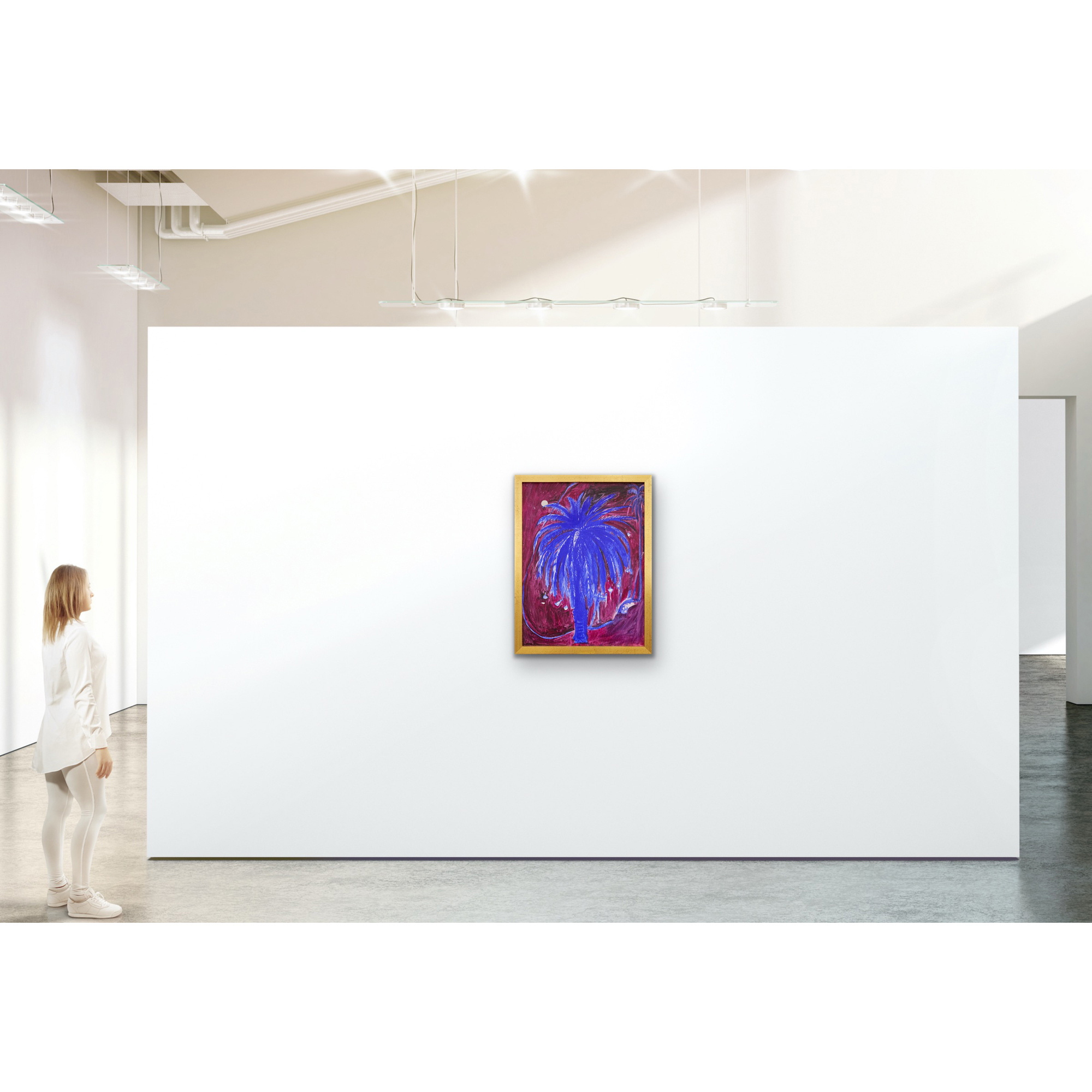

Lot 13
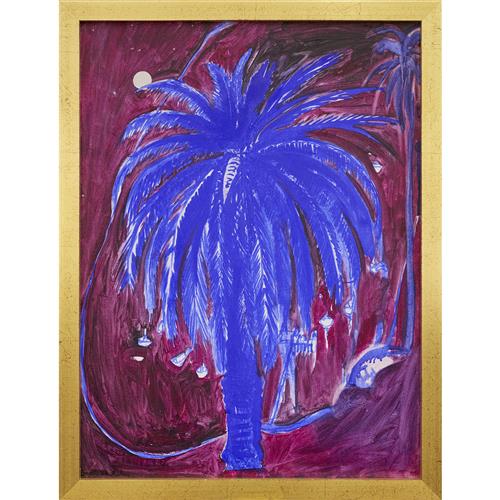
Midnight at Lavender Bay c.1991
oil on canvas
signed lower left: brett whiteley
60 x 46cm
Estimate $150,000 - $200,000
(probably) Robin Gibson Gallery, Sydney 1991
Private collection, Sydney
(probably) Brett Whiteley, Robin Gibson Gallery, Sydney, 12 - 30 October 1991 (no catalogue)
This work will appear in the addendum to Sutherland, K, Brett Whiteley: Catalogue Raisonné, Schwartz City, Melbourne, 2020, as cat. no. 100.91
This painting was authenticated by Wendy Whiteley in July 2025. We are grateful to Kathie Sutherland for her assistance in cataloguing this work.
RELATED WORKS:
Brett Whiteley, Orange Palm and Lavender Bay (Small Version) 1991 (Sutherland, K, Brett Whiteley: Catalogue Raisonné, cat. no. 98.91)
Brett Whiteley, The Pier at Lavender Bay 1991, oil on canvas. Private collection. (Sutherland, K, Brett Whiteley: Catalogue Raisonné, cat. no. 99.91)
In the middle of the twentieth century, when Australian art began to exude its first collective aroma of international uniqueness, Brett Whiteley was the most mercurial and spectacularly ambitious amongst an impressive contingent of contemporary antipodean painters then beginning to make an impact on the world stage.
With outrageous energy and chutzpa, he conquered all before him, art lovers, collectors, critics and museums, spellbound. Including London's Tate Gallery, which acquired one of his earliest abstractions in 1961, just one year after his arrival from Sydney to take up a travelling scholarship in Italy, awarded no less than by Russell Drysdale in 1959. (1) On the tidal wave of which, establishing a decade of residence in England before returning home, he was in fact amongst the youngest ever to be recognised as such by the Tate in its entire history.
On the eve of his departure from Australia in 1960 aged twenty-one, his precocious curiosity had already unleashed a fierce intention of becoming regarded as a serious painter, through a super-charged exploration of not only techniques, but also the very essence of charisma in his artist heroes, as he wrote to his father Clem upon arriving in Europe:
"I am now in Modigliani's country. This has been my secret, strange and abnormally mystical ambition, to sit alone…to retire entirely from everything and everyone that is important - and allow my understanding (or maybe it's my misunderstanding) of how environment can mould, shape and even stain the personality of a genius." (2)
And so, over the ensuing three decades, Whiteley's ego surged forward, progressively challenging himself as well as his admirers to accommodate new ways of seeing abstraction, landscape, portraiture, Australian avifauna and philosophical narratives, even if it meant occasionally shocking his audience out of any complacency by breaking the odd rule. This does not mean he actually rejected established canons of art history, only that he felt impelled to shape them towards a fresher spectacle of pictorial construction in his own language. Bosch, Rembrandt, Van Gogh, Gauguin, and then of his own time Drysdale, Dobell and Lloyd Rees in Australia, William Scott, Arshile Gorky and Francis Bacon in Europe, not to mention the French poets Rimbaud and Baudelaire, were amongst a vast array of North Stars that guided him constantly.
However behind all his ambitious pursuits between 1961 and his death in 1992, spiced with an acute shrewdness concerning the dynamics of fame, there were shadowy whispers of concern, even amongst his admirers, not to mention certain naysaying critics, that Whiteley's relentless flight might inevitably crash and burn. Those naysayers were right in one sense, pertaining to a catastrophic drug addiction that eventually killed him. (3)
But not about his art. Indeed, his capacity to create a steadying aesthetic keynote near the very end when his demise was nigh is exemplified in this recently discovered, modest-scale 'Midnight at Lavender Bay'. After much extravagance which included the dangerously thrilling shambles of his American Dream polyptych, and the impossibly expansive autobiography of Alchemy, possibly his greatest masterwork, it is remarkable how he finally arrived at an enchantingly small, simplified coda of affection for the liquid ecstasy of his beloved Lavender Bay, the subject which he famously declared to be soaking in perfume. (4) In his romantic imagination such perfume suggested an idea of living with the smell of eternity.
Gazing at this image with its unusually singular symmetry reminds us too how way back in 1961, at the opening of Bryan Robertson's now legendary Whitechapel Gallery exhibition Recent Australian Painting in London, Whiteley confronted Sid Nolan for his apparent lack of respect for the flat picture plane. To which Nolan riposted with his painting Boy and the Moon c.1939-40, with its minimal abstract shape floating bang in the middle of a rectangle without apology. (5) Whiteley no doubt carried that image from an older competitor in his back-pack of inspiration for the rest of his career.
But perhaps more interestingly, in 1989, just two years before painting Midnight at Lavender Bay, and three years before his passing, Whiteley spent two months in Paris, followed by a visit to Japan, resulting in an exhibition, Paris Regard de Côté. (6) In that fabled city he walked the streets and lanes, looking ahead, left and right, recording with refreshing elan its verticals, diagonals, arabesques and sunlit walls - hence the exhibition title referring to the edges - which he claimed was the only true way of halting the passage of time.
Which brings us to this Sydney coda, whereby at last all clutter and noise from the past are finally quietened. The flattened form of a hallucinatory Canary Island Date Palm silhouetted in blue quietly holds the centre. Tiny boats quiver below in a darkly violet, anaesthetic sea like captive butterflies in a Kunisada woodcut; and a meandering line of ultramarine reminds us the secure Lavender Bay shoreline is not far away. Above, a shy moon peeks from behind a palm frond, the final evidence of a departed sun, leaving us to reflect on Whiteley's essential genius to project when he so chose the dream of a perfect metaphysical moment.
That moment also embracing the fear of replicating his dear father's early death was poignantly upon him.
Barry Pearce (Fellow of the University of South Australia)
Barry Pearce began his museum career at the Art Gallery of South Australia in 1967 and later studying at the British Museum. When he returned from overseas he became inaugural Curator of Prints and Drawings at the Art Gallery of South Australia, then Paintings at the Art Gallery of Western Australia, and then Curator of Australian Art at the Art Gallery of New South Wales, where he remained until his retirement.
Pearce has curated landmark exhibitions, published widely on Australian and European art, and lectured extensively. He received the Centenary Medal in 2003 and was made Fellow of the University of South Australia in 2016. His most recent major project was Arthur Boyd: Landscape of the Soul (2019), a national touring exhibition for the Bundanon Trust.
(1) The Italian Travelling Art Scholarship established by the Italian Government inspired a similar scholarship established by Whiteley's mother Beryl in her son's name in 1999.
(2) From Whiteley's Notebook 1961, Brett Whiteley Estate, copyright Wendy Whiteley.
(3) Whiteley died in Thirroul, New South Wales, 15th June 1992 from overdose of drugs and alcohol.
(4) The American Dream 1968-69, mixed media 214 x 219.6 cm, private collection; Alchemy 1972-73, mixed media 203 x 161.5 cm, Art Gallery of New South Wales; Quote regarding ultramarine from Barry Pearce et al Brett Whiteley: Art & Life London, Thames & Hudson 1995 p35.
(5) Simon Pierse Australian Art and Artists in London, 1950-1965: An Antipodean Summer Surrey, Ashgate Publishing Limited 2012 p114.
(6) Published by Australian Galleries, Melbourne & Sydney 1990.
© Wendy Whiteley/Copyright Agency, 2025
Fine Art
AUCTION
Sale: LJ8795
6:00pm - 21 October 2025
Hawthorn
VIEWING
SYD: Highlight lot 13
Fri 10 - Sun 12 Oct, 10am - 4pm, The Bond, 36-40 Queen Street, Woollahra
MEL: Fri 17 Oct - Sun 19 Oct, 10am - 4pm
2 Oxley Rd, Hawthorn VIC
CONTACT
Wiebke Brix
wiebke.brix@leonardjoel.com.au
SIMILAR ITEMS
Lot 3
ALBERT NAMATJIRA (1902-1959) A James Range Valley c.1945 watercolour on paper 16 x 36.5cm
Estimate: $20,000-30,000
Lot 15
ARTHUR BOYD (1920-1999) Hillside River and Trees oil on board 30.5 x 20cm
Estimate: $15,000-25,000
Lot 112
DAVID BOYD (1924-2011) Nude 1968 oil and sfumato on board 121 x 91cm
Estimate: $8,000-12,000
Lot 125
§ GEORGE RAFTOPOULOS (born 1972) Generale 8 2022-2023 oil on canvas 130 x 120.5cm
Estimate: $6,000-8,000