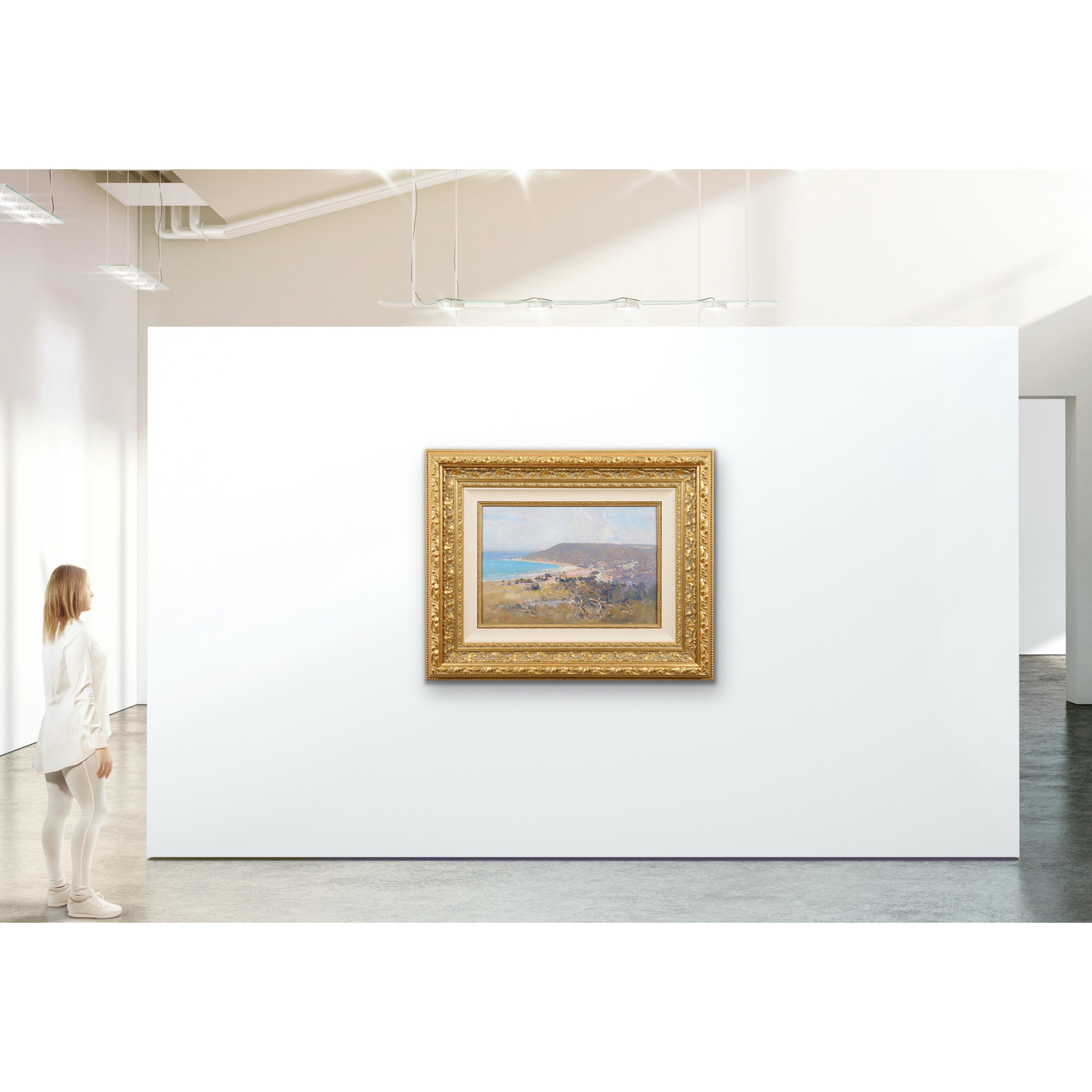
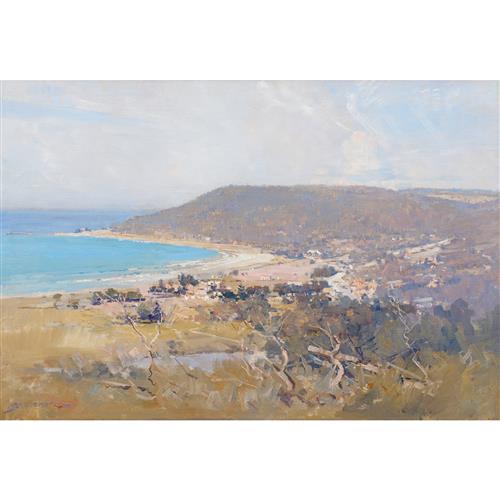
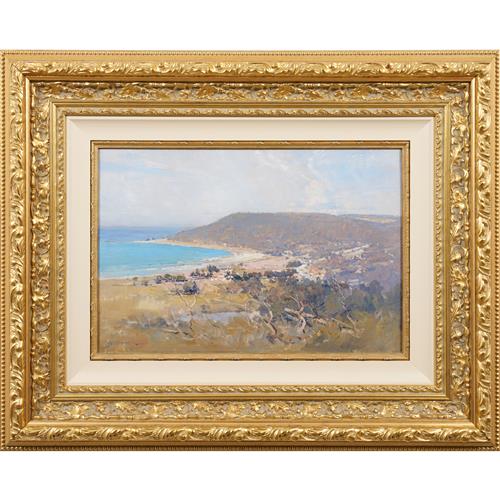
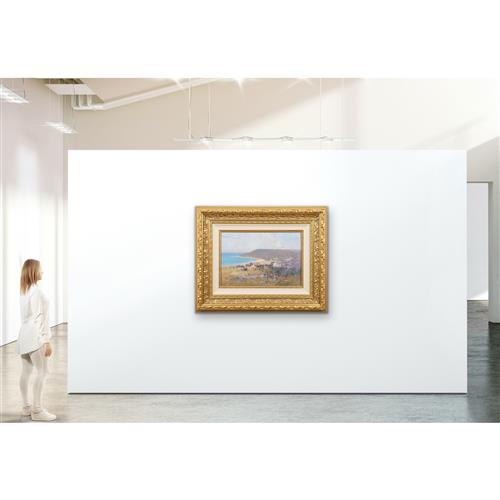
(Lorne and the Bay) 1921
oil on canvas
signed lower left: A STREETON
50.5 x 76cm
Estimate $200,000 - $300,000
(possibly) The Collection of Miss Regina Milne
Private collection
Christie's Australia, Melbourne, 27 - 28 November 2000, lot 49 (unsold)
Private collection, Sydney
Private collection, Perth
Thence by descent
(possibly) Spring Exhibition 1922, Victorian Artists' Society, Eastern Hill, 23 October - 5 November 1922, cat. no. 89 (as "Loutit Bay, Lorne")
(possibly) Streeton, A., The Arthur Streeton Catalogue, self published, Melbourne, 1935, p.132, cat. no. 721 (as "Lorne and the Bay")
The aftermath of World War I brought a desire for peace, stability and the security of home. Arthur Streeton, like many Australians who experienced the war on British and European shores, returned to seek the familiar, to again enjoy life immersed in the idyllic isolation and sunny vistas of Australia. Commissioned as an Official War Artist, it was a time of intense productivity (he produced over 180 works in six months), his contract sending him to the Somme where he painted soldiers marching from one battle to the next amongst smoke plumes, workers in makeshift hospitals, a dutiful nurse beside injured soldiers dealing with the trauma of war.
Streeton arrived with his family in February 1920 and other than a lengthy overseas trip in 1922-23, he remained in his homeland for the rest of his life, the inhumanity of war, looming Spanish flu and political upheavals contributing to his motivation. But he had not returned home to rest. With his brushes and paints, few financial worries, Streeton embarked upon a series of journeys across Australia, the quiet and lustrous town of Lorne part of his campaign to cast his eye over new locations.
A crowded calendar in 1920 filled with exhibitions in Sydney and Melbourne meant Streeton waited until 1921 to undertake the longed-for coastal journeys to Lorne, Sorrento and Portsea in the first half of the year. Travel to Lorne was not easy and required a train journey to Deans Marsh, a transfer to coaches passing along rough bush tracks over the Otway Ranges before dense forests gave way to reveal Louttit Bay and the crystal waters of the Southern Ocean. The magnificence of the landscape aside, Lorne was also on the cusp of something far greater.
Construction of the Great Ocean Road had been announced in 1918, Lorne central to the proposal to build a twisting snake like slick of road blown out of treacherous cliffs that reached from land to sea and gave little indication of a pathway. The project was designed to both employ returned servicemen and increase access to the Western District. It would become the world's largest war memorial.
Streeton's journey to Lorne may have been prompted by environmental concerns. The works he painted, however, are more than pre-emptive documentation. They are personal and central to his reflection upon that which he valued; his war service, a childhood spent in the Victorian seaside town of Queenscliff, the taste of salty air on his lips, his early days standing on rocks in Sandringham where it all began. Our picture, '(Lorne and the Bay)', takes full advantage of the spectacle that emerges when the glorious sweep of Lorne comes into view with its sparkling aquamarine waters and a beach, dotted with swimmers and walkers, that stretches its way into a township that is perfectly framed by impenetrable cliffs. In a letter to Sydney Ure Smith, Streeton considered his Lorne pictures amongst his best from this period. (1)
A 1919 photograph held in the Lorne Historical Society's archives shows a view of Lorne from the opposite side to Streeton's perspective, the placement of the houses and shops dotted throughout suggesting Streeton was accurate with his brush, a large stately home, possibly his interpretation of 'Kincraig' on Mount Joy Parade, dominant.
"How lucky!" he must have thought as he sat with one hand on his easel, the southerly winds that can race along the coastline never far away, the spindly trees in the foreground offering little protection, the wide brushstrokes freely dotted throughout suggesting the wind was, indeed, a factor. And he paints with a surety and spontaneity of one who knows the Australian landscape and its value, his view looking down and across into deep space one he had painted many times. It is a landscape he dreamt of during heart breaking war years. It is a landscape he understands; the summery blue haze of the mountains, the raw and brown umbers that define many of his Australian pictures, the composition so perfectly balanced, wispy clouds floating and signalling that soon they will clear and Lorne again will be charged with sunlight.
There are at least five paintings of Streeton's visit to Lorne, a reacquaintance with his famous "Streeton blue" evident in the work, 'Ocean blue, Lorne', held in the collection of the Geelong Art Gallery, a view of the ocean framed by towering gum trees. In 2004, Geoffrey Smith gave his definitive perspective on Streeton's 1921 series of coastal views. "These are amongst the most significant of all his Victorian coastal subjects" he wrote "yet remain largely unknown in his oeuvre; for relatively small in number they were purchased from their initial exhibitions by private collectors and disappeared from public view." (2)
Dr Julie Cotter
(1) Arthur Streeton to Sydney Ure Smith, 16 June 1922, quoted in Letters from Smike: The Letters of Arthur Streeton 1890-1943, Melbourne, OUP, 1989, p.164.
(2) Geoffrey Smith, "Arthur Streeton and the Australian Coast," in Arthur Streeton and the Australian Coast: MPRG Mornington Peninsula Regional Gallery 11 December 2004 - 6 March 2005, (Mornington), Mornington Peninsula Regional Gallery, (2004), p.27.
RELATED WORK:
Arthur Streeton, Ocean Blue, Lorne 1921, oil on canvas, 64 x 76.5cm, Private collection
Arthur Streeton, An Ocean Bay 1926, oil on canvas, 22.8 x 71cm, Private collection
Fine Art
AUCTION
Sale: LJ8822
6:00pm - 6 October 2026
Hawthorn
VIEWING
Friday 2 - Sunday 4 October, 11am - 5pm, 2 Oxley Rd, Hawthorn
CONTACT
Wiebke Brix
wiebke.brix@leonardjoel.com.au
SIMILAR ITEMS
Lot 53
EMILY KAM KNGWARRAY (c.1910-1996) (Language group: Anmatyerr) Summer Awelye 1991 synthetic polymer paint on linen 130 x 220cm
Estimate: $200,000-300,000
Lot 5
ARTHUR BOYD (1920-1999) (Bride over Shoalhaven) c.1982 oil on board 120 x 90cm
Estimate: $100,000-150,000
Lot 24
CHRISTOPHER WOOD (British, 1901-1930) Paris oil on board 37.5 x 45.5cm
Estimate: $80,000-120,000
Lot 2
GRACE COSSINGTON SMITH (1892-1984) Still Life with Lilies oil on board 43.5 x 38.5cm
Estimate: $40,000-60,000