Lot 10
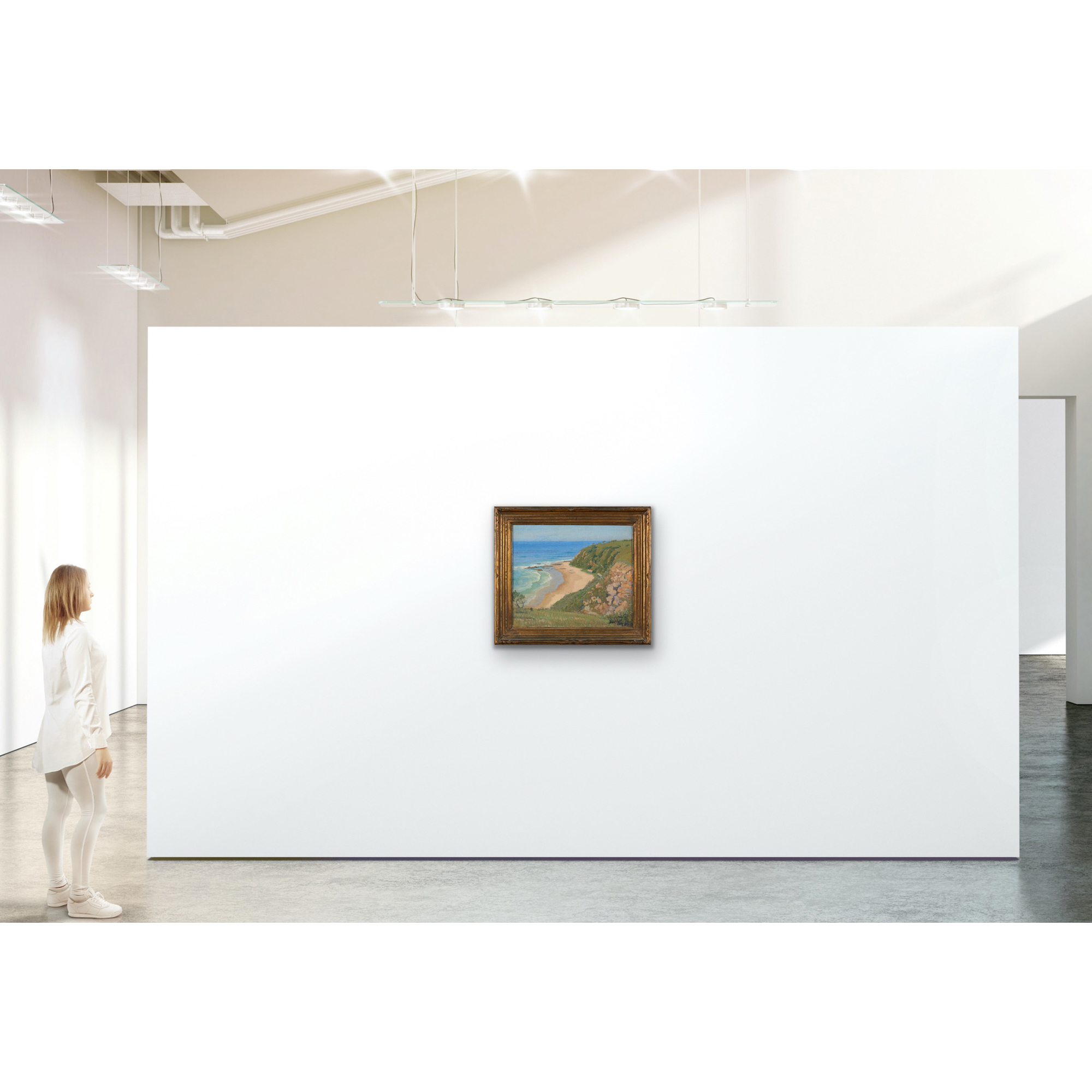
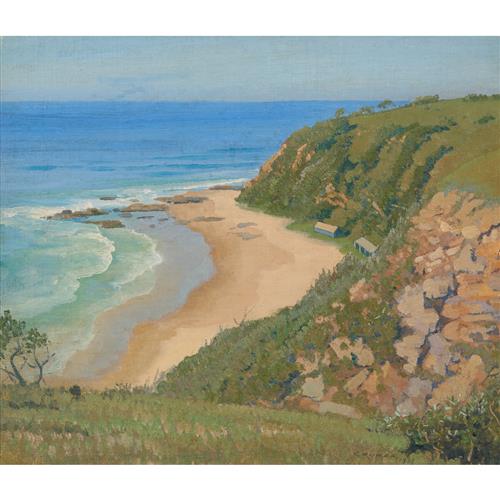
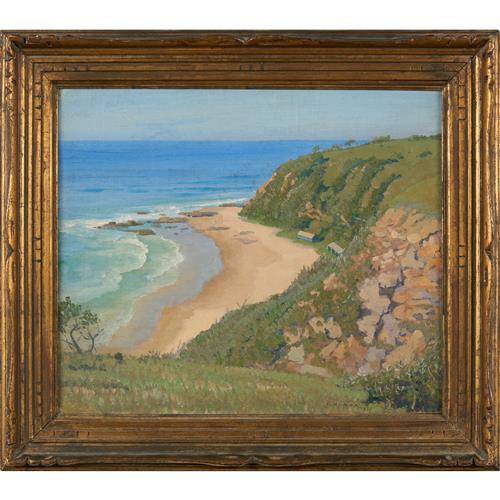
Nambucca Beach 1933
oil on canvas on board
in original Frederick Holdsworth frame (label verso)
signed and dated lower right: Gruner 1933
inscribed verso: a nambucca beach / owner Saul Symonds / less 100 sale
36.5 x 43cm
Estimate $50,000 - $70,000
The Collection of Mr and Mrs Saul Symonds, Sydney
Thence by descent, Jean Campbell, Canberra 1940–78
Private collection, Sydney
Private collection, Perth
(probably loaned) Exhibition of the Works of Elioth Gruner, National Art Gallery of New South Wales, Sydney, 21 December 1933 – 21 February 1934, cat. no. 22
-Viewing in Sydney-
Among the most celebrated Australian landscape painters of the early twentieth century, Elioth Gruner developed a visual language distinguished by its atmospheric subtlety, compositional harmony, and his skilful ability to capture the effects of light. Gruner's work is often associated with the influence of Australian Impressionism and the Heidelberg School, however, his later works reveal a more complex engagement with modernist ideas about structure, colour, and spatial design. In particular, his paintings in the 1930s demonstrate a refined synthesis of natural observation and visual organisation, positioning him as a key artist of the Australian landscape during the interwar period.
Born in New Zealand in 1882 and raised in Sydney from an early age, Gruner studied under Julian Ashton at the Sydney Art School. (1) From the beginning of his career, Gruner displayed a remarkable ability to capture changing atmospheric conditions, especially the effects of sunlight in rural and coastal environments. Art critics frequently praised the luminosity of his paintings, in fact, artist and writer Norman Lindsay famously remarked that Gruner painted "the purest light" in Australian art. (2) Gruner went on to win the prestigious Wynne Prize seven times, the first being in 1916 for Morning Light 1916 which is in the collection of the Art Gallery of New South Wales. (3) The seven paintings which won the Wynne Prize are now shared between the Art Gallery of New South Wales which has five and the remaining two are in the collection of the National Gallery of Australia, Canberra.
Although Gruner's earlier paintings align closely with the 'en plein air' naturalism of the Heidelberg school, his artistic direction evolved following his travels to Europe between 1923 and 1925. During this period, he encountered the work of Post-Impressionist artists Paul Cézanne and Paul Gauguin, whose emphasis on structural composition and simplified form influenced his later approach to landscape painting. (4) It was by the 1930s that Gruner's artworks reveal a heightened awareness of compositional balance. Rolling hills, farm paddocks, shorelines, and tree groves are thoughtfully arranged, and his colour palette becomes increasingly restrained and tonal.
This mature style is especially evident in one of Gruner's coastal paintings, 'Nambucca Beach' 1933. The work presents a secluded bay, viewed from an elevated perspective, where the curve of sand guides the viewer's eye toward the calm expanse of the ocean. The composition is notable for its remarkable equilibrium. The sea and sky occupy nearly half the canvas, creating an atmosphere of openness and tranquillity, while the surrounding cliff establishes a stabilising counterweight to the ocean. The painting demonstrates Gruner's exceptional ability to evoke atmosphere through tonal variation rather than dramatic contrast. Soft blues and aquamarines dissolve into white sea foam along the shoreline, while the sandy beach is rendered in warm creams and earthy colours that harmonise with the sunlit cliff. Unlike many of the period's depictions of the Australian coast that emphasised ruggedness and drama, Gruner instead presents the landscape as serene, contemplative, and deeply ordered.
A similarly reflective mood characterises his work titled 'The New Crop' 1932, though the setting shifts from coastline to farmland. In this painting, Gruner depicts rolling agricultural paddocks, bordered by dense treelined hills and a pale blue luminous sky. The composition is structured through horizontal bands of cultivated earth, pasture, and tree groves, producing spatial depth and visual stability and elevating the rural landscape into a lyrical arrangement of colour and form. The ploughed foreground field becomes an expansive sweep of muted browns and greens animated by visible brushwork that evokes the texture of freshly turned soil. Fence posts rhythmically mark the lower edge of the composition, guiding the viewer's eye toward the darker, dense tree grove. The contrast between open farmland and dense bushland creates a subtle dialogue between cultivation and untamed nature which is often a recurring theme within Australian landscape painting of this era.
Elioth Gruner's landscapes of the 1930s exemplify the defining characteristics of his late style, including an emphasis on compositional clarity, tonal restraint, and an unparalleled understanding of Australian light. His landscapes evoke a quieter form of national identity that is grounded in contemplation, balance, and intimate familiarity. Through his Impressionist atmosphere and modernist structure, Gruner produced some of the most enduring and poignant visions of the Australian landscape in twentieth-century art.
Amanda Hayward (née North)
Senior Fine Art Specialist
(1) Clark, D., Elioth Gruner: The Texture of Light, Canberra Museum and Gallery, Canberra, 2014, pp. 1-2.
(2) National Portrait Gallery, Norman Lindsay: In their own words, accessed on 24th April 2026: www.portrait.gov.au/words/norman-lindsay
(3) Art Gallery of NSW, Elioth Gruner, accessed on 24th April 2026: www.artgallery.nsw.gov. au/collection/artists/gruner-elioth/
(4) Clark, D., Elioth Gruner: The Texture of Light, Canberra Museum and Gallery, Canberra, 2014, p. 8.
Fine Art
AUCTION
Sale: LJ8803
6:00pm - 30 June 2026
Hawthorn
VIEWING
SYD (Highlights): Friday 12 - Sunday 14 June, 10am - 4pm
The Bond, 36-40 Queen St, Woollahra NSW
MEL: Fri 26 - Sun 28 June, 11am - 5pm
2 Oxley Rd, Hawthorn VIC
CONTACT
Wiebke Brix
wiebke.brix@leonardjoel.com.au
SIMILAR ITEMS
Lot 9
RUPERT BUNNY (1864-1947) La Cassette (The Casket) 1916 oil on canvas 73.5 x 60.5cm
Estimate: $200,000-300,000
Lot 8
CLARICE BECKETT (1887-1935) (Mentone Cliffs) c.1932 oil on board 44.5 x 54cm
Estimate: $80,000-100,000
Lot 60
GONKAR GYATSO (Tibetan, born 1961) On First Sunshine 2012 stickers, paper collage and pencil on resin cast sculpture 40 x 46 x 31cm
Estimate: $60,000-90,000
Lot 14
ARTHUR STREETON (1867-1943) Yorkshire 1911 oil on canvas 49.5 x 75cm
Estimate: $60,000-80,000