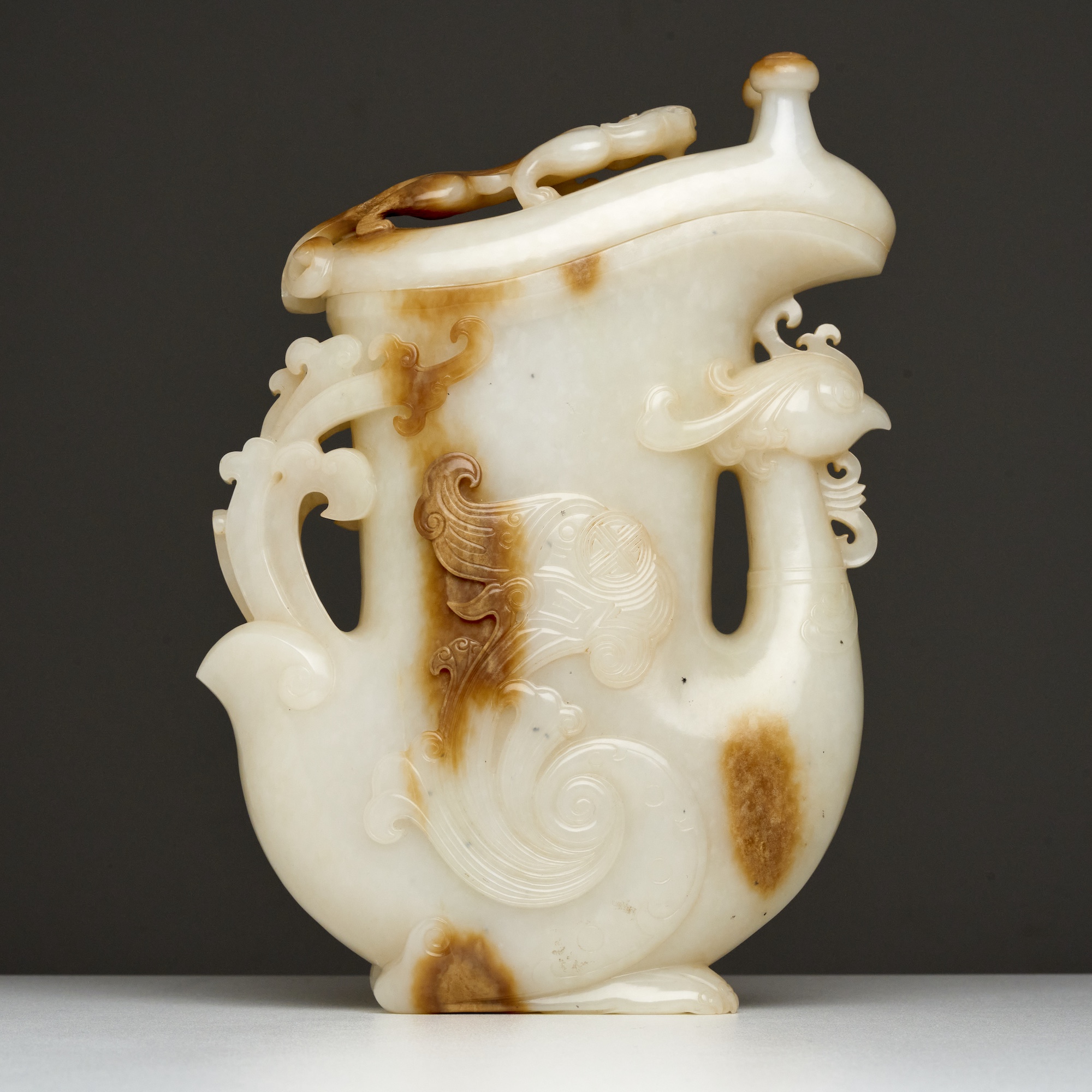
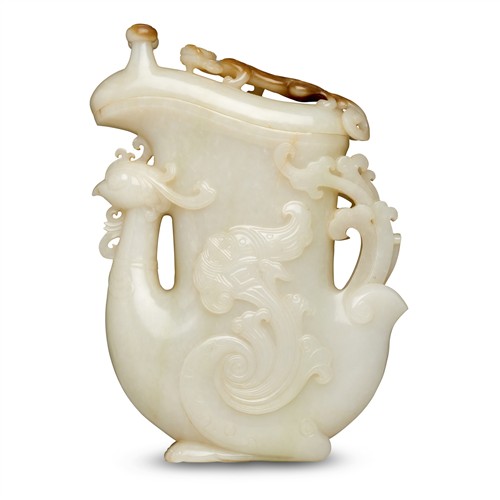
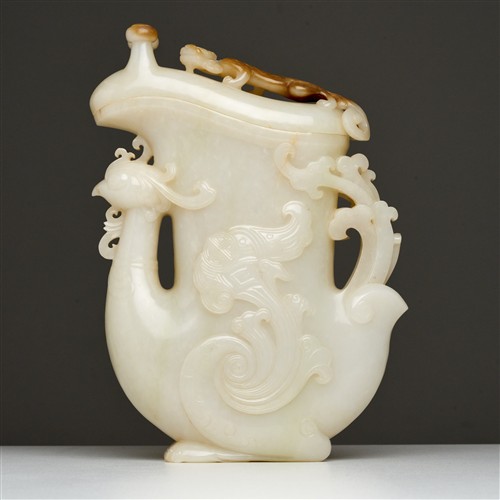
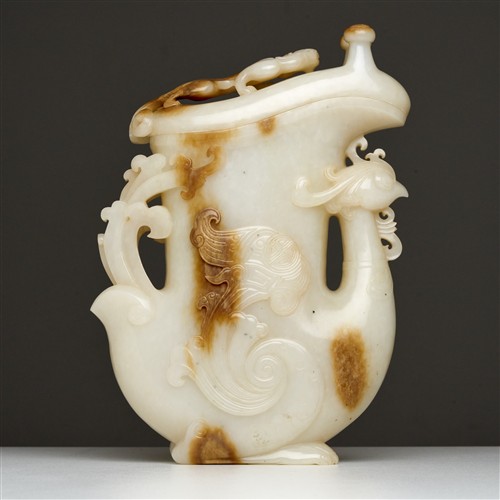
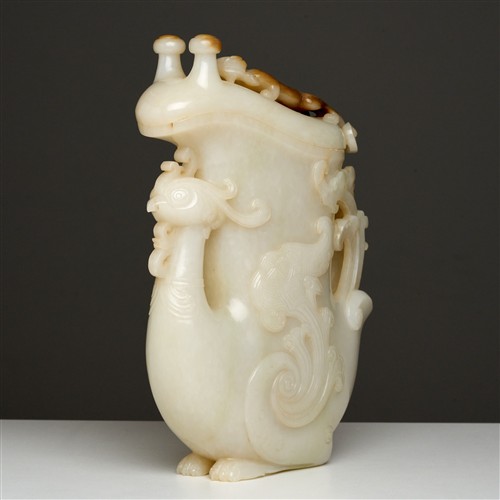
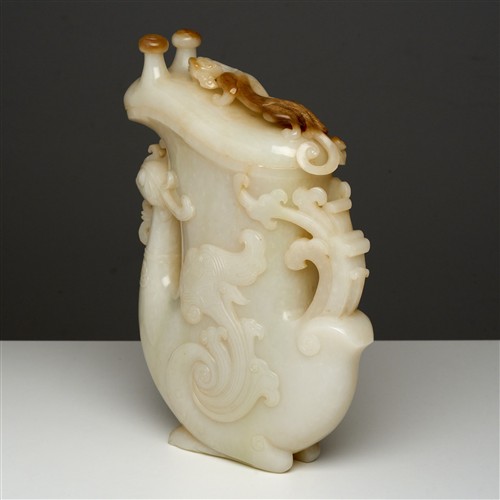
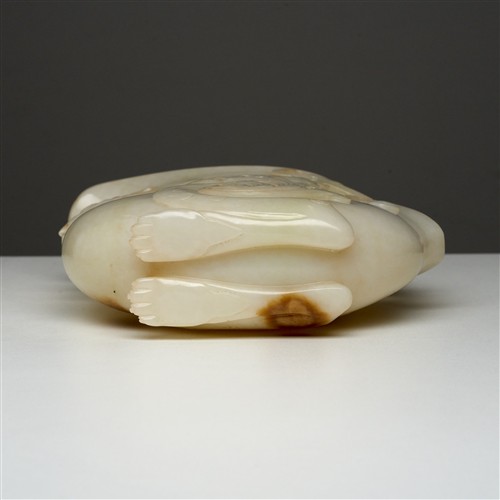
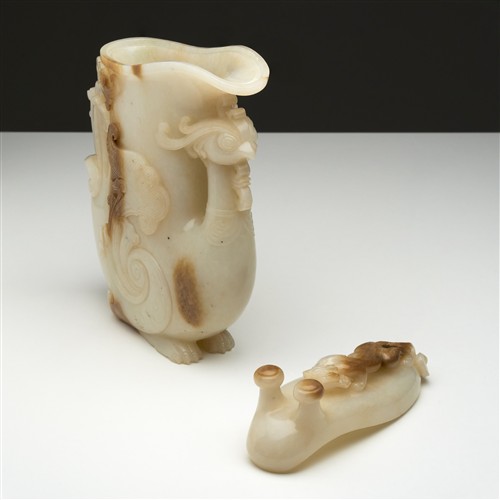
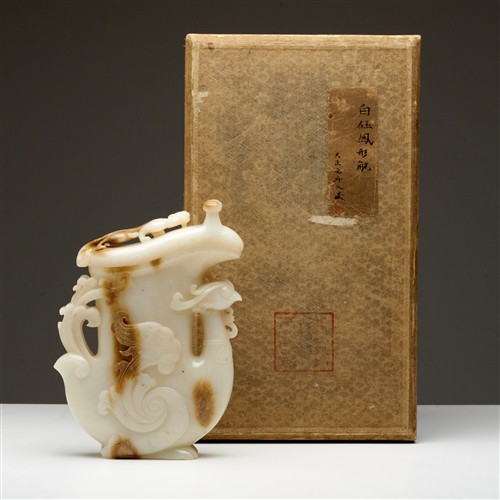
The well-hollowed vessel is carved in the form of an archaistic phoenix, standing with its talons firmly tucked beneath the body. The bird is finely detailed with a stylised crest surmounting its head, while its elegantly sweeping tail forms the handle, intricately pierced and carved with ruyi-shaped plumage extending gracefully around the vessel. The sides are carved in high relief with outstretched wings, richly embellished with layered feathers and archaistic scroll motifs. The translucent stone is of an even, lustrous white tone, enhanced by attractive russet inclusions to one side.The fitted cover is carved as a mythical beast with a rounded head and a pair of horns flanking a ridged spine, further embellished with a chilong rendered in high relief.
With its original Japanese tomobako (wooden storage box), the cover impressed with a red seal reading Gongfeng Tianlan ("Presented for Imperial Appreciation"), and bearing an old paper label indicating that the piece entered the collection in the first year of the Taisho era (1912).
清 白玉帶沁雕鳳形觥及蓋
此件玉觥掏膛精良,以仿古鳳鳥為形。鳳鳥昂首挺立,雙爪內斂伏於身下,姿態穩健端莊。頭頂飾卷雲式冠羽,刻畫細緻生動;長尾向後舒展並巧作提柄,羽翎雕琢成如意形紋飾,鏤雕玲瓏剔透,環繞器身,線條流暢優美,極富動感。
器身兩側以高浮雕技法刻劃展翅羽翼,層層翎羽排列有序,其間飾以仿古卷雲紋及夔龍式紋樣,紋飾繁縟而不失典雅,充分展現清代玉匠對商周青銅器造型與裝飾藝術的深刻理解。玉質瑩潤細膩,呈勻淨通透之白玉色澤,一側保留天然沁色,褐紅相間,色彩對比鮮明雅致,更添古樸韻味。
原配器蓋雕作神獸形,獸首圓渾飽滿,頭生雙角,脊背起棱,氣勢古穆。蓋面另雕一條螭龍盤踞其上,採高浮雕技法琢製,身軀蜿蜒靈動,細節刻畫精湛,進一步增添整器的層次感與觀賞趣味。
本器保留原配日本時代木箱(供箱),盒蓋鈐有「供奉天覽」朱文印,顯示其曾為重要收藏之珍玩。另附舊藏標籤,記載其於大正元年(1912年)入藏日本,流傳有緒,來源清晰,更具收藏與研究價值。
源流:
日本華族舊藏,大正時期(1912-1926)曾供奉天覽。據原配木盒所鈐「供奉天覽」朱印及舊藏標籤記載。
25.3cm high
Estimate $30,000 - $50,000
Overall in good condition, there are two very minute nicks to the tip of the nails on the left claw.
The opinions expressed in the condition reports are a guide only and should not be treated as a statement of fact. Prospective buyers are encouraged to seek further information or request additional images during our pre-sale period where Leonard Joel staff are available for advice. Please note condition reports can be amended during the pre-sale period, so we strongly suggest any interested bidders check the published condition report available on the website before the auction commences. Leonard Joel makes no guarantee of the originality of mechanical or applied components. Absence of reference to such modifications does not imply that a lot is free from modifications.
Formerly from a Japanese aristocratic collection, presented for Imperial viewing during the Taisho period (1912-1926). (according to the red seal and the old level on the box).
Jade carvings of this impressive scale, fashioned from white jade of such exceptional purity and quality, are exceedingly rare. The present vessel takes its inspiration from the archaic bronze gong wine vessels first produced during the later Shang dynasty, particularly the second phase of the Anyang period, when they largely supplanted the earlier zoomorphic zun forms. The type enjoyed a notable revival during the Song dynasty and was subsequently embraced by the Qing court. Under the patronage of the Qianlong Emperor, the study and reinterpretation of antiquity became a central tenet of imperial artistic production. Advocating a return to the virtues embodied in ancient forms, the Emperor encouraged artisans to draw inspiration from archaic prototypes, believing that such models would imbue their works with dignity, sincerity, and refined elegance. As noted by Chang Li-tuan, the concept of "restoring the ancient ways" reflected an appreciation of the intrinsic qualities of honesty, simplicity, and harmonious vitality; see Chang Li-tuan, The Refined Taste of the Emperor: Special Exhibition of Archaic and Pictorial Jades of the Ch'ing Court, National Palace Museum, Taipei, 1997, p. 49.
In the present example, the master craftsman successfully harmonised the ancient ritual-vessel form with the graceful naturalism of the phoenix, creating a sophisticated reinterpretation of a classical prototype. The result is a work that is both firmly rooted in antiquity and distinctly reflective of eighteenth-century imperial taste.
The extraordinary quality of the jade itself further elevates the piece. Following the Qianlong Emperor's campaigns against the Dzungar Khanate between 1755 and 1759, the imperial workshops enjoyed unprecedented access to the finest nephrite from Xinjiang. Such material enabled court craftsmen to create works on a grand scale while showcasing the exceptional translucency and texture of the stone. In keeping with the finest traditions of Qing jade carving, the artisan expertly balanced richly carved decorative elements with expanses of unadorned, meticulously polished surfaces, allowing the natural beauty of the material to remain a defining feature of the work.
The present vessel appears to rank among the largest and finest known examples of its type. Compare a related white jade phoenix-form gong vessel of smaller size (16.6 cm high) in the collection of the Palace Museum, Beijing, illustrated by Yang Boda in Zhongguo Yuqi Quanji, Hebei, 2005, p. 542, no. 37. See also two related examples, one of pale celadon jade and the other of white jade, from the Qing Court Collection (19.5 cm and 14.1 cm high), illustrated in Compendium of Collections in the Palace Museum: Jade, Vol. 10, Qing Dynasty, Beijing, 2011, pls. 82 and 84. Another related white and russet jade gong vessel of smaller size (11.5 cm high), excavated from the Yuanmingyuan and now in the Musée National du Château de Fontainebleau, is illustrated in Tsao Huei-Chung, Jade: From Emperors to Art Deco, Paris, 2016, no. 194. Further comparison may be made with another related example illustrated by R. Y. Lefebvre d'Argencé, Chinese Jades in the Avery Brundage Collection, San Francisco, 1977, pl. LVII.
Closely related archaistic vessels were also produced by the imperial workshops in other media. Compare, for example, a Qianlong-period cloisonné enamel rhyton of comparable form illustrated in Colorful, Elegant and Exquisite: A Special Exhibition of Imperial Enamel Ware from Mr Robert Chang's Collection, Suzhou, 2007, pp. 34-35.
For a particularly comparable white jade example lacking its cover and of slightly smaller size (18.8 cm high), dated to the Qianlong period, see Bonhams Hong Kong, 29 May 2018, lot 27. Another closely related imperial white jade archaistic gong vessel and cover, also dating to the Qianlong period, was sold at Christie's London, 13 May 2008, lot 65.
白玉光潔瑩潤,局部烤色。仿古彝器,扁筒式,口微敞,器形修長,器身前後分別圓雕及鏤雕鳳凰首尾,雙目圓睜,頂戴羽冠,昂首仰胸,氣宇軒昂,鳳尾成如意形羽狀,捲曲上揚,鳳凰雙翼浮雕於觥腹兩側,作仿古夔龍紋,器底雕鳳足,生動寫實又不失古雅之風。
體量如此宏大且採用品質如此卓絕之白玉琢製而成的玉器,實屬罕見珍貴。本件鳳形觥取法於商晚期青銅酒器之古代觥制。此類器形最早見於殷墟時期,並於當時逐漸取代部分獸形尊器,成為重要的禮儀用器。至宋代,仿古之風興盛,古代青銅器形制再次受到文人士大夫推崇,觥式亦隨之復興。清代乾隆皇帝尤為崇尚古制,提倡「復古」之風,強調從上古器物中汲取藝術靈感,認為玉工若能師法古器,便可在作品中體現質樸誠敬之精神,進而達到高雅精緻之藝術境界。正如張麗端於《清代宮廷玉器與圖畫玉器特展》中所述,「復古」所追求者,乃是一種蘊含真誠、樸實與和諧生機的精神價值(見張麗端,《清代宮廷玉器與圖畫玉器特展》,臺北故宮博物院,1997年,頁49)。
本器巧妙融匯古代禮器之莊重形制與鳳鳥之靈動神韻。玉匠以高超技藝重新詮釋傳統觥器,既保留上古青銅器之典雅氣韻,又賦予鳳鳥生動自然之姿態,展現乾隆時期宮廷玉雕兼具考古精神與審美創新的藝術特色,可謂集仿古與創新於一身之宮廷佳作。
尤為難得的是,本器所用玉材品質極為出眾。乾隆二十年至二十四年(1755-1759年)間,清廷平定準噶爾汗國後,新疆和田地區優質玉料得以源源不斷輸入宮廷造辦處,為大型宮廷玉器的製作提供了豐富而優越的材料來源。本器玉質純淨細膩,凝潤瑩澤,匠師在繁複精湛的浮雕與鏤雕裝飾之外,特意保留大面積光素無紋之處,並施以細緻拋光,使玉石天然之溫潤光澤得以充分展現,更凸顯其卓越材質。
綜觀已知同類作品,本器無論體量或玉質,均可列屬現存同類鳳形觥中的佼佼者。可資比較者包括北京故宮博物院藏一件白玉鳳形觥,高16.6公分,著錄於楊伯達編《中國玉器全集》,河北美術出版社,2005年,頁542,圖版37;另可參考《故宮博物院藏文物珍品大系.玉器卷十.清代》所載兩件清宮舊藏觥式器,分別為青白玉及白玉質地,高19.5公分及14.1公分(北京,2011年,圖版82及84)。此外,楓丹白露宮國家博物館藏一件出自圓明園之白玉帶沁色觥,高11.5公分,著錄於曹惠中《Jade: From Emperors to Art Deco》,巴黎,2016年,編號194。另有一例收錄於R. Y. Lefebvre d’Argencé,《Chinese Jades in the Avery Brundage Collection》,舊金山,1977年,圖版LVII。
值得注意的是,此類仿古宮廷器形不僅見於玉器,亦廣泛應用於其他宮廷工藝媒材。例如一件乾隆時期掐絲琺瑯犀角形觥,即可見相近設計理念,著錄於《Colorful, Elegant and Exquisite: A Special Exhibition of Imperial Enamel Ware from Mr Robert Chang's Collection》,蘇州,2007年,頁34至35。
拍賣市場上,與本器極為相近者可參考邦瀚斯香港2018年5月29日拍賣,第27號拍品,一件乾隆時期白玉鳳形觥,高18.8公分,惟原蓋已佚。另有一件乾隆時期御製白玉仿古觥連蓋,於佳士得倫敦2008年5月13日拍賣,第65號拍品成交。相較之下,本器保存完整,體量更為宏大,玉質亦尤為精純,彌足珍貴。
此玉器配有日本時繪木盒, 盒蓋上印有“供奉天覽”朱印 ,並有標籤標註“大正元年” (公元1912年)入藏。顯示本器曾於大正時期進獻給日本天皇御覽。
Important Chinese & Asian Art
AUCTION
Sale: LJ8825
11:00am - 25 October 2026
Hawthorn
VIEWING
Thurs 22 - Sat 24 October, 11am - 5pm
2 Oxley Rd, Hawthorn VIC
CONTACT
Luke Guan
luke.guan@leonardjoel.com.au
SIMILAR ITEMS
Lot 14
A VERY RARE PAIR OF CHINESE FAMILLE ROSE AND GRISAILLE-DECORATED 'LANDSCAPE' STOOLS, YONGZHENG PERIOD (1723 - 1735)
Estimate: $100,000-200,000
Lot 112
A CHINESE HIGH-FIRED WHITE-GLAZED CUP, SUI DYNASTY (581-618)
Estimate: $50,000-80,000
Lot 134
AN EXTREMELY RARE CHINESE HUSHAN WARE OVOID PHOSPHATIC EWER, TANG DYNASTY, 8TH/9TH CENTURY
Estimate: $50,000-70,000
Lot 178
A CHINESE ARCHAIC BRONZE RITUAL VESSEL, ZUN, LATE SHANG/EARLY WESTERN ZHOU DYNASTY, 12TH-10TH CENTURY BCE
Estimate: $50,000-70,000