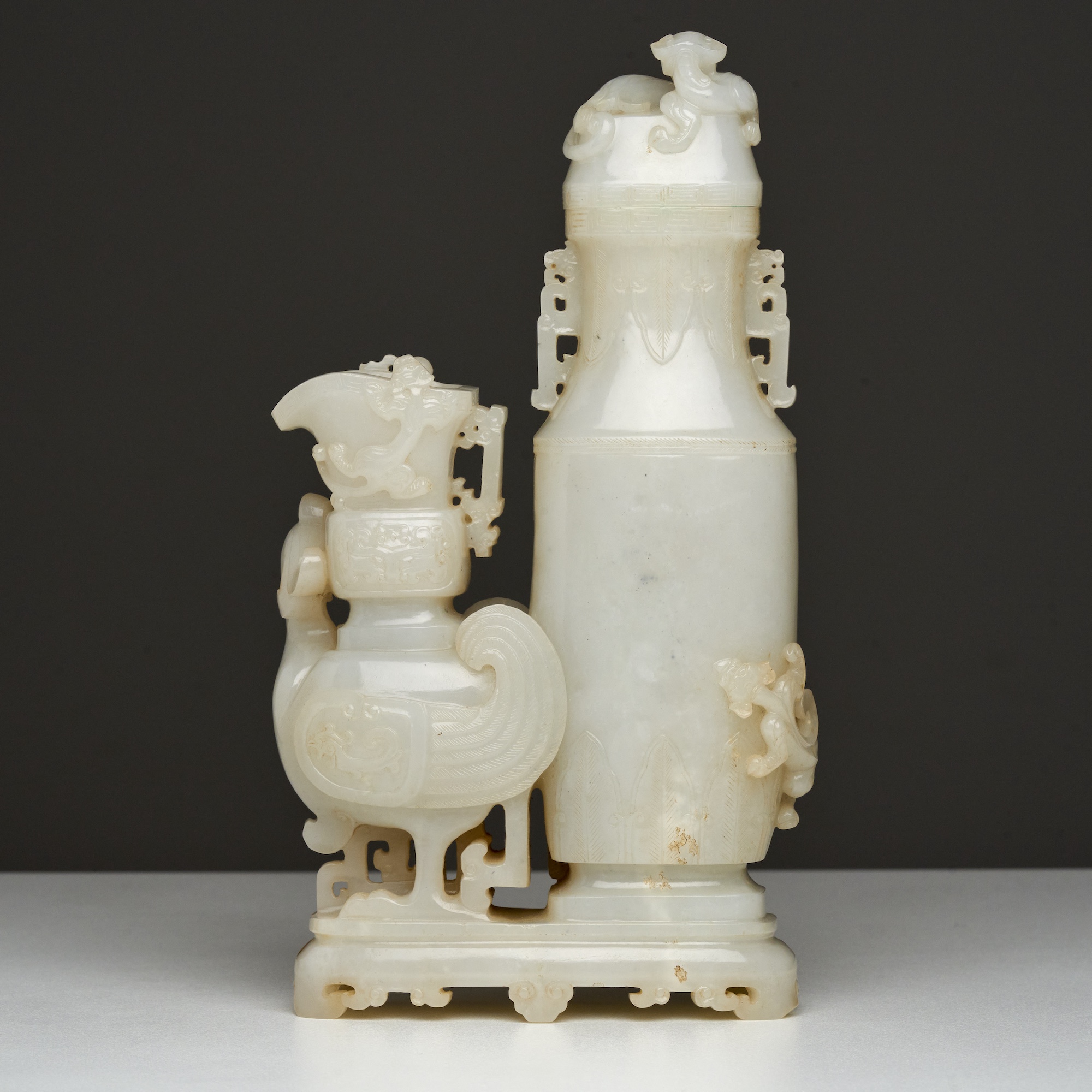
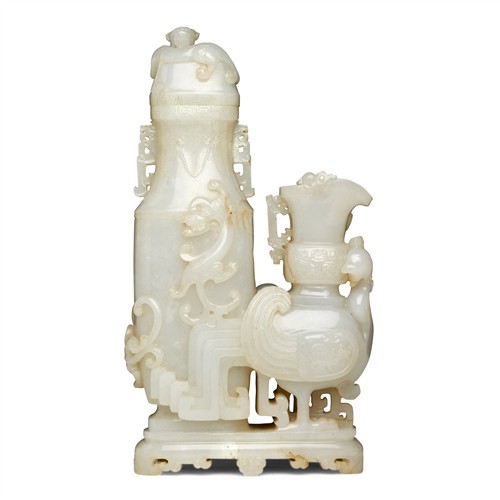
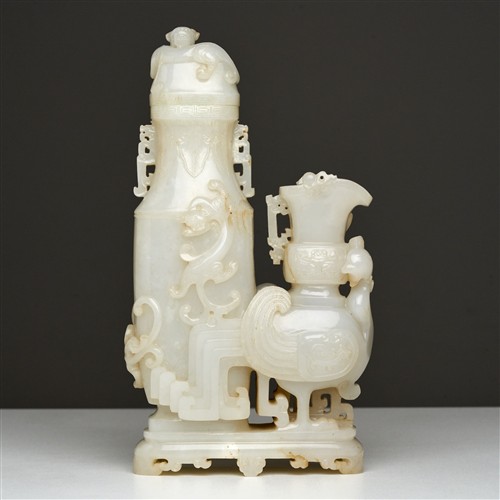
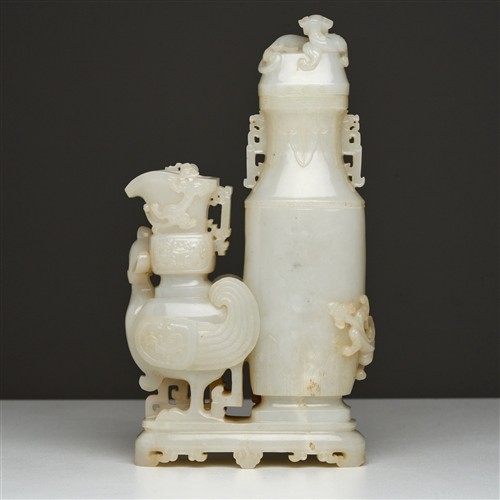
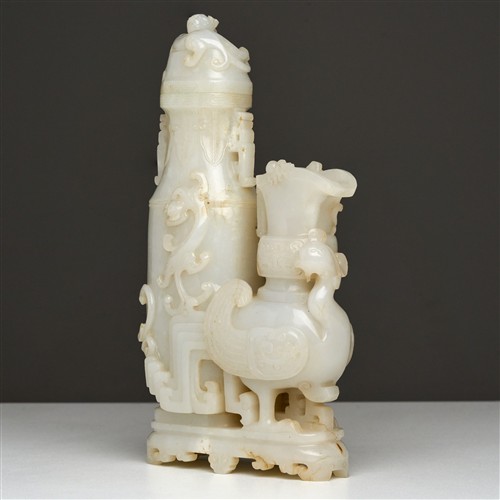
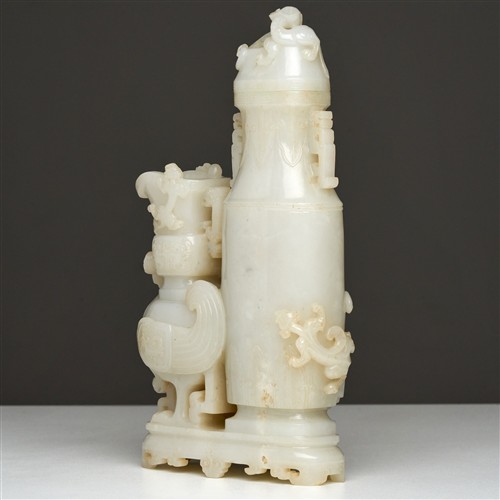
Carved from a single exceptionally large piece of white jade, the present work represents a highly accomplished example of the innovative archaistic jade carvings produced during the Qianlong period and the mid-Qing dynasty. Conceived as a twin vessel group, the composition combines a principal covered vase and a subsidiary zun-form vessel supported by a celestial bird, both united upon a shared openwork cloud-scroll base.
The principal vase rising from a waisted foot to a gently flared neck set with a pair of archaistic kui-dragon handles. The domed cover is surmounted by a recumbent chilong finial, while the exterior is further embellished with high-relief chilong dragons sinuously traversing the body, their finely rendered forms lending movement and vitality to the otherwise symmetrical composition.
The subsidiary vessel is ingeniously conceived as a small archaistic zun carried upon the back of a celestial bird, or tianji. Standing proudly with head raised, the mythical bird is finely carved with stylised plumage and archaistic decorative motifs. The diminutive zun borne upon its back is further enriched with taotie-inspired masks and archaistic ornament, reinforcing the antiquarian character of the ensemble.
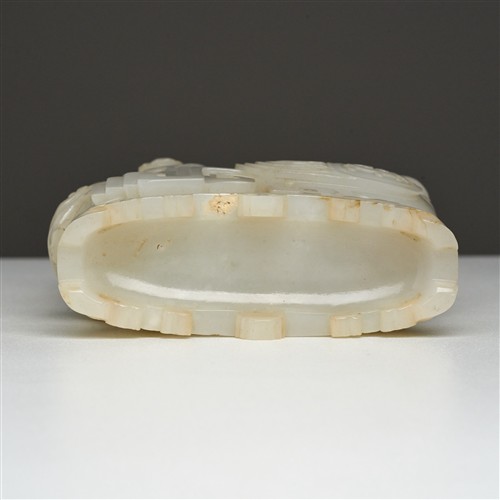
Remarkably, the entire composition has been carved from a single block of jade without assembly. The openwork base is exquisitely pierced with scrolling cloud motifs, creating a sense of visual lightness while maintaining structural harmony. Rich in auspicious symbolism, the combination of chilong dragons and the celestial bird evokes imperial authority, peace, prosperity, and longevity, reflecting the fascination of the Qianlong court with the reinterpretation of ancient forms through the medium of jade.
The stone is of fine, even white tone characteristic of prized Hetian jade favoured by the Qing court. Areas of natural inclusions and pale russet suffusions enhance the material's visual appeal, while the silky lustre and meticulous finish attest to the high standards of craftsmanship associated with the Imperial Workshops during the eighteenth century.
The origins of the twin-vessel form may be traced to the Neolithic hehuan hu (joined vessels). By the Qianlong period, however, court craftsmen had transformed these early precedents into increasingly sophisticated sculptural compositions, combining auspicious creatures with vessels of archaistic inspiration. Surviving examples remain rare and are predominantly associated with former imperial collections.
The present vessel may be closely compared to the celebrated White Jade Phoenix and Chilong Twin Vase and Cover in the collection of the Tianjin Museum. Both works share an almost identical conceptual arrangement, consisting of a principal covered vase paired with a subsidiary vessel borne by an auspicious bird and joined upon a unified carved base. Together they represent a distinctive category of innovative composite vessels developed under imperial patronage during the Qianlong period.
Related examples of celestial bird-form vessels and composite twin-vase constructions are also preserved in the collections of the National Palace Museum, Taipei, illustrating the Qing court's enduring enthusiasm for archaistic forms and inventive reinterpretations of ancient ritual prototypes.
Similar white jade vase group also in archaistic form and decorated with phoenixes, see Christie's New York, 23/03/2012, lot 1905. Also see a similar example with yellow jade, sold at Christie's Hong Kong, 1/06/2011, lot 3906.
清乾隆 白玉螭龍天雞雙聯蓋瓶
此件雙聯蓋瓶以整塊和田白玉精雕而成,屬乾隆時期宮廷玉器中極具代表性的仿古創新之作。一器雙體,由帶蓋螭龍雙耳主瓶與天雞負尊副瓶組成,二者巧妙連結於同一鏤雕雲紋底座之上,構思精巧,氣勢恢宏,充分體現乾隆朝對上古禮器的崇尚與創新演繹。
主瓶束頸鼓腹,頸部飾夔龍式雙耳,器蓋以盤伏螭龍為鈕。瓶身高浮雕數條螭龍穿梭遊走,其身姿婉轉靈動,雕工細膩流暢,富有生氣。副瓶則別出心裁地以天雞為座,神鳥昂首挺立,姿態雄健,羽翼飾以仿古紋樣,層次分明。鳥背承托一件小型尊式器,尊口外撇,頸部飾獸面紋,古意盎然。
全器由一塊玉料雕琢而成,通體鏤空透雕,絕無拼接痕跡。底座飾卷雲勾連紋,繁而不亂,層次豐富,而整體布局均衡和諧。螭龍象徵帝王權威,天雞寓意吉祥瑞應,二者結合蘊含國泰民安、福壽綿長之美好祝願,充份反映清宮祥瑞文化與宮廷審美趣味。
玉材為典型乾隆時期所珍視的和田白玉,質地細膩溫潤,油脂光澤柔和內斂。局部保留天然玉綹與淺褐色沁斑,更增天然之美與古雅韻味。整器打磨精細,拋光考究,工藝特徵與清代中期宮廷造辦處玉雕作品高度契合。
天津博物館藏清乾隆 白玉鳳螭紋雙聯蓋瓶可作本器最直接之館藏比較例。二者構思如出一轍,均採用主蓋瓶與瑞鳥背負小尊之連體設計,共用一體式底座,應屬乾隆宮廷玉作創新發展出的雙聯瓶式樣。
此外,臺北國立故宮博物院亦藏有數件同類天雞尊及雙聯瓶作品,可資參考乾隆一朝對仿古複合器型的特殊偏好與藝術追求。
雙聯瓶之淵源可上溯至新石器時代之合歡壺。至乾隆時期,宮廷玉匠已不滿足於簡單雙器相聯的形式,而進一步演化為主瓶結合瑞獸或瑞禽負瓶的複雜構圖,不僅技術要求極高,亦極具宮廷陳設氣派。此類作品傳世稀少,多見於清宮舊藏及重要收藏機構,彌足珍貴。
源流:
日本私人收藏。
二十世紀八十年代購自美國紐約 Alan Hartman 與 Simone Hartman 伉儷舊藏。
22cm high
Estimate $30,000 - $50,000
Overall in good condition.
The opinions expressed in the condition reports are a guide only and should not be treated as a statement of fact. Prospective buyers are encouraged to seek further information or request additional images during our pre-sale period where Leonard Joel staff are available for advice. Please note condition reports can be amended during the pre-sale period, so we strongly suggest any interested bidders check the published condition report available on the website before the auction commences. Leonard Joel makes no guarantee of the originality of mechanical or applied components. Absence of reference to such modifications does not imply that a lot is free from modifications.
Formerly in the collection of Simone & Alan Hartman, New York, in the 1980s.
Japanese private collection.
Important Chinese & Asian Art
AUCTION
Sale: LJ8825
11:00am - 25 October 2026
Hawthorn
VIEWING
Thurs 22 - Sat 24 October, 11am - 5pm
2 Oxley Rd, Hawthorn VIC
CONTACT
Luke Guan
luke.guan@leonardjoel.com.au
SIMILAR ITEMS
Lot 14
A VERY RARE PAIR OF CHINESE FAMILLE ROSE AND GRISAILLE-DECORATED 'LANDSCAPE' STOOLS, YONGZHENG PERIOD (1723 - 1735)
Estimate: $100,000-200,000
Lot 112
A CHINESE HIGH-FIRED WHITE-GLAZED CUP, SUI DYNASTY (581-618)
Estimate: $50,000-80,000
Lot 134
AN EXTREMELY RARE CHINESE HUSHAN WARE OVOID PHOSPHATIC EWER, TANG DYNASTY, 8TH/9TH CENTURY
Estimate: $50,000-70,000
Lot 178
A CHINESE ARCHAIC BRONZE RITUAL VESSEL, ZUN, LATE SHANG/EARLY WESTERN ZHOU DYNASTY, 12TH-10TH CENTURY BCE
Estimate: $50,000-70,000