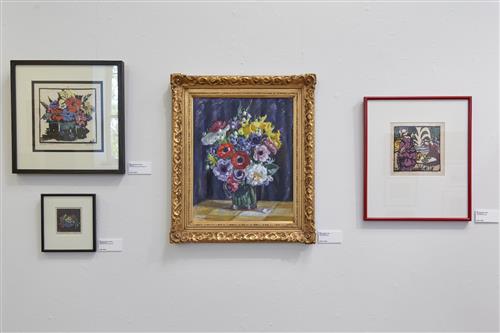
Lot 15
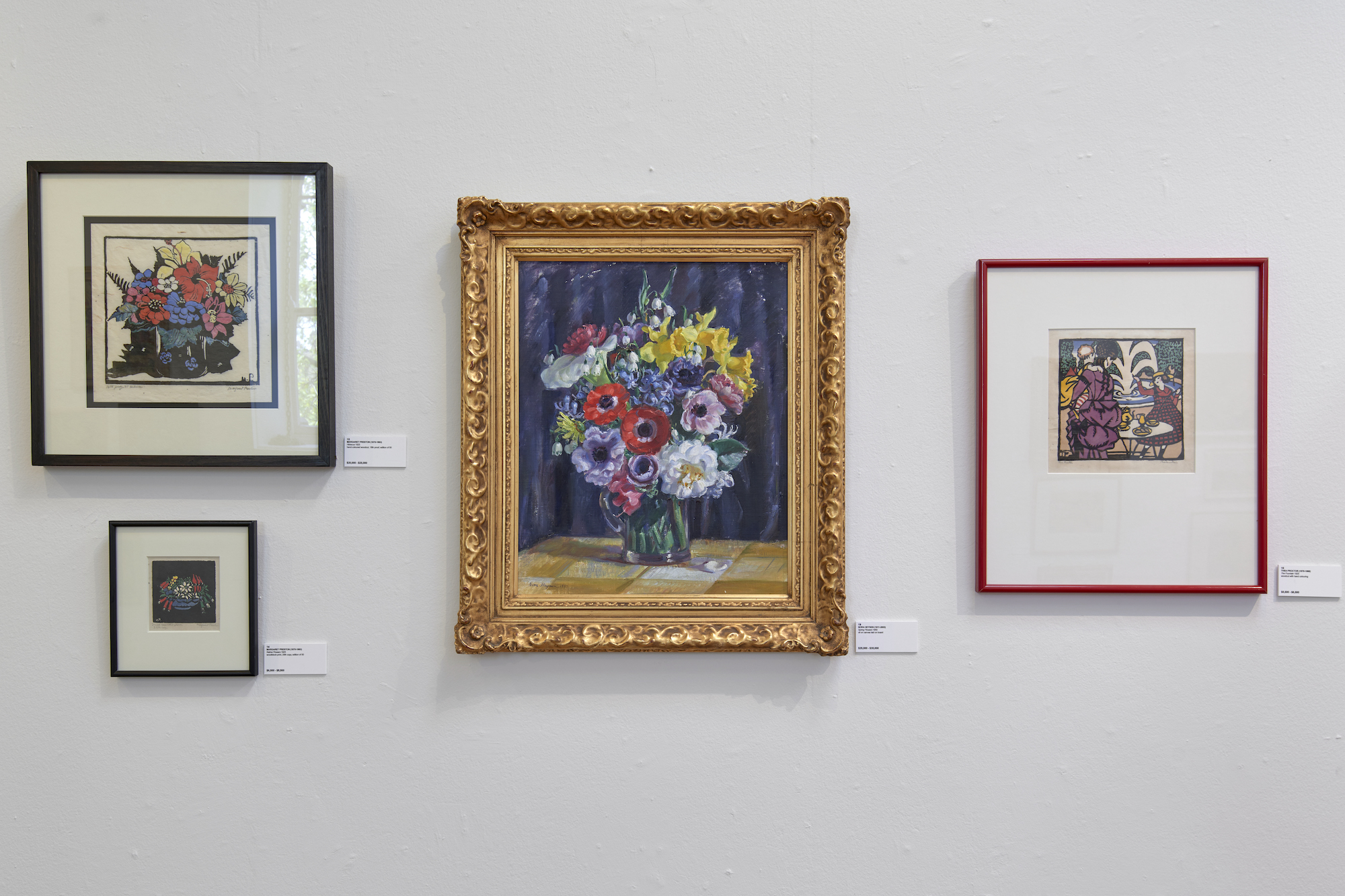
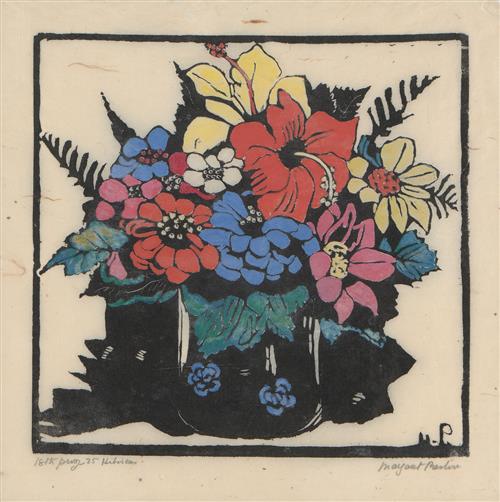
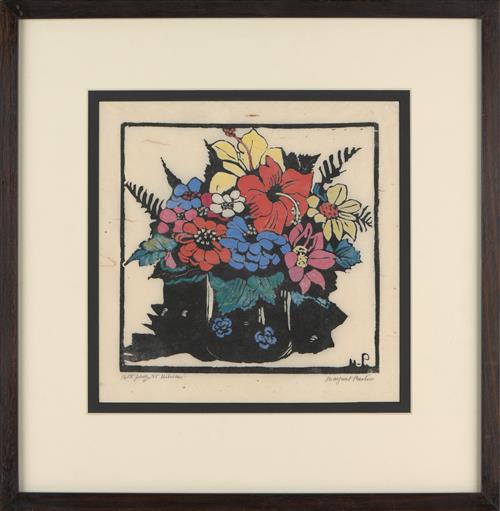
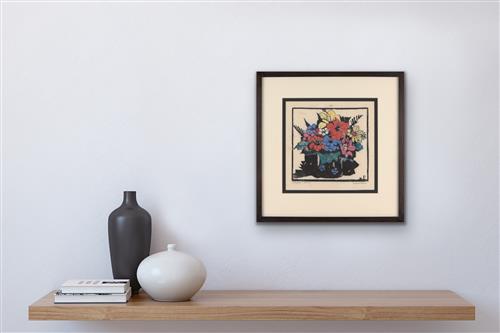
Hibiscus 1925
hand-coloured woodcut, 18th proof, edition of 50
signed lower right: Margaret Preston
numbered, dated and titled lower left: 18th proof 25 Hibiscus
23.5 x 24.5cm
Estimate $20,000 - $25,000
The Collection of Dame Nellie Melba GBE
Sotheby's, Fine Asian, Australian & European Arts & Design Including Property From The Collection Of Dame Nellie Melba, Melbourne, 31 March 2015, lot 60
Private collection, Melbourne
Butler, R., The Prints of Margaret Preston, Australian National Gallery, Canberra and Oxford University Press, Melbourne, 1987, cat. no. 97, pp. 114, 115 (illustrated, another impression)
Butler, R., The Prints of Margaret Preston: A Catalogue Raisone, National Gallery of Australia, Canberra, 2005, cat. no. 97, p.125 (illustrated, another impression)
Gray, A., Jordan, C., Hooper, J., Modern Australian Women Artists: The Andrée Harkness Collection, Museum Victoria Publishing, Melbourne, 2020, pp. 8, 167 (illus.), 234
Margaret Preston is one of Australia's most significant artists, having encouraged the development of modernism in the first part of the twentieth century.
Preston painted for her own cause, rather than commercial success. Throwing caution to the wind, she often spoke her mind on art, politics and anything in between. She wanted "to paint her pictures as she would, to choose her own subjects and do them in her own way, leaving all thought of selling out of her mind"(1).
It was whilst travelling in England and Europe between 1904 and 1907 that Preston encountered numerous modernist styles, although not all were to her liking. She was particularly captivated by Japanese art and the bold colour and outline of the Fauvists, and brought many of these ideas back to Australia with her. By 1919, she married, albeit somewhat late in life, and was freed from the pressures to earn a living. Settling in Sydney, where local modernism was gaining traction, Preston applied her new aesthetic principles to interiors, fabric design, and even flower arrangement in addition to her painting and print-making. She now completely devoted herself to her practice which had been evolving over the previous 30 years.
Throughout the 1920s the Prestons travelled - including to New Caledonia in 1923, Hong Kong, Bangkok and Bali in 1924, and China and North Queensland in 1926-27 amongst other destinations. Although Preston had travelled before, these destinations exposed her to a new array of flora and colour that formed much her work through the mid-1920s and onwards. Back home, new imports to Australia, specifically fabrics from Paul Poiret and Raoul Dufy inspired her; in fact, she arranged a selection of these fabrics at David Jones store in 1924, which directly influenced her work of this period. We see exotic flowers featured in her arrangements and in some of her paintings the inclusion of detailed textiles laid across tables. This is notable in the woodcut Hibiscus 1925, but also paintings of the same period including White and Red Hibiscus 1925 (Collection of the Art Gallery of South Australia) and even later in 1929 with Double Hibiscus 1929 (Collection of the National Gallery of Australia) all showcasing the red hibiscus - a prominent flower throughout Indonesia.
Woodcuts were already exceedingly popular in the 1920s, both as a medium for artists and as a product for interiors. Preston enjoyed the ability to produce multiples of her work, experimenting with thick black outline and hand-colouring. Whilst Margaret was a time-saver in other ways, she preferred to stick to hand printing for her prints using a Japanese baren (flat pad) herself. Hibiscus 1925 displays a beatiful floral arrangement in what appears to be a Gladys Reynell vase - a close friend and peer of Preston's and an accomplished ceramicist. Like many of her prints of this period, Preston focuses on an intensely coloured central floral arrangement formed with heavy black outline and bold colouring with primary colours. While woodcuts appear is several decades throughout her career, is it those she produced in the 1920s that are her most accomplished and express her modernist principles most clearly.
Whilst still life was considered a traditional subject matter, Preston brought it into the 20th Century for the modern Australia. Her paintings and prints have become a desired addition to every institutional collection in the country and now private collectors are following suit with vigour.
Other impressions of this print are currently held in the permanent collections of the National Gallery of Victoria, Melbourne; National Gallery of Australia, Canberra; Bendigo Art Gallery, Victoria; and McClelland Gallery and Studio Park, Victoria.
Olivia Fuller
Head of Art
(1) Preston, M., "From Eggs to Electrolux", Art in Australia - Margaret Preston Number, 3rd series, no. 22, December 1927
Women Artists
AUCTION
Sale: LJ8652
6:00pm - 4 October 2022
333 Malvern Rd, South Yarra 3141
VIEWING
Friday 30 September - Sunday 2 October, 10am - 4pm
333 Malvern Road, South Yarra VIC
CONTACT
Hannah Ryan
hannah.ryan@leonardjoel.com.au
SIMILAR ITEMS
Lot 19
NORA HEYSEN (1911-2003) Spring Flowers 1950 oil on canvas laid on board
Estimate: $25,000-35,000
Lot 23
MARGARET OLLEY (1923-2011) Pomegranates 1965 oil on board
Estimate: $30,000-35,000
Lot 38
INGE KING (1915-2016) Voodoo 1987 polychromed steel, edition of 6
Estimate: $25,000-35,000
Lot 34
CLARICE BECKETT (1887-1935) Grey Day oil on board
Estimate: $20,000-30,000