Lot 78
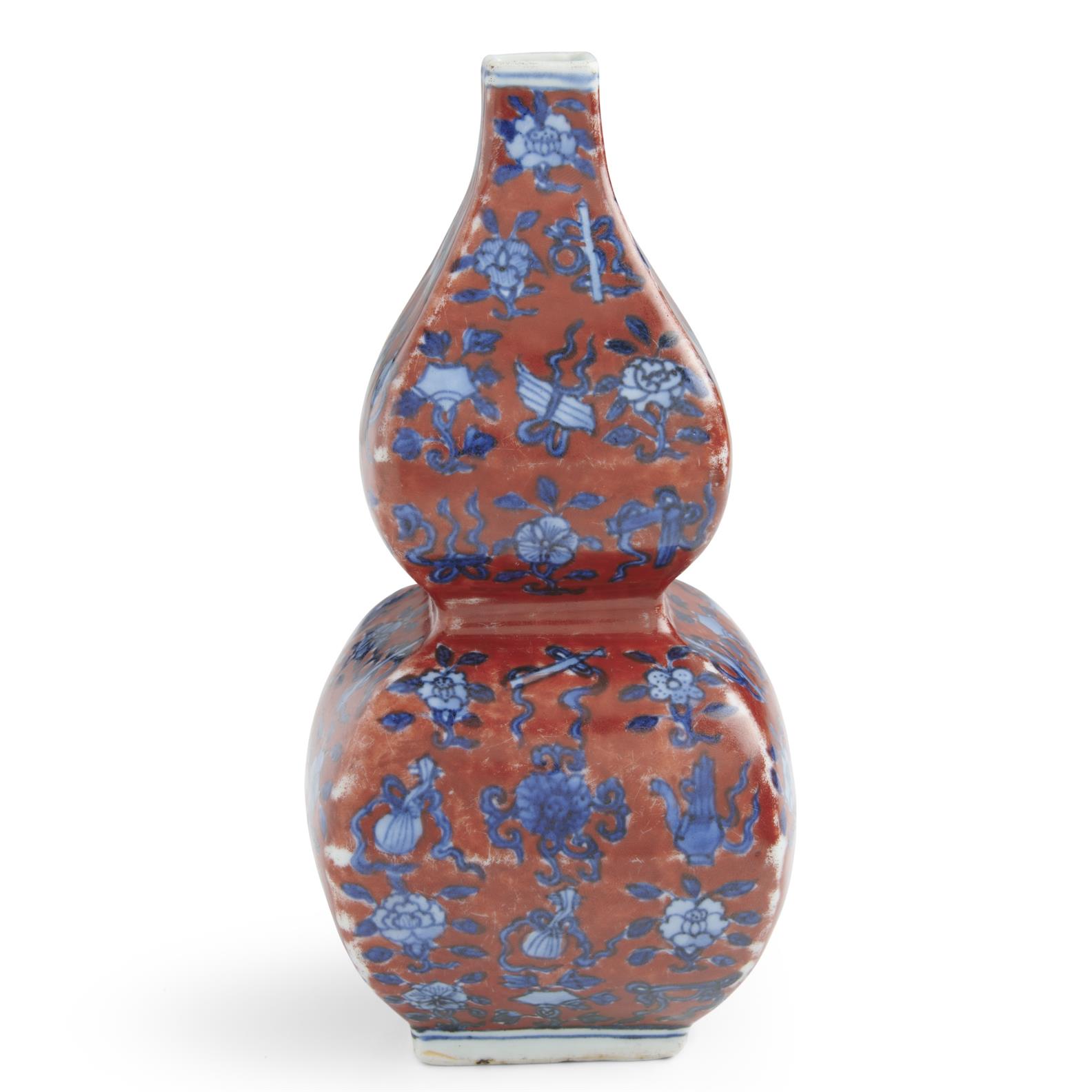
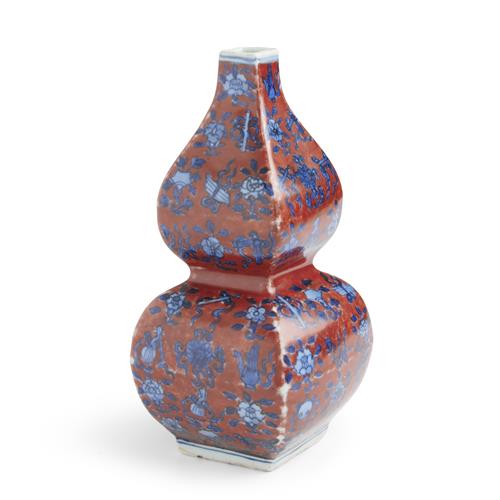
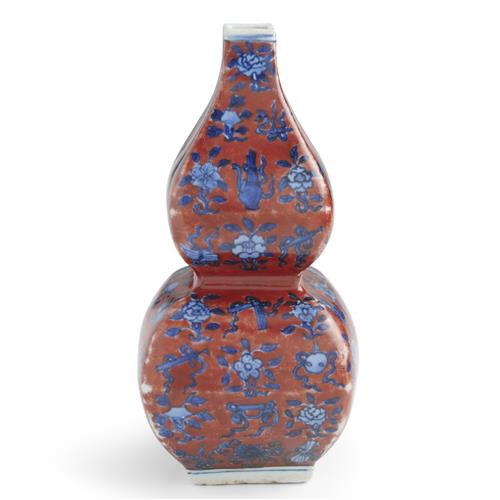
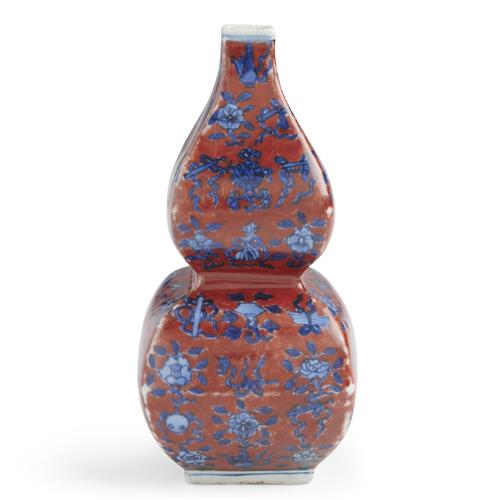
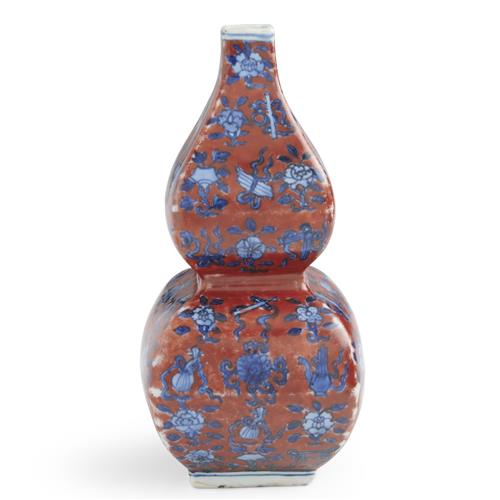
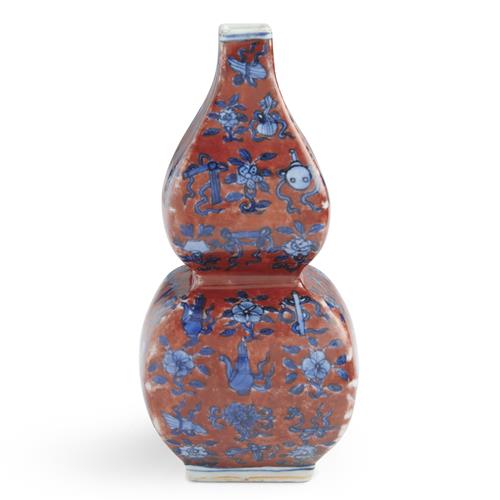
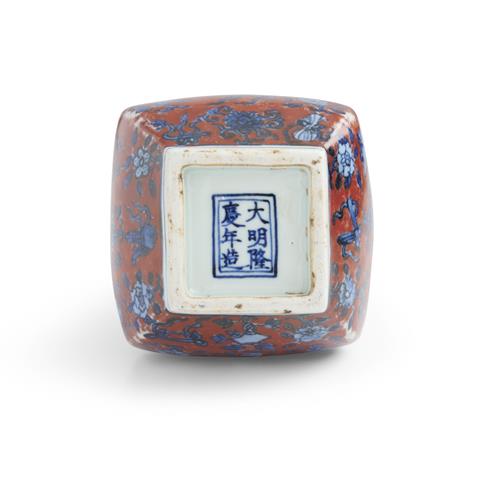
This vase has a square mouth and a tightened waist, shaped like a bottle-gourd but has squarish sides. The main theme of "Eight Musical Instruments" are painted with underglaze blue accompanied by flower sprays. The blank spaces are filled with overglaze red enamel over a secondary firing at a lower temperature. The very bright underglaze blue contrasts with the deep red overglaze enamel to produce an exquisite polarity bringing forth a riveting ancient look. The base has a six-character regular script mark of "made in the Great Ming's Longqing reign" in underglaze blue. This is indeed a fine piece of work from the Longqing period.
The "Eight Musical Instruments" (Bayin in Chinese) were well recorded in the book Sanzijing by the Song dynasty writer Wang Yingling. It stated that the pao (pottery gourds), tu (clay), ge (hide), mu (wood), shi (stone), jin (metal), si (silk) and zhu (bamboo) produce the eight sounds (Bayin). These sounds are typically represented by the musical instruments of zhong, qing, qin, xiao, sheng, xun, gu and zhu. The early Ming Emperor Taizu established strict music and musical instruments to be performed at the very solemn imperial temples and ritual
festivities. Subsequent emperors also followed in establishing ritual and solemn regal music to be performed during their reigns. The Jiajing reign (1522-1566) had established the most imperial ritual music. This was followed by Emperor Longqing (reigned 1567-1572). The Longqing period porcelains with the theme painting of the "Eight Musical Instruments" showed the emperor's devotion to ritual imperial music.
The Longqing period was only a short reign of six years. It was however a tumultuous six-year period including a great flood which had severely affected the production in Jingdezhen. Production of porcelain plummeted as a result. As such, it is usually quite rare to find porcelain vessels made in the Longqing period. However, Geng Baochang's renowned book Ming and Qing Porcelain on Inspection stated that:"It is not as recorded in most literature and reports that ‘there are no porcelain vessels of the Longqing period'. From
some extant relics, it could be seen that the two types of porcelain, the wucai and the blue and white both achieved a very remarkable high skill in the three reigns of Jiajing, Longqing and Wanli. These two are head and shoulders above the rest of the other porcelain." The current squarish bottle-gourd vase is quite unique and innovative with a very light and taut body. The underglaze blue has a tinge of purple while the red ground color is pure and intense emanating an ancient elegance. This vase is still in an impeccable condition. Vessels of similar design and painting had not been found so far after careful scrutiny of published details from various Chinese and overseas museums. This vase seems to be the only extant vessel of its kind from the Longqing period.
Compare with a similar vase, see Enlightening Elegance – Imperial Porcelain of the Mid to Late Ming, The Huaihaitang Collection, p. 220, fig.55, The Chinese University of Hong Kong Art Museum, 2012.
明 「大明隆慶年造」六字青花楷書款及本朝 御製青花紅彩八音圖葫蘆瓶
此瓶造型别致,方口束腰,呈方形葫芦状。器身以青花绘制“绶带八音图”为主题纹饰,间以折枝花卉装饰,构图繁密而不失雅致。空白处施以红彩,采用二次低温烧制工艺完成。青花色泽鲜艳明丽,红彩深沉纯正,二者对比强烈,增添古朴大气之美。器底书有“大明隆庆年造”六字青花双框楷书款,彰显其隆庆一朝官窑精品身份。
“八音”一词源于宋代王应麟《三字经》:“匏土革,木石金。丝与竹,乃八音。”意指钟、磬、琴、箫、笙、埙、鼓、柷八种传统乐器,是中国文化中寓意吉祥的经典图案之一。类似的“天宝图”在《程氏墨苑》中亦有记载,强调乐器图案承载了声、音、律与和谐理念。《礼记·乐记》曾提到:“乐者,天地之和也;礼者,天地之序也。”乐象征天地的和谐,礼则是宇宙的秩序与规范。明史中记载,明太祖制定宗庙礼乐,后历代皇帝不断完善,其中嘉靖朝最为盛行。隆庆皇帝秉承礼乐传统,奉行“大乐与天地同和,大礼与天地同节”的理念。隆庆三年修订的礼乐体系,与隆庆瓷器上的“八音图”纹饰相互呼应,反映出礼乐文化在器物上的彰显。
隆庆朝仅有六年,因时局动荡与景德镇水患,瓷器产量锐减,存世器物尤为稀少。据耿宝昌《明清瓷器鉴定》记载:“隆庆时期的青花与五彩器物技艺尤为精湛,独树一帜。”此方形葫芦瓶胎体轻薄,制作精巧,青花呈蓝紫色调,红彩纯正鲜艳,纹饰布局精密协调,古雅而端庄,尽显明代制瓷艺术的高峰水准。
经查阅国内外博物馆资料,同类纹饰与器型罕见,仅见此一例。本品状态保存完好,是隆庆一朝官窑匠心与卓越技艺的杰出结晶,尤为珍贵,堪称传世佳品。
參閱: 《機暇明道—懷海堂藏明代中晚期官窯瓷器》,55 圖,香港中文大學文物館,2012 年。
源流:
重要日本私人藏家珍藏。
出版:
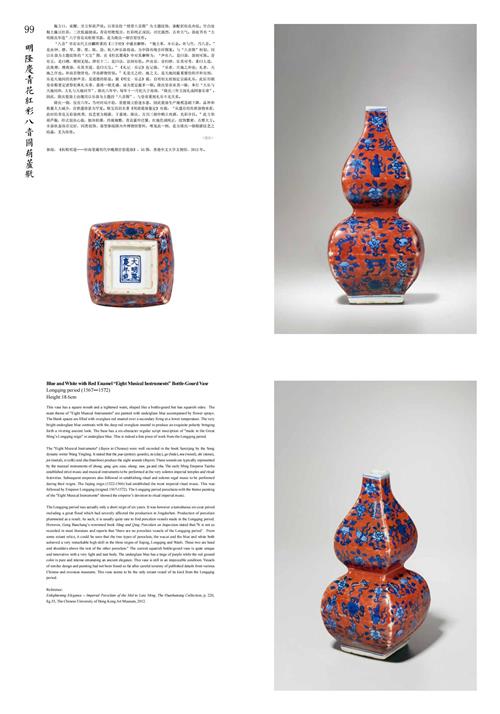
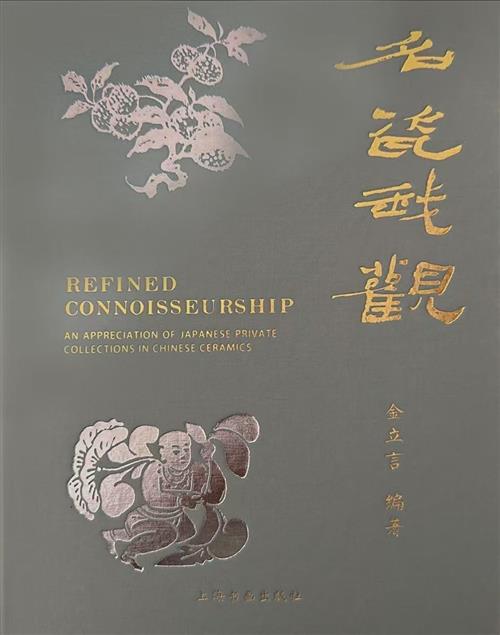
《名瓷我觀: 日本私家收藏清賞》,圖版:99。
18.5cm high
Estimate $100,000 - $200,000
Overall in good condition.
Please click here to see the detail photos of the whole auction.
The opinions expressed in the condition reports are a guide only and should not be treated as a statement of fact. Prospective buyers are encouraged to seek further information or request additional images during our pre-sale period where Leonard Joel staff are available for advice. Please note condition reports can be amended during the pre-sale period, so we strongly suggest any interested bidders check the published condition report available on the website before the auction commences. Leonard Joel makes no guarantee of the originality of mechanical or applied components. Absence of reference to such modifications does not imply that a lot is free from modifications.
Collection of an important Japanese collector.
Refined Connoisseurship: An Appreciation of Japanese Private Collections in Chinese Ceramics, no. 99.
Fine Chinese and Asian Art
AUCTION
Sale: LJ8763
11:00am - 2 March 2025
Hawthorn
VIEWING
Thurs 27 Feb - Sat 1 Mar, 10am - 4pm
2 Oxley Rd, Hawthorn VIC
CONTACT
Luke Guan
asianart@leonardjoel.com.au
SIMILAR ITEMS
Lot 29
A PAIR OF CHINESE BLUE AND WHITE FLORAL BOWLS QING DYNASTY, QIANLONG PERIOD (1736-1795)
Estimate: $15,000-25,000
Lot 88
A PAIR OF CHINESE FAMILLE-ROSE DISHES, YONGZHENG SIX-CHARACTER UNDERGLAZED BLUE MARK AND OF THE PERIOD (1723-1736)
Estimate: $8,000-12,000
Lot 163
A RARE CHINESE BLACK ‘EGGSHELL’ POTTERY STEMCUP, LONGSHAN CULTURE, C. 2500-2000B.C.
Estimate: $8,000-12,000
Lot 84
A RARE AND FINE CHINESE INK ENAMELED DRAGON PROCELAIN PLAQUE AND HUANGHUALI TABLE SCREEN, TANG YING SEAL MARK, QIANLONG PERIOD (17...
Estimate: $7,000-9,000