Back
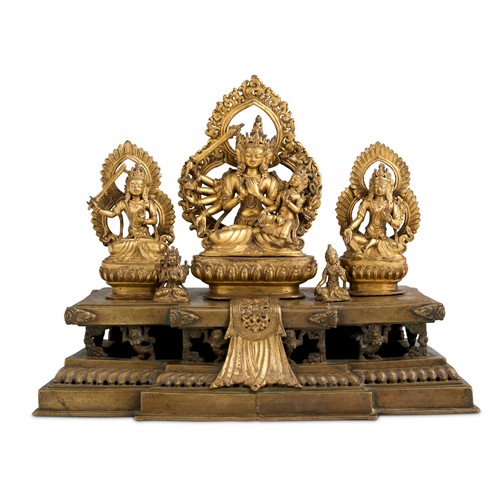
A LARGE AND RARE NEPALESE GILT-BRONZE BUDDHIST TRINITY GROUP, DATED TO 1832 AND OF THE PERIOD
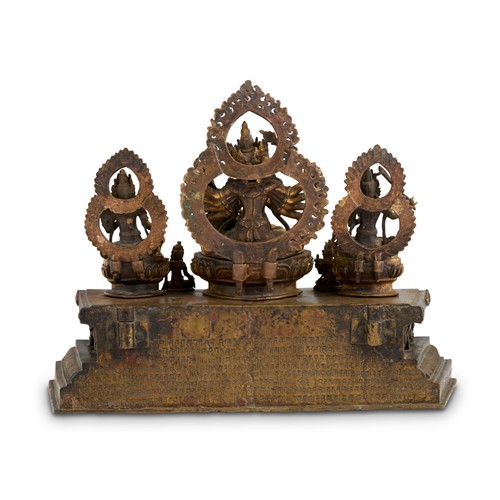
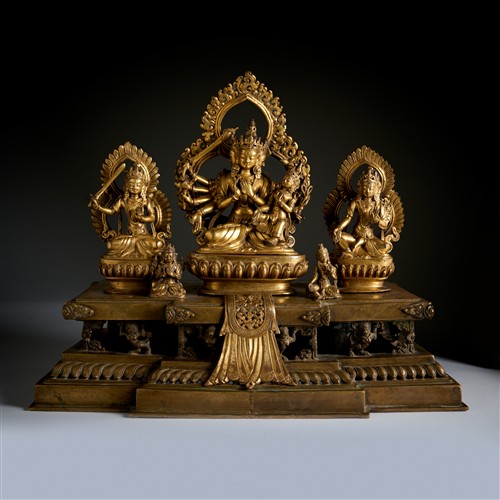
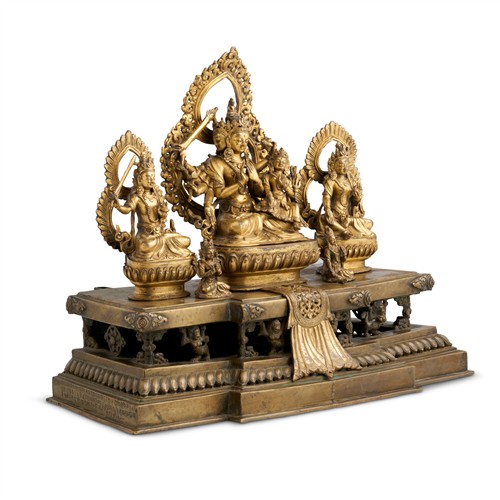
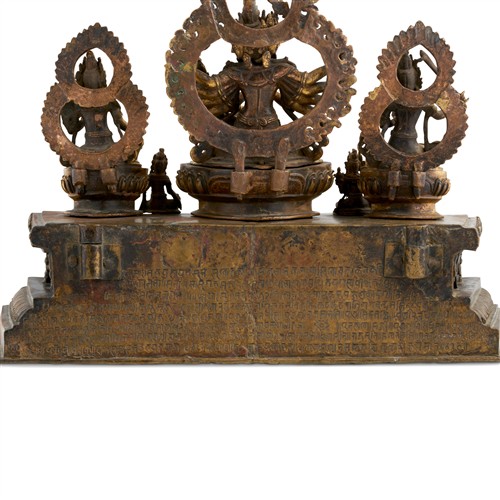
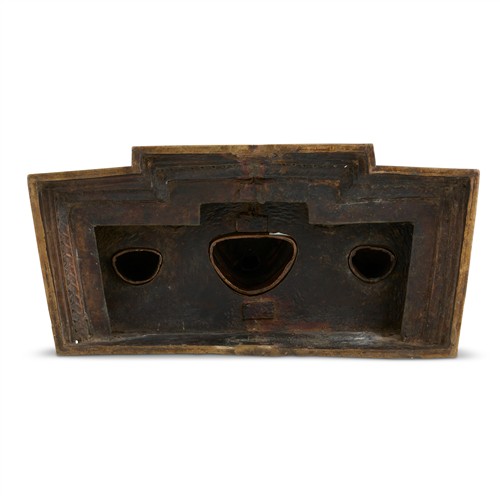
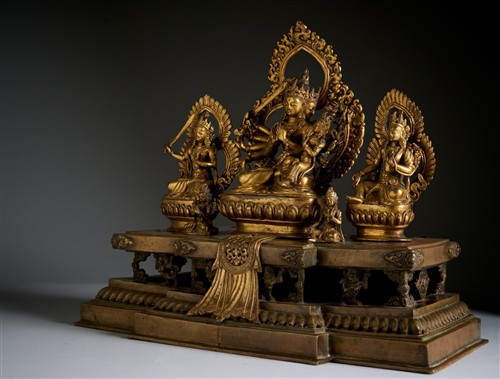
The central figure in a three-headed and six-armed form, seated with his consort in dhyanasana on a double lotus base, holding various Buddhist attributes including a sword, vajra and ghanta, wearing a multi-crowned headdress, roundel earrings, and a long beaded necklace with armlets and bracelets, a gently folded dhoti and celestial scarf, his shakti seated on his left knee in lalitasana, seated either side on lotus bases further forms of Manjusri and retinue figures, the entire group surrounded by swirling scrollwork and seated on a rectangular, tiered openwork base decorated in relief with yakshas, the reverse of the base with inscription.
This sculpture depicts Manjushri in the form of Dharmadhatsuvajisvara seated at the centre in dhyanasana (meditation) with his female consort Sarasvati with hands in varadamudra and abhayamudra, surrounded by other forms of Manjusri and retinue figures.
Compare with a related Nepalese gilt-bronze group depicting Manjusri and consort, dated 1816, which was sold at Christie's London, 10 November 2006, lot 260.
The translation appearing on the reverse and side of the group reads as:
Namomitaprabhapate mune: sukhavativasite canukarapa/ sukhavati
Kanakavi-
citrakanana// manorama sugatasutairala?k?ta/ tatha casuya prathitayasasya
dhimatah prabha-
sitam bahumuni ratnasamcana// sreyostu// samvat 952 mti bhadrapadamase krsnapakse ekadasyantithau
sivayoge yathakarnnamuhurte brhaspativasare kamnya rasigate savitari karkka?arasigate candramasi idamsa divase
pita sri bhajudhanaju xxx mata gunalaksmi// thvate nihma pramukham putra sri simnarasi// putra sri ratramanasim// putri sihalaksmi putri ratna thakum
Thaoya namana// suvarnnanirmita sri sukhavati lokesvara dayakao pratistha yana juro// * // puna bhakha: sajiva putra sri vidhidhunaju// putra sri dhiju
... //putra sri Laksminarasim// putra sri ... sim putra sri rajanarasim// pautra sri sthayo muni// dhaca muni// raja muni// hakhanarsim ...
... thvate samohana ubhaya juyao// thva suvarna pratima dayaka juro// thvateya punyana saptavrddhi kalyana juya mara// subha//
Text on the side:
puna kha// babu mamayata asugrumati coya tatya: yapako pujo 7 dhami vupi pha 2//
dyadi vupi pha 1/ thuti vu babumama paroksa jusyam li thuti vuya sahmana
va?avadeva puja yayamala// jula//subha//
Translation:
'Greeting to Amitabha Buddha, who resides in the Sukhavati heaven. Sukhavati is indeed very beautiful. This is a dwelling place of Many great sages. The heaven is brightly illuminated by the glory of renowned inelegant [Buddha Amitabha] and it has wonderful golden park...
May it be auspicious. On Thursday, the eleventh day of the dark half of the Bhadra month (August/September) of Nepal Samvat 952 (CE 1832) the golden image of Sukhavati Lokesvara was created and consecrated. [Astrologically it was] on the day of Sivayoga, Karana muhurta. On this day the Sun was on Kanya Rasi and the Moon on Karkata Rasi.
The image is made for our [deceased members of the family], father Bhaju Dhanaju ... mother Guna Laksmi and their sons Simnarasim and Rajamanasim and their daughters Simha Laksmi and Ratna Thakum. ... Their children, who are still alive, are their sons Vidhidhunaju, Dhiju, ... Laksminarasim, ...Sim, Rajanarasim and their grandsons Sthayo Muni, Dhaca Muni, Raja Muni, and Hakha Narasim. As a united group, they are fully responsible for the commission of this golden image. With this religious merit, may they have seven-fold prosperity and auspicious happy life!'
On the side of the pedestal:
'Following is the annual revenues and the names of land donated for the religious merit of father and mother: the cultivated land of Dhapako, which yields 7 pujao of rice, the cultivated land of Dhami, which yields 2 pha rice, the cultivated land of Dyadi, which yields 1 pha rice. With these revenues, the annual rite called vasavadeva [of the god] should be conducted. May it be auspicious.'
Translation by G.V. Vajracharya, September 2018
1832年紀年 尼泊爾銅鎏金三尊佛 組像
底部銘文譯為:
“禮敬居於極樂世界(Sukhāvatī)的阿彌陀佛。極樂世界實在無比莊嚴殊勝,乃諸大聖賢所安住之淨土。彼天界因無量光佛阿彌陀佛之光明而普照輝耀,並擁有奇妙莊嚴的黃金園苑……
願吉祥圓滿。
於尼泊爾曆952年(公元1832年)跋陀月(Bhadra,約當八月至九月)下弦十一日,星期四,鑄造並開光此尊鎏金極樂觀自在菩薩(Sukhāvatī Lokeśvara)像。是日適逢「濕婆瑜伽」(Śivayoga)及「Karana Muhurta」吉時。其時太陽位於處女宮(Kanyā Rāśi),月亮位於巨蟹宮(Karkaṭa Rāśi)。”
源流:
英國顯赫私人收藏
倫敦邦瀚斯拍賣行,2018年11月8日,拍品250
36cm wide, 30cm high
Sold for $40,000
Lot 91
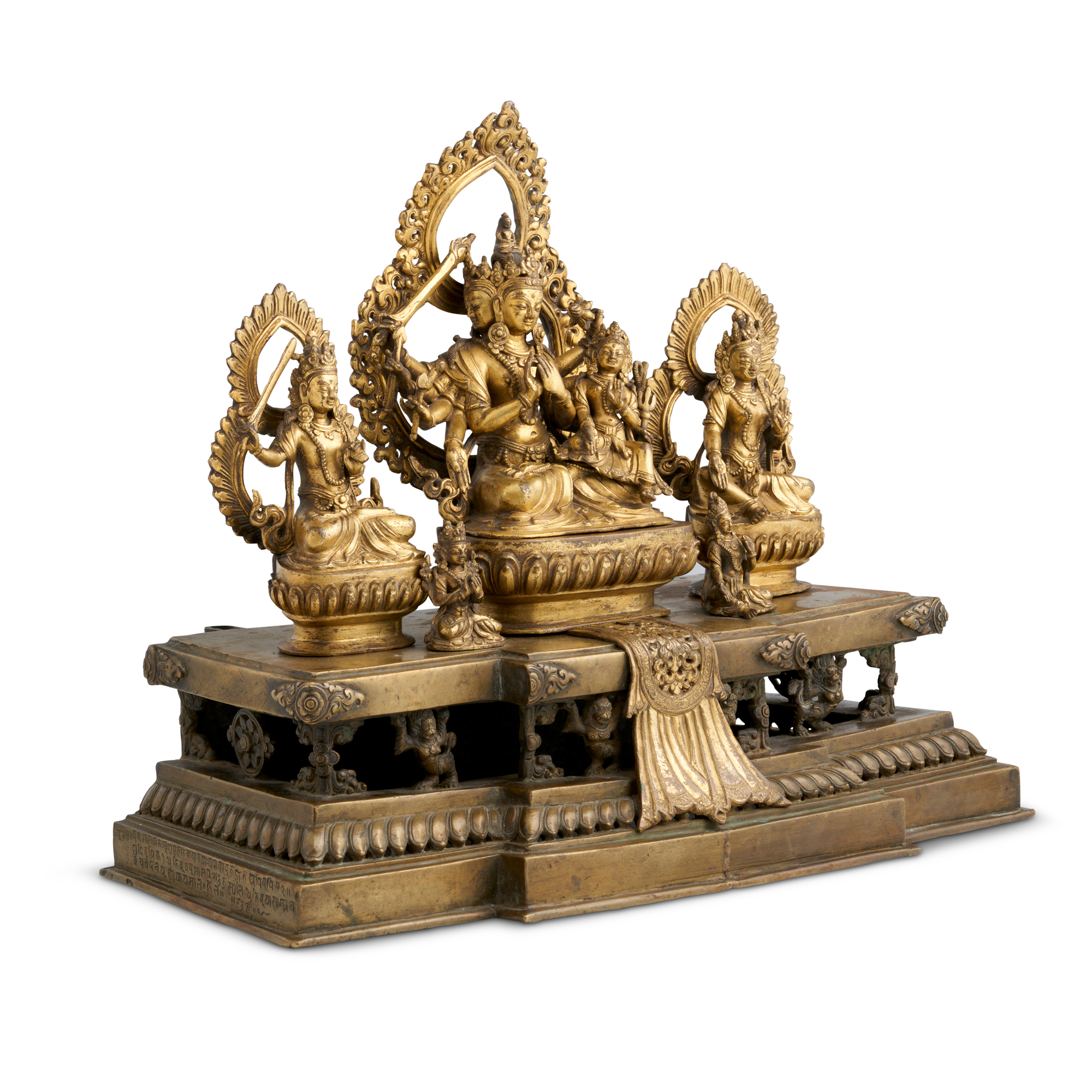
The central figure in a three-headed and six-armed form, seated with his consort in dhyanasana on a double lotus base, holding various Buddhist attributes including a sword, vajra and ghanta, wearing a multi-crowned headdress, roundel earrings, and a long beaded necklace with armlets and bracelets, a gently folded dhoti and celestial scarf, his shakti seated on his left knee in lalitasana, seated either side on lotus bases further forms of Manjusri and retinue figures, the entire group surrounded by swirling scrollwork and seated on a rectangular, tiered openwork base decorated in relief with yakshas, the reverse of the base with inscription.
This sculpture depicts Manjushri in the form of Dharmadhatsuvajisvara seated at the centre in dhyanasana (meditation) with his female consort Sarasvati with hands in varadamudra and abhayamudra, surrounded by other forms of Manjusri and retinue figures.
Compare with a related Nepalese gilt-bronze group depicting Manjusri and consort, dated 1816, which was sold at Christie's London, 10 November 2006, lot 260.
The translation appearing on the reverse and side of the group reads as:
Namomitaprabhapate mune: sukhavativasite canukarapa/ sukhavati
Kanakavi-
citrakanana// manorama sugatasutairala?k?ta/ tatha casuya prathitayasasya
dhimatah prabha-
sitam bahumuni ratnasamcana// sreyostu// samvat 952 mti bhadrapadamase krsnapakse ekadasyantithau
sivayoge yathakarnnamuhurte brhaspativasare kamnya rasigate savitari karkka?arasigate candramasi idamsa divase
pita sri bhajudhanaju xxx mata gunalaksmi// thvate nihma pramukham putra sri simnarasi// putra sri ratramanasim// putri sihalaksmi putri ratna thakum
Thaoya namana// suvarnnanirmita sri sukhavati lokesvara dayakao pratistha yana juro// * // puna bhakha: sajiva putra sri vidhidhunaju// putra sri dhiju
... //putra sri Laksminarasim// putra sri ... sim putra sri rajanarasim// pautra sri sthayo muni// dhaca muni// raja muni// hakhanarsim ...
... thvate samohana ubhaya juyao// thva suvarna pratima dayaka juro// thvateya punyana saptavrddhi kalyana juya mara// subha//
Text on the side:
puna kha// babu mamayata asugrumati coya tatya: yapako pujo 7 dhami vupi pha 2//
dyadi vupi pha 1/ thuti vu babumama paroksa jusyam li thuti vuya sahmana
va?avadeva puja yayamala// jula//subha//
Translation:
'Greeting to Amitabha Buddha, who resides in the Sukhavati heaven. Sukhavati is indeed very beautiful. This is a dwelling place of Many great sages. The heaven is brightly illuminated by the glory of renowned inelegant [Buddha Amitabha] and it has wonderful golden park...
May it be auspicious. On Thursday, the eleventh day of the dark half of the Bhadra month (August/September) of Nepal Samvat 952 (CE 1832) the golden image of Sukhavati Lokesvara was created and consecrated. [Astrologically it was] on the day of Sivayoga, Karana muhurta. On this day the Sun was on Kanya Rasi and the Moon on Karkata Rasi.
The image is made for our [deceased members of the family], father Bhaju Dhanaju ... mother Guna Laksmi and their sons Simnarasim and Rajamanasim and their daughters Simha Laksmi and Ratna Thakum. ... Their children, who are still alive, are their sons Vidhidhunaju, Dhiju, ... Laksminarasim, ...Sim, Rajanarasim and their grandsons Sthayo Muni, Dhaca Muni, Raja Muni, and Hakha Narasim. As a united group, they are fully responsible for the commission of this golden image. With this religious merit, may they have seven-fold prosperity and auspicious happy life!'
On the side of the pedestal:
'Following is the annual revenues and the names of land donated for the religious merit of father and mother: the cultivated land of Dhapako, which yields 7 pujao of rice, the cultivated land of Dhami, which yields 2 pha rice, the cultivated land of Dyadi, which yields 1 pha rice. With these revenues, the annual rite called vasavadeva [of the god] should be conducted. May it be auspicious.'
Translation by G.V. Vajracharya, September 2018
1832年紀年 尼泊爾銅鎏金三尊佛 組像
底部銘文譯為:
“禮敬居於極樂世界(Sukhāvatī)的阿彌陀佛。極樂世界實在無比莊嚴殊勝,乃諸大聖賢所安住之淨土。彼天界因無量光佛阿彌陀佛之光明而普照輝耀,並擁有奇妙莊嚴的黃金園苑……
願吉祥圓滿。
於尼泊爾曆952年(公元1832年)跋陀月(Bhadra,約當八月至九月)下弦十一日,星期四,鑄造並開光此尊鎏金極樂觀自在菩薩(Sukhāvatī Lokeśvara)像。是日適逢「濕婆瑜伽」(Śivayoga)及「Karana Muhurta」吉時。其時太陽位於處女宮(Kanyā Rāśi),月亮位於巨蟹宮(Karkaṭa Rāśi)。”
源流:
英國顯赫私人收藏
倫敦邦瀚斯拍賣行,2018年11月8日,拍品250
36cm wide, 30cm high
Estimate $45,000 - $65,000
It's overall in good condition, the main mandorla is missing.
CLICK TO SEE DETAIL PHOTOS OF THE WHOLE AUCTION