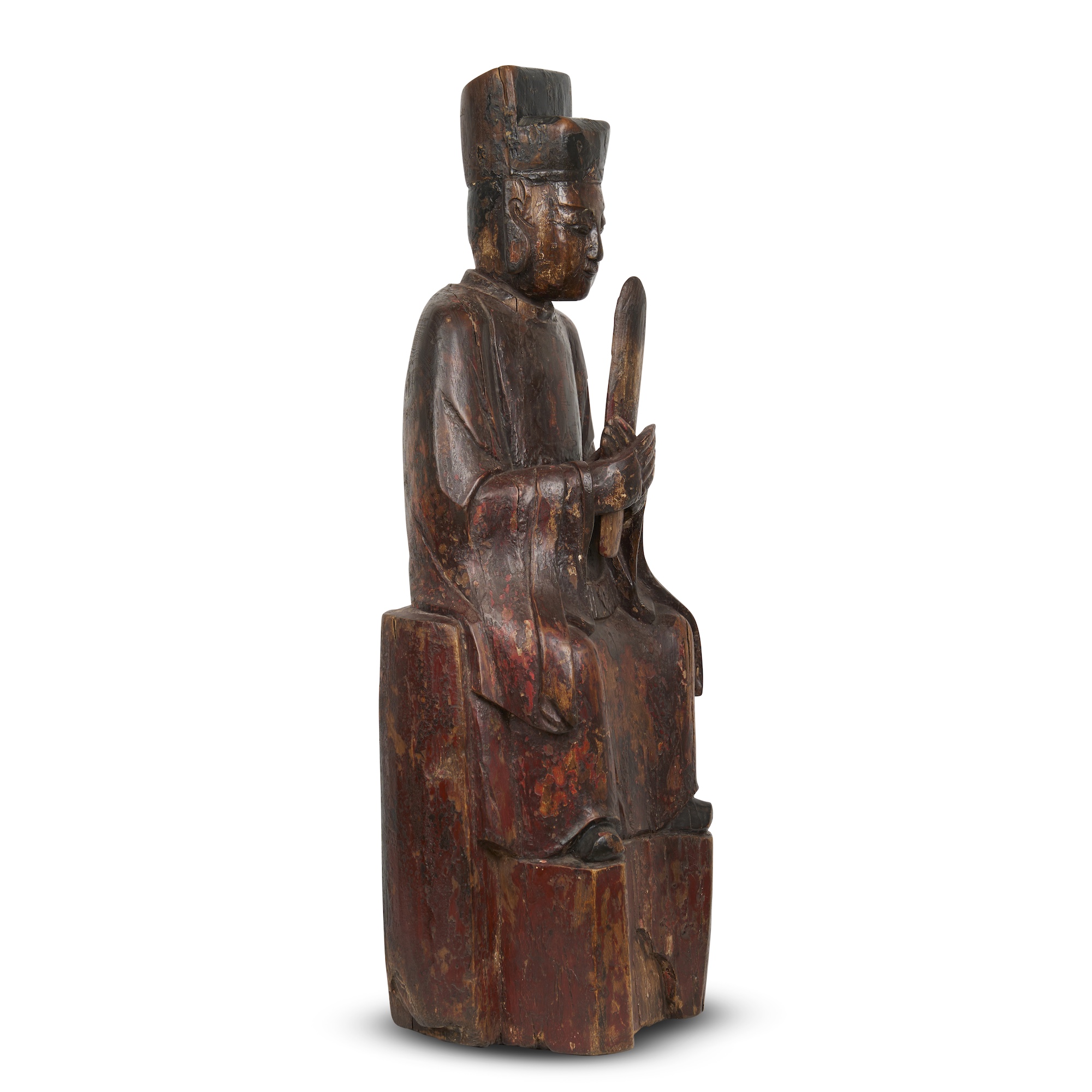
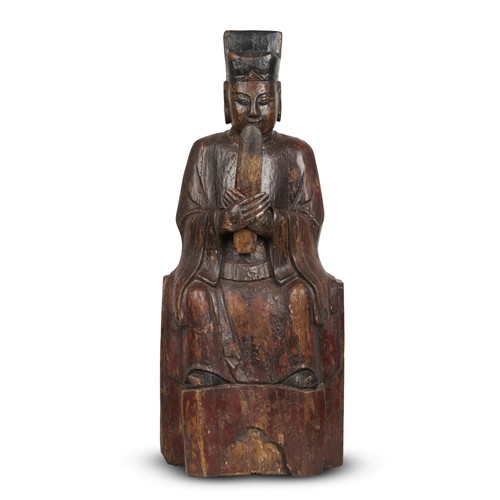
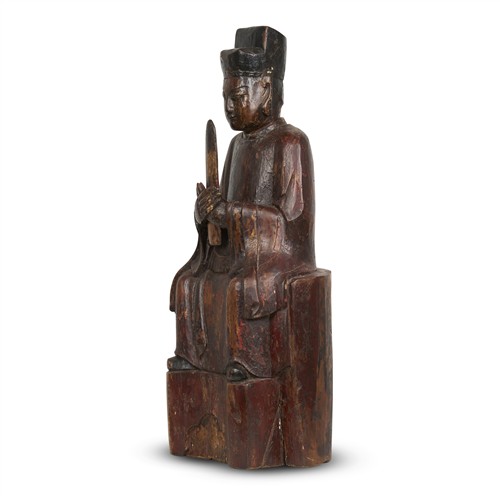
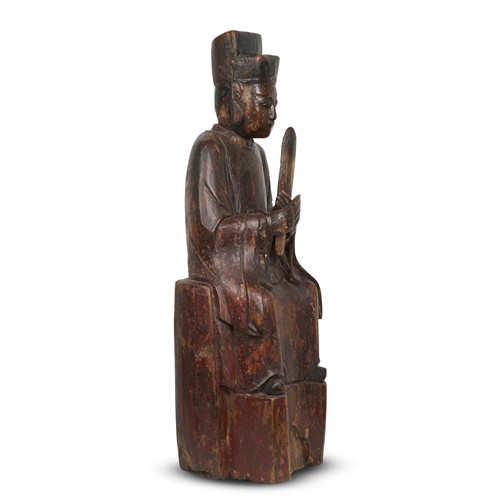
The carved seated figure with legs pendant, his hands raised before his chest holding a tablet, wearing long flowing robes with remnants of polychrome lacquer, tied around the waist with a belt, the downcast face with serene expression, remnants of a moustache and beard and high sage cap with mirrored roundel.
Representations of the Heaven Official (Tianguan), a deity traditionally associated with the bestowal of blessings, prosperity and official success, occupied an important place in popular religious practice throughout imperial China. Venerated in both public and private settings, such figures were especially prominent during New Year celebrations, when prayers and offerings were made in anticipation of good fortune for the year ahead. The inscribed tablet held before the chest typically symbolizes the conferral of auspicious wishes and heavenly favour.
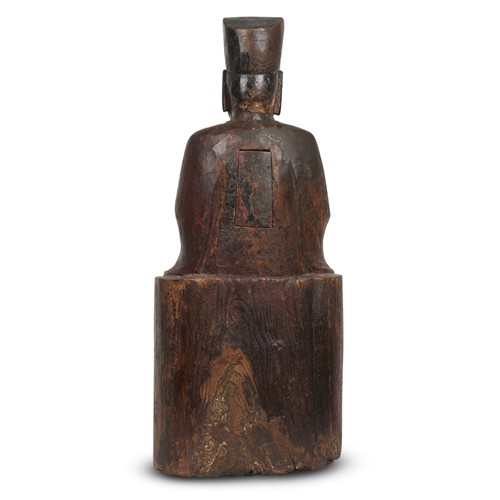
The present figure is further distinguished by its exceptional craftsmanship. The voluminous robes are rendered with remarkable fluidity and depth, the naturalistic folds conveying both dignity and movement. Traces of gilding remain across the surface, indicating that the sculpture was originally enhanced with gold leaf, a costly embellishment reflecting the high degree of reverence accorded to the image by its devotees. A hollow compartment carved into the reverse was likely intended to house consecratory materials or dedicatory documents, a practice commonly associated with sacred sculptures.
As early as the Tang dynasty, sculpted and painted representations of Confucius and other revered figures of the literati tradition received ritual offerings at the imperial court. This practice, however, became increasingly contested, and in 1530 the Jiajing Emperor decreed that images of Confucius and his disciples in official temples should be replaced with spirit tablets, emphasizing the veneration of their teachings rather than their physical likenesses. Surviving sculptural figures dating to the Yuan and early Ming periods are therefore comparatively rare. The present work belongs to a broader tradition of devotional sculpture that flourished before such reforms, enhancing both its historical significance and rarity.
An almost identical figure with larger size (108cm high), dated to late Yuan/early Ming Dynasty, was offered at Bonham London, 12/5/2008, lot 84.
75cm high
Estimate $4,000 - $6,000
Overall in good condition, a few areas of lacquer losses and natural old cracks which are all consistent with age and use.
The opinions expressed in the condition reports are a guide only and should not be treated as a statement of fact. Prospective buyers are encouraged to seek further information or request additional images during our pre-sale period where Leonard Joel staff are available for advice. Please note condition reports can be amended during the pre-sale period, so we strongly suggest any interested bidders check the published condition report available on the website before the auction commences. Leonard Joel makes no guarantee of the originality of mechanical or applied components. Absence of reference to such modifications does not imply that a lot is free from modifications.
A private collection, NSW., acquired from Humble House Gallery, ACT, 15/2/2002 (with original receipt, no. 78).
Important Chinese & Asian Art
AUCTION
Sale: LJ8825
11:00am - 25 October 2026
Hawthorn
VIEWING
Thurs 22 - Sat 24 October, 11am - 5pm
2 Oxley Rd, Hawthorn VIC
CONTACT
Luke Guan
luke.guan@leonardjoel.com.au
SIMILAR ITEMS
Lot 14
A VERY RARE PAIR OF CHINESE FAMILLE ROSE AND GRISAILLE-DECORATED 'LANDSCAPE' STOOLS, YONGZHENG PERIOD (1723 - 1735)
Estimate: $100,000-200,000
Lot 112
A CHINESE HIGH-FIRED WHITE-GLAZED CUP, SUI DYNASTY (581-618)
Estimate: $50,000-80,000
Lot 134
AN EXTREMELY RARE CHINESE HUSHAN WARE OVOID PHOSPHATIC EWER, TANG DYNASTY, 8TH/9TH CENTURY
Estimate: $50,000-70,000
Lot 178
A CHINESE ARCHAIC BRONZE RITUAL VESSEL, ZUN, LATE SHANG/EARLY WESTERN ZHOU DYNASTY, 12TH-10TH CENTURY BCE
Estimate: $50,000-70,000