Lot 26
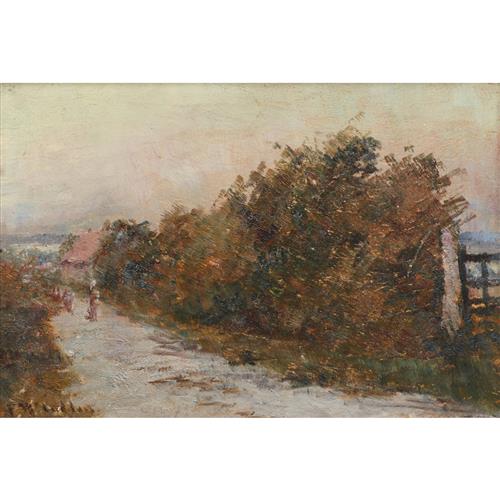
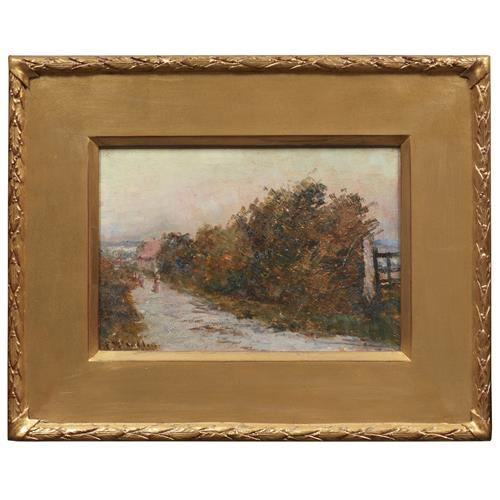
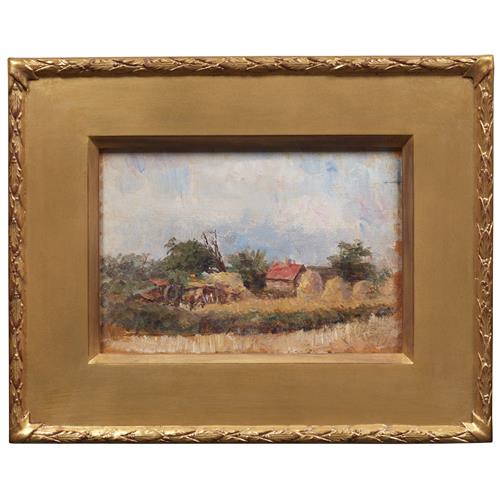
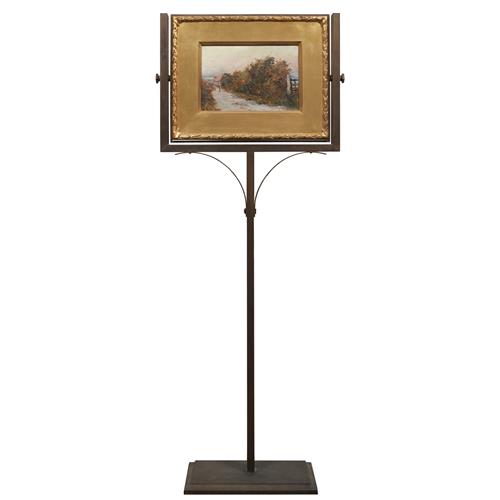
The Country Lane
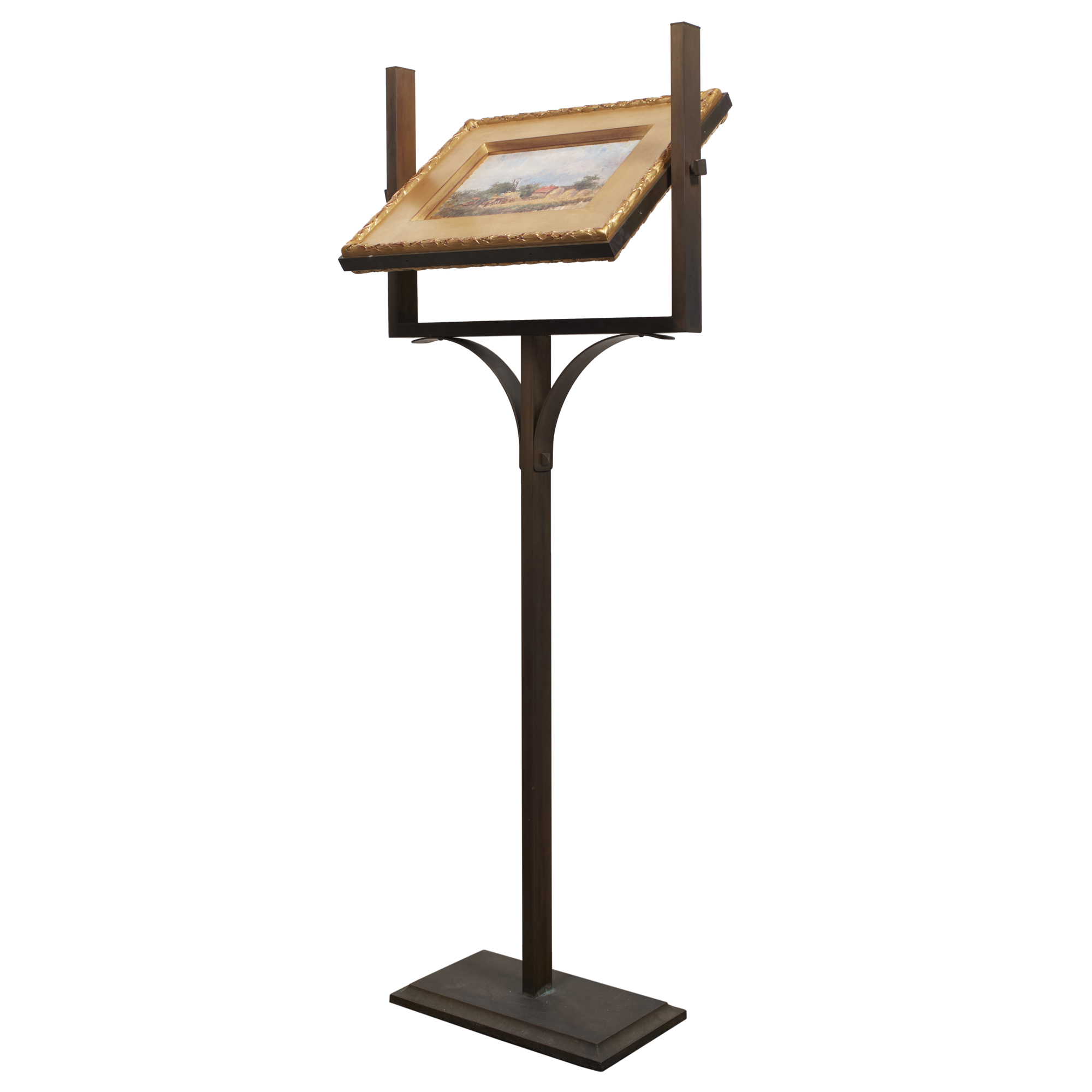
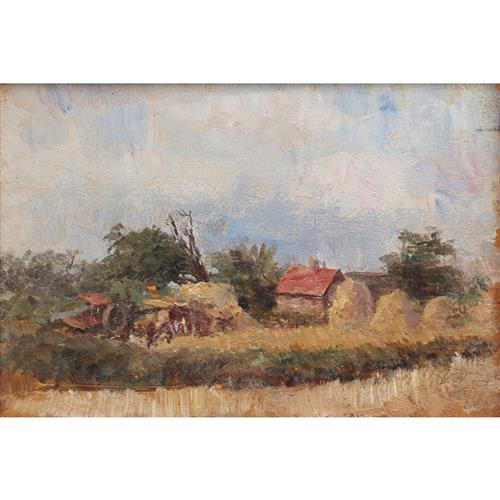
Farm House (verso)
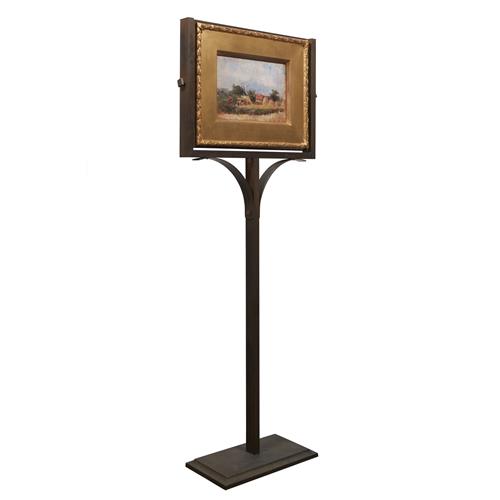
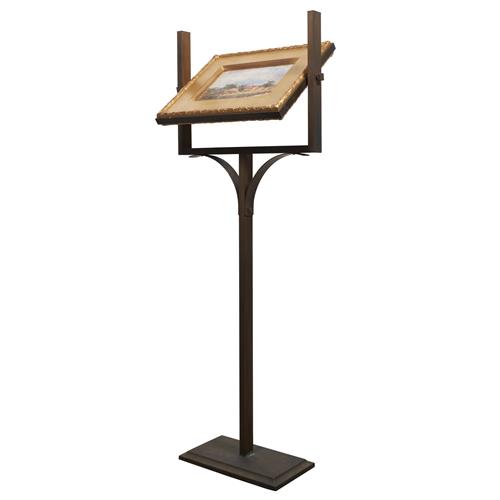
oil on board, double-sided
in a custom made frame stand
signed lower left: F. McCubbin
23 x 33.5cm
Estimate $25,000 - $35,000
Mrs Alexander, student of the Artist
Thence by descent
Christies, Melbourne, 8 May 2001, lot 134
Private collection, Western Australia
Frederick McCubbin (1855-1917) was among a group of painters of the Australian scene now known as the 'Heidelberg School'. At art school they had been introduced to the landscape painter's craft by Eugene von Guerard, who was fixated with technique; although he did inspire the students to go sketching in bushland at Studley Park. 'For the first time I was awakened to the beauties to Australian landscape,' McCubbin always recalled of that afternoon. Painting together on their bush camps, from the late 1880s these artists reached high levels of achievement by combining aspects of rural life, open-air naturalism, and certain impressionist values.
Where others in the 'Heidelberg School' initially excelled painting rural views and sun-drenched vistas, McCubbin gain attention with pictorial statements using a figure or two in secluded bush settings. His celebrated 'big pictures' 'Lost' (1886), 'Down on His Luck' (1889) and 'On the Wallaby Track' (1896) were dramas of human struggle in an untamed land. But these shady forest scenes exuded a strong affinity for nature, indeed, the Argus newspaper suggested each of his intimiste pictures of Victorian bush amounted to 'a little poem without words.' There was a poignant beauty to McCubbin's delicate tracery of gum leaves and twiggy branches, of gentle saplings and dry grasses.
Roberts, Streeton and Conder subsequently left the colony, adopting a cosmopolitan twang when painting in Europe. However, McCubbin accepted a coveted teaching position at the National Gallery School and stayed put in Melbourne. Setting aside story-telling, he would henceforth channel his energies into consciously Australian compositions which imbibed nature with a moody veracity.
McCubbin adopted a disciplined work pattern from the late 1890s. If he resided in Melbourne during the teaching week, much painting time was spent an hour's train journey north of the city at Mt Macedon, where the artist established himself in 'Fontainebleau' cottage. The spacious studio there was where his finest work was lovingly crafted.
'Bush Study, Macedon' (Lot 30) is among a series of bushland images McCubbin made of the mountain's upper slopes. With short, loosely pulled strokes and small paint dashes, it shows a section of virgin forest touched by a previous bushfire. Looking through packed timbers we see the trunk of a sturdy eucalypt rising in full sunlight, although it is screened by the scorched limbs of an adjacent dead tree, while other saplings around bear sprays of green growth.
The Macedon locality offered a multitude of natural settings, McCubbin choosing varied subjects on regular rambles there. Sure enough, the artist draws the viewer's attention to a different aspect of nature with a stunted eucalypt in 'Mount Macedon' (Lot 19). It is set on a sunny day just before the onrush of spring. With a bed of bracken at its base, the scrawny tree is by a grassy walking track between the railway station and scattered houses at Macedon. Taking obvious delight in its random growth, the artist has fastidiously recorded this dense tangle of dead lichen-covered branches to the front, and verdant young boughs behind, which have flourished for untold years.
Another aspect of nature is handled in 'Bush Setting, Mount Macedon' (Lot 28) where dark forest rises over the trickling beck that supplied water behind a cottage (hence the large tub). Much is carried in these works by the tasty brushwork, indeed, the artist wanted the viewer to lean in close and savour his paint skin. McCubbin excelled at what conservators term his 'opalescent' illumination, crafting layers of oil pigment shot through with jewel like colours. This was made by applying multiple notes of paint with small brushes he trimmed to shape, and tiny scrapers he made himself. The finished picture may be small, but up close it is selfevidently intense, each tiny note enabling the artist to work with shimmering divided colours.
A break in McCubbin's oeuvre occurred in 1907 when he took several months leave to travel overseas. He sailed for Britain where he based himself in London, meeting up with old friends, and making excursions to France and Italy to see the sights and visit great museums, intently studying Old Master works. This would be his only trip abroad.
'Hammersmith Bridge' (Lot 9) and 'The Country Lane' (Lot 26) are products of that trip. Both painted on prepared panels, one is a quick oil sketched by the Thames in west London, whereas the latter is a considered-and more deftly worked-view of a profuse hedgerow encountered in the English countryside. Ever fascinated by nature, McCubbin strives to convey the persona of this unfamiliar landscape while knitting spicy strokes in his characteristic paint skin.
Upon his return to Melbourne, the artist increasingly painted everyday corners of Prahran and South Yarra. 'Towards Prahran' (Lot 16) shows a long brick wall, over which we glimpse the tops of shrubs in a domestic garden, and a slender sight of the distant inner suburb. Yet again the motif serves as an avenue into visual enjoyment, observed facts giving way to a multitude of glistening dabs and buttery scuffs of pigment.
'Figures in Street, A Bit of South Yarra' (Lot 29), a contemporaneous work, is an accomplished oil sketch of pedestrian traffic. It is evident McCubbin has absorbed Monet on his overseas travels, but this is an impression in his own painterly terms, using brush and scrapers to summarise figures.
In 1909 McCubbin purchased 'Carlesberg', a colonial period house at the end of Kensington Rd, South Yarra. Bordered by the Como Estate, it came with 3 1/2 acres of informal garden which directly overlooked the river. The views from, and trees within, that sloping garden supplied subjects for his very late canvases.
With a deliberately diffuse paint application 'Artist's Garden, South Yarra' (Lot 13) is a lovingly crafted view of melaleucas along a fence. All is stillness and lyrical beauty in this secluded corner of the artist's garden, a slice of nature he identified with. Shown on a frosty winter morning, this is late McCubbin at his very finest.
'The Lime Tree (Yarra from Kensington Rd)' (Lot 10) is the last painting McCubbin completed. Much is packed into this composition, which offers another tree, a glimpse of the Yarra River and of suburban Richmond beyond, as well as the artist's signature paintwork. Knowing he was mortally ill, McCubbin chose to make a final work showing the mature Linden tree in his garden when it was covered in new spring leaves on a warm day-a symbol of nature's regeneration.
Dr Christopher Heathcote
Christopher Heathcote (PhD) is an author of several books, art critic, and authority on Australian art. In a chequered career he has been senior art critic for The Age, associate editor of Art Monthly Australia, an academic at La Trobe and Melbourne Universities then the Victorian College of the Arts, a curator of exhibitions at regional galleries and Canberra's National Gallery, as well as head of the Gordon Institute's art school.
A Private Collection of Important Australian Art
AUCTION
Sale: LJ8793
6:00pm - 25 August 2025
Hawthorn
VIEWING
SYD: Thur 14 - Sun 17 Aug, 10am - 4pm
The Bond, 36-40 Queen St, Woollahra, NSW
MELB: Thur 21 - Sun 24 Aug, 10am - 4pm
2 Oxley Rd, Hawthorn, VIC
CONTACT
Wiebke Brix
wiebke.brix@leonardjoel.com.au
SIMILAR ITEMS
Lot 10
FREDERICK MCCUBBIN (1855-1917) The Lime Tree (Yarra River from Kensington Road, South Yarra) 1917 oil on canvas 97 x 110cm
Estimate: $600,000-800,000
Lot 20
RUPERT BUNNY (1864-1947) Portrait de Mme B... c.1914 (also known as Portrait of the Artists Wife) oil on canvas 217 x 107.5cm
Estimate: $300,000-400,000
Lot 17
RUPERT BUNNY (1864-1947) The Sonata c.1910 (also known as La Sonate) oil on canvas 80 x 64cm
Estimate: $200,000-300,000
Lot 22
ARTHUR STREETON (1867-1943) Ramparts Face the Ocean 1932 (also known as Southern Ocean) oil on canvas 50 x 75cm
Estimate: $150,000-200,000