Back
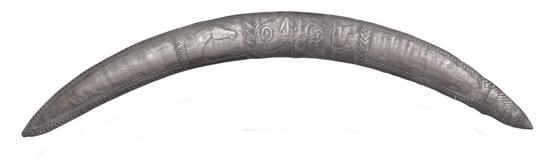
Q^G BOOMERANG
EARLY TRANSITIONAL QUEENSLAND BOOMERANG
circa 1901-1910, possibly from Barambah/ Cherbourg
carved hardwood with natural ridges. Incised on the front surface with figurative images including a spade, horse head and saddle and bordered by traditional designs, deep glossy patina overall
61.5cm (length)
PROVENANCE
Private collection, UK
OTHER NOTES
Over the last few decades a rare group of indigenous cross-cultural objects have sporadically come to light and each time they raise more questions than are answered. A scarcity of information surrounds them and the fact that most artists are seldom identifiable lends the objects an intrigue, and on a both scholarly and collector level, a last frontier quality. It's only in recent times that academics and the dedicated few have begun to map this fairly uncharted, but important cultural territory. Hence, the re-emergence of this group of repatriated Queensland artifacts offer valuable and curious insights into a little known chapter of Australian history and are sure to contribute to the growing body of cross-cultural knowledge, as well as presenting an uncommon opportunity for collectors.
Described in various quarters as contact or transitional art, decorated artifacts emerged towards the end of the 19th century and by mid century had shifted from carved surfaces to pokerwork and paint. In essence, contact art bears witness to Aborigines' experience of change, of dislocation from traditional lands, and also their interest and willingness to adapt to facets of European life.[1]
The early contact artifacts (pre 1920) ranging from woomeras, coolamons, clubs to boomerangs, incised with stone scrapers and later metal tools, display a combination of both figurative and geometric elements (the latter carried encoded knowledge but were inserted discretely to the object's borders and tips). In subsequent periods the geometric designs began to dissipate and native animal imagery dominated. In contrast, early contact figurative imagery frequently depicted new found features of European life including missionaries, police, stockmen, often in combination with native animals or scenes from traditional indigenous life.
Contact art has been traced to settlements and missions as far afield as La Perouse, NSW, Flinders Ranges, S.A. and Barambah, now called Cherbourg, in SE Queensland. The Barambah artifacts are some of the earliest found and may have begun as personal recordings for an individual or their community, however by 1911 they were consciously created for an external market:
"Barambah inmates were involved in exhibitions and performances that were specifically designed to promote the settlement. In 1911, the Chief Protectors' Department organised a display of the various facets of its work. Each settlement and mission, including Barambah, was asked to contribute items of work by its inmates. Items displayed ranged from samples of schoolwork to traditionally made implements and weapons." [2]
The group of early 20th century Queensland artifacts comprised of two decorated boomerangs and a club, have emerged from a private collector in the United Kingdom, however their provenance while long held is, unsurprisingly, unknown. Nonetheless, the reclaimed nature of the trio is certain, evident from the natural ridges found on one boomerang, to the scratched grip markings on the club, reinforcing their dating to an early period when decoration was applied to pre-existing objects, rather than later times when boomerangs were carved from scratch and decorated for a ready commercial market.
Similarly, the artifact group all bear decorative attributes displayed in Barambah carvings, but after research, one of the boomerangs, while retaining some shared characteristics, overwhelmingly and tantalisingly proffers a different point of origin.
Emblazoned with the word 'Galbraith' on its left half side, a flower near the centre and a charming multi carriage train on its right, the highly detailed and finely executed boomerang is rich with clues to its lineage. The prominence bestowed upon 'Galbraith' does not belong to a town or cattle station, but in all likelihood to Percy Dumas Fead Galbraith. Born in 1854 in County Cork, Ireland he served in the New Zealand Police Force and by 1884 he was a sub-inspector in the Queensland Police. He rose through the ranks to Inspector (2nd Class) status and by 1901 Percy Galbraith was appointed Aboriginal Protector of Normanton in Gulf country, a remote port and cattle hub in north-west Queensland and he remained there until 1904. In gleaning the annual Chief Aboriginal Protector reports [3], Galbraith comes across as a humane individual who was committed to his role of protecting and upholding the rights of the Aboriginal people at a time when tensions were rife between the Europeans, particularly station owners and the indigenous population. He advocated Aborigines' unhindered access to traditional water holes, declaring "to deprive them of this right simply means wiping them out or driving them in to the smaller townships where women must prostitute themselves in order to enable the men and children to live. Those that are myalls [nomadic aborigines] will naturally kill the cattle, or even commit murder, if driven away from their hunting grounds." [4]
Given Protector Galbraith's role within the community, it is feasible that he was either gifted the boomerang by an indigenous person (maybe a stockman or a tracker) or instead, Galbraith may himself have commissioned the decorated boomerang as a memento. It could be speculated that he was influenced by the avid interest in indigenous material culture held by his superior, Chief Aboriginal Protector Walter E. Roth. Known for his care and respect of the Aboriginal people, Roth was also an anthropologist and ethnographer whose 2000 strong artifact collection and documentation [5] was acquired by the Australian Museum, Sydney in 1905.
Returning to the boomerang surface, the carved train filled with passengers, cattle, horses and cargo provides more evidence grounding it in the early 20th century and the Normanton region. In 1891 the Normanton-Croydon train line was built to service the export of gold discovered in Croydon six years earlier. The boom was short-lived and by 1907 the mines and towns were in decline. Until 1906 an A10 Locomotive ran on the line and photographs of this particular steam engine reveal that its features are exactly replicated in the carving down to its four coupled wheels with their distinctive 5 -spoke star shape[6].
The flower decorating the Galbraith boomerang provides an intriguing link to Barambah with a club from the SE Qld settlement boasting an identical motif [7]. Barambah was settled over the same period as Galbraith's Normanton tenure, so the existence of the same floral carving suggest that either two artists belonging to the same language group were active in separate locations, or contentiously, that the Galbraith boomerang predates many of the Barambah artifacts.
Other Barambah stylistic attributes, primarily traditional markings including cross-hatching, as well as crescent shapes, arrows and beading used as decorative and framing devices are carved into the Galbraith boomerang's design. The club is purely embellished with geometric designs including the same arrows and circle designs found in Barambah art.
Scott Rainbow, author of A study of the transitional art of Barambah/ Cherbourg Settlement in QLD (2009) and major collector of the art, has identified seven common recurring Barambah motifs and characteristics, two of which are featured in the 'Q^G' boomerang. Flanking the central panel are an incised image of a horse head and that of a saddle which Rainbow relates to Aboriginal stockmen, although, in this case they could equally and most probably symbolise the police upon decoding the letter and symbol stamp.
The recreational activities of the Aboriginal stockmen, namely card playing found their way into the pictorial language of contact art and constitutes the second example of common motifs. Sitting at the boomerang's apex is a clear rendition of a spade. Carved inside it are the letters "Q "and "G" along with the broad arrow symbol. This symbol is a military ordnance mark which denoted government issued equipment assigned to the Queensland police as well as Aboriginal trackers. The stamp was operational in Queensland between 1890-1910, however it began to be phased out from 1901 once Federation occurred [8].
Whether this boomerang belongs to Barambah is not certain, however the rustic style of the letter G, the compositional structure and spare design differentiates it from the Galbraith artifact which exhibits greater embellishment and intricate detail indicating that it is by another artistic hand.
Recognition for contact artifacts has long been overdue, but with an increasing number of studies by Paul Tacon et al and the Scott Rainbow collection, these special objects have been recast from ignorantly being best considered as curiosities and at worst early tourist ware into significant social, historical and cultural documents for indigenous and non-indigenous Australians alike.
SOPHIE ULLIN
[1] Tacon, P., South, B., and Hooper. S.B., 'Depicting cross-cultural interaction; figurative designs in wood, earth and stone from south-east Australia, Archeol, Oceania 38 (2003), pp.89-101
[2] Rainbow, S., A study of the transitional art of Barambah/ Cherbourg Settlement in QLD, September 2009, p.1, on www.artoceanic.com
[3] Annual Report of the Chief Protector of Aboriginals for 1901-1904, http:/archive.aiatsis.gov.au./removeprotect
[4] Percy Galbraith quoted in May,D., Aboriginal Labour and the Cattle Industry; Queensland from White Settlement to the Present, Cambridge University Press, 1994, p.64
[5] The artefacts were collected between 1898-1904 and majority were from Queensland. Khan, K., Catalogue of the Roth Collection of Aboriginal Artefacts from North Queensland, Australian Museum Scientific Publications, Sydney 1996, vol 2, p,6 .
[6] Note: Normanton boasted a Victorian period railway station which in all probability bore its name in Victorian/Edwardian lettering, as most other building signs from historical photos attest. It is the same style font used in the execution of 'Galbraith'.
[7] Rainbow, S., Ibid, ref.no. CH10 p.12 (illus)
[8] Information provided by Paddy O'Brien from I.S. Wright , Sydney 1 February 2012
Sold for $7,000
Lot 148
EARLY TRANSITIONAL QUEENSLAND BOOMERANG
circa 1901-1910, possibly from Barambah/ Cherbourg
carved hardwood with natural ridges. Incised on the front surface with figurative images including a spade, horse head and saddle and bordered by traditional designs, deep glossy patina overall
61.5cm (length)
PROVENANCE
Private collection, UK
OTHER NOTES
Over the last few decades a rare group of indigenous cross-cultural objects have sporadically come to light and each time they raise more questions than are answered. A scarcity of information surrounds them and the fact that most artists are seldom identifiable lends the objects an intrigue, and on a both scholarly and collector level, a last frontier quality. It's only in recent times that academics and the dedicated few have begun to map this fairly uncharted, but important cultural territory. Hence, the re-emergence of this group of repatriated Queensland artifacts offer valuable and curious insights into a little known chapter of Australian history and are sure to contribute to the growing body of cross-cultural knowledge, as well as presenting an uncommon opportunity for collectors.
Described in various quarters as contact or transitional art, decorated artifacts emerged towards the end of the 19th century and by mid century had shifted from carved surfaces to pokerwork and paint. In essence, contact art bears witness to Aborigines' experience of change, of dislocation from traditional lands, and also their interest and willingness to adapt to facets of European life.[1]
The early contact artifacts (pre 1920) ranging from woomeras, coolamons, clubs to boomerangs, incised with stone scrapers and later metal tools, display a combination of both figurative and geometric elements (the latter carried encoded knowledge but were inserted discretely to the object's borders and tips). In subsequent periods the geometric designs began to dissipate and native animal imagery dominated. In contrast, early contact figurative imagery frequently depicted new found features of European life including missionaries, police, stockmen, often in combination with native animals or scenes from traditional indigenous life.
Contact art has been traced to settlements and missions as far afield as La Perouse, NSW, Flinders Ranges, S.A. and Barambah, now called Cherbourg, in SE Queensland. The Barambah artifacts are some of the earliest found and may have begun as personal recordings for an individual or their community, however by 1911 they were consciously created for an external market:
"Barambah inmates were involved in exhibitions and performances that were specifically designed to promote the settlement. In 1911, the Chief Protectors' Department organised a display of the various facets of its work. Each settlement and mission, including Barambah, was asked to contribute items of work by its inmates. Items displayed ranged from samples of schoolwork to traditionally made implements and weapons." [2]
The group of early 20th century Queensland artifacts comprised of two decorated boomerangs and a club, have emerged from a private collector in the United Kingdom, however their provenance while long held is, unsurprisingly, unknown. Nonetheless, the reclaimed nature of the trio is certain, evident from the natural ridges found on one boomerang, to the scratched grip markings on the club, reinforcing their dating to an early period when decoration was applied to pre-existing objects, rather than later times when boomerangs were carved from scratch and decorated for a ready commercial market.
Similarly, the artifact group all bear decorative attributes displayed in Barambah carvings, but after research, one of the boomerangs, while retaining some shared characteristics, overwhelmingly and tantalisingly proffers a different point of origin.
Emblazoned with the word 'Galbraith' on its left half side, a flower near the centre and a charming multi carriage train on its right, the highly detailed and finely executed boomerang is rich with clues to its lineage. The prominence bestowed upon 'Galbraith' does not belong to a town or cattle station, but in all likelihood to Percy Dumas Fead Galbraith. Born in 1854 in County Cork, Ireland he served in the New Zealand Police Force and by 1884 he was a sub-inspector in the Queensland Police. He rose through the ranks to Inspector (2nd Class) status and by 1901 Percy Galbraith was appointed Aboriginal Protector of Normanton in Gulf country, a remote port and cattle hub in north-west Queensland and he remained there until 1904. In gleaning the annual Chief Aboriginal Protector reports [3], Galbraith comes across as a humane individual who was committed to his role of protecting and upholding the rights of the Aboriginal people at a time when tensions were rife between the Europeans, particularly station owners and the indigenous population. He advocated Aborigines' unhindered access to traditional water holes, declaring "to deprive them of this right simply means wiping them out or driving them in to the smaller townships where women must prostitute themselves in order to enable the men and children to live. Those that are myalls [nomadic aborigines] will naturally kill the cattle, or even commit murder, if driven away from their hunting grounds." [4]
Given Protector Galbraith's role within the community, it is feasible that he was either gifted the boomerang by an indigenous person (maybe a stockman or a tracker) or instead, Galbraith may himself have commissioned the decorated boomerang as a memento. It could be speculated that he was influenced by the avid interest in indigenous material culture held by his superior, Chief Aboriginal Protector Walter E. Roth. Known for his care and respect of the Aboriginal people, Roth was also an anthropologist and ethnographer whose 2000 strong artifact collection and documentation [5] was acquired by the Australian Museum, Sydney in 1905.
Returning to the boomerang surface, the carved train filled with passengers, cattle, horses and cargo provides more evidence grounding it in the early 20th century and the Normanton region. In 1891 the Normanton-Croydon train line was built to service the export of gold discovered in Croydon six years earlier. The boom was short-lived and by 1907 the mines and towns were in decline. Until 1906 an A10 Locomotive ran on the line and photographs of this particular steam engine reveal that its features are exactly replicated in the carving down to its four coupled wheels with their distinctive 5 -spoke star shape[6].
The flower decorating the Galbraith boomerang provides an intriguing link to Barambah with a club from the SE Qld settlement boasting an identical motif [7]. Barambah was settled over the same period as Galbraith's Normanton tenure, so the existence of the same floral carving suggest that either two artists belonging to the same language group were active in separate locations, or contentiously, that the Galbraith boomerang predates many of the Barambah artifacts.
Other Barambah stylistic attributes, primarily traditional markings including cross-hatching, as well as crescent shapes, arrows and beading used as decorative and framing devices are carved into the Galbraith boomerang's design. The club is purely embellished with geometric designs including the same arrows and circle designs found in Barambah art.
Scott Rainbow, author of A study of the transitional art of Barambah/ Cherbourg Settlement in QLD (2009) and major collector of the art, has identified seven common recurring Barambah motifs and characteristics, two of which are featured in the 'Q^G' boomerang. Flanking the central panel are an incised image of a horse head and that of a saddle which Rainbow relates to Aboriginal stockmen, although, in this case they could equally and most probably symbolise the police upon decoding the letter and symbol stamp.
The recreational activities of the Aboriginal stockmen, namely card playing found their way into the pictorial language of contact art and constitutes the second example of common motifs. Sitting at the boomerang's apex is a clear rendition of a spade. Carved inside it are the letters "Q "and "G" along with the broad arrow symbol. This symbol is a military ordnance mark which denoted government issued equipment assigned to the Queensland police as well as Aboriginal trackers. The stamp was operational in Queensland between 1890-1910, however it began to be phased out from 1901 once Federation occurred [8].
Whether this boomerang belongs to Barambah is not certain, however the rustic style of the letter G, the compositional structure and spare design differentiates it from the Galbraith artifact which exhibits greater embellishment and intricate detail indicating that it is by another artistic hand.
Recognition for contact artifacts has long been overdue, but with an increasing number of studies by Paul Tacon et al and the Scott Rainbow collection, these special objects have been recast from ignorantly being best considered as curiosities and at worst early tourist ware into significant social, historical and cultural documents for indigenous and non-indigenous Australians alike.
SOPHIE ULLIN
[1] Tacon, P., South, B., and Hooper. S.B., 'Depicting cross-cultural interaction; figurative designs in wood, earth and stone from south-east Australia, Archeol, Oceania 38 (2003), pp.89-101
[2] Rainbow, S., A study of the transitional art of Barambah/ Cherbourg Settlement in QLD, September 2009, p.1, on www.artoceanic.com
[3] Annual Report of the Chief Protector of Aboriginals for 1901-1904, http:/archive.aiatsis.gov.au./removeprotect
[4] Percy Galbraith quoted in May,D., Aboriginal Labour and the Cattle Industry; Queensland from White Settlement to the Present, Cambridge University Press, 1994, p.64
[5] The artefacts were collected between 1898-1904 and majority were from Queensland. Khan, K., Catalogue of the Roth Collection of Aboriginal Artefacts from North Queensland, Australian Museum Scientific Publications, Sydney 1996, vol 2, p,6 .
[6] Note: Normanton boasted a Victorian period railway station which in all probability bore its name in Victorian/Edwardian lettering, as most other building signs from historical photos attest. It is the same style font used in the execution of 'Galbraith'.
[7] Rainbow, S., Ibid, ref.no. CH10 p.12 (illus)
[8] Information provided by Paddy O'Brien from I.S. Wright , Sydney 1 February 2012
Estimate $2,000 - $3,000
Sunday Fine Art Sale March
AUCTION
Sale: LJ5614
2:00pm - 25 March 2012
333 Malvern Rd, South Yarra 3141
VIEWING
CONTACT
Nicole Salvo
nicole.salvo@leonardjoel.com.au
SIMILAR ITEMS
Lot 90
JOHN GLOVER (1767-1849) Leathes Water, Skiddaw and Saddleback in Distance oil on canvas
Estimate: $70,000-90,000
Lot 39
HANS HEYSEN (1877-1968) Lilydale Landscape (Dame Nellies Country) also titled Landscape Across the Yarra Valley from Coome Cottage,...
Estimate: $50,000-70,000
Lot 68
JOHN PERCEVAL (1923-2000) Nightfall, Williamstown Docks oil on canvas
Estimate: $60,000-70,000
Lot 16
JOHN GLOVER (1767-1849) Wooded River Landscape with Anglers and Cattle in the Foreground oil on canvas
Estimate: $40,000-60,000