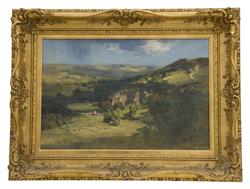
Lot 21
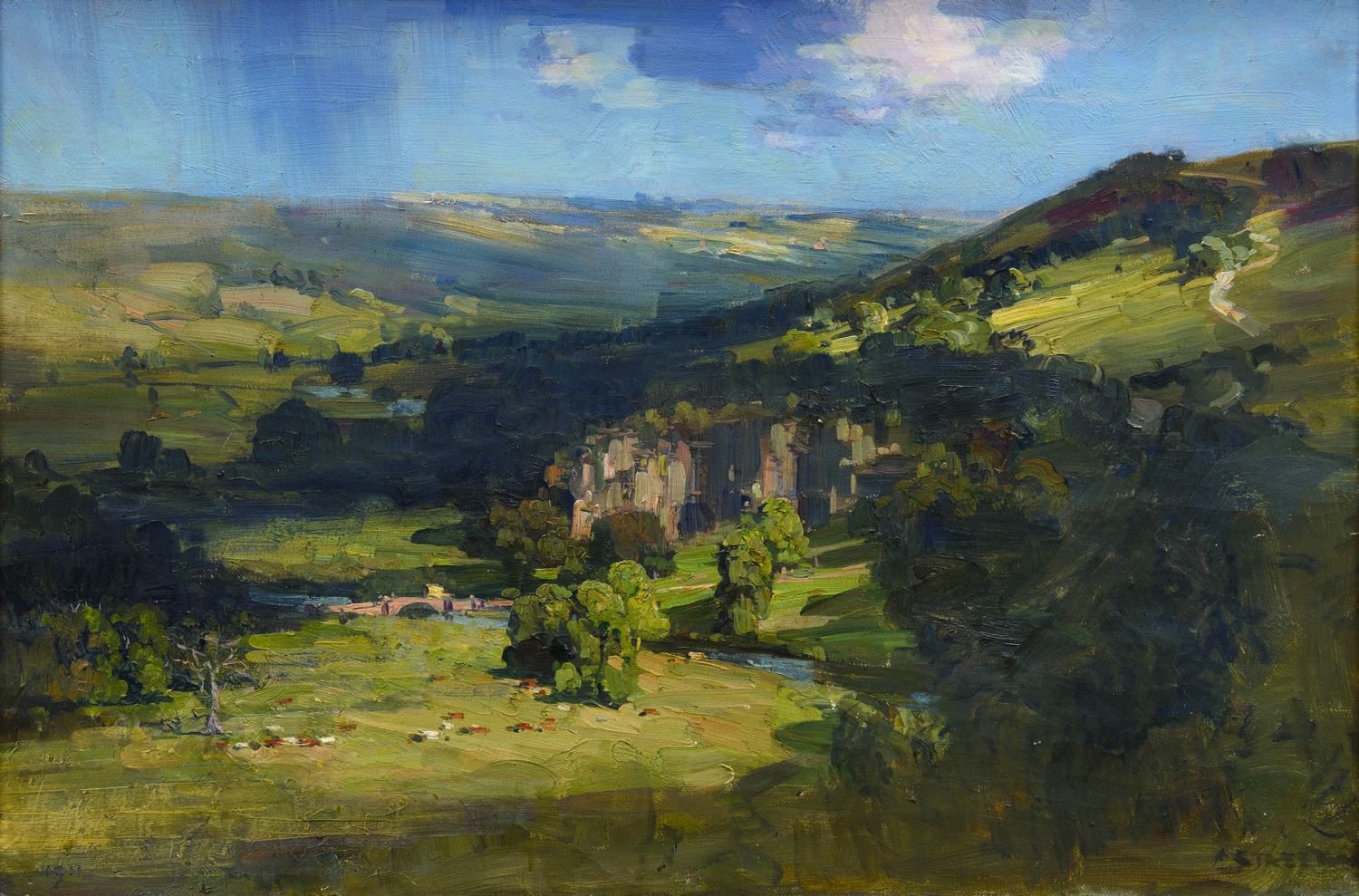
Valley of Sir Richard Arkwright 1911
oil on canvas
signed lower right: A. STREETON
dated lower left
in original John Thallon frame (label verso)
51 x 75cm
Estimate $70,000 - $90,000
The painting is in very good condition consistent with age.
The paint surface displays light surface dirt and minor fly spots. There are areas of light cracks forming in the paint, the most notable in the upper left corner within the sky. These appear overall stable however.
There are 5 minor losses of pigment through the centre. There are two on the right hand side, that appear to be the result of another object coming into contact with the canvas (these are roughly 1-2mm each). There is another loss within the central trees (approximately 2mm) and two minute losses further to the left hand side (pin-sized).
There is a small loss of pigment on the far bottom edge, left hand side approximately 3mm. There are two small losses far upper edge, right hand side each approximately 2mm. There is a minor loss in the lower right, which appears to be from a foreign object coming into contact with the paint surface (approximately 2mm).
There is very minor slack to the canvas, as it has naturally loosened over time.
Under UV light, there are no apparent areas of restoration and no indications of repair verso. Under UV light we can see the layer of varnish having an overall yellowish-green colour only visible under UV light, typical of older varnish of this period. Therefore it may be preferable to have this old varnish removed and readhered freshly.
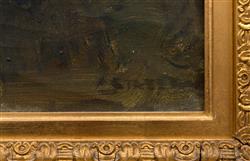
The frame is the work's original John Thallon frame, although there are seemingly gold paint additions to the facade. No significant losses are apparent to the frame.
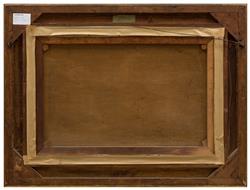
The verso of the canvas is exposed.
The opinions expressed in the condition reports are a guide only and should not be treated as a statement of fact. Prospective buyers are encouraged to inspect articles for sale at our pre-sale viewing where Leonard Joel staff are available for advice.
Leonard Joel makes no guarantee of the originality of mechanical or applied components. Absence of reference to such modifications does not imply that a lot is free from modifications.
Sir Arthur Streeton
Victorian Artists Society Gallery, Melbourne
The Collection of Dr. J H. Kelly
Thence by descent
Mr Streeton's Pictures, Victorian Artists Society Gallery, Melbourne, June, 1914, cat. no. 10
'Mr Arthur Streeton's pictures', Leader, Melbourne, 6 June 1914, p.51
Streeton, A., The Arthur Streeton Catalogue, Arthur Streeton, Melbourne, 1935, no. 456
Related works:
Arkwright's Valley, Derbyshire 1911, oil on canvas, 90.0 x 144.6cm, The Collection of the National Gallery of Victoria, Melbourne
Arkwright Valley c.1913, lithograph, 19.9 x 31.6cm, The Collection of the Art Gallery of New South Wales, Sydney
In 1911, when Valley of Sir Richard Arkwright was painted, Arthur Streeton was living a charmed life in England. He had comfortable lodgings at St John's Wood, London, he was a member of various high-ranking British and Colonial art associations and was establishing himself as an artist with international reach and reputation.
During these English years, Streeton was well known for travelling and painting abroad, particularly in Venice, but he also ventured to paint locations closer to home. The search for suitable subject matter took him to the English counties, where he often painted in the company of newly made friends or as a guest of wealthy art patrons.
Although we do not know precisely why Streeton ventured to the East Midlands in 1911, he would have been attracted to the area's beautiful valleys, meandering streams, broad leaf foliage and rocky outcrops and peaks. Known as the birthplace of the world's first water-powered cotton mills, the purpose-built industrial town of Cromford was both a thriving haven for visitors and the home of the mill's founder Sir Richard Arkwright (1755-1843) and his family.
Streeton's 1935 catalogue of oil paintings for 1911 show that he found several subjects of interest within a short distance of the village. Two hill and cloud studies are listed, as is our painting, Valley of Sir Richard Arkwright. A well-known companion picture Arkwright's Valley was later acquired by the National Gallery of Victoria. A comparison between the two Arkwright Valley works reveal much about Streeton's working methods and his painterly response to nature.
Valley of Sir Richard Arkwright is a delightfully fresh en plein air work. Still in its original Thallon frame, it has been tightly held in the same Australian family's collection for over 80 years. The subject matter is a typically bucolic English landscape. The view possibly takes in The Black Rocks or alternatively, the natural grit or sandstone quarries that abounded in this area. Streeton conveys the feeling of English light and the dominant colours of the local landscape but he also deftly captures transitory, atmospheric effects. Dark clouds and a passing squall are sensitively rendered, contrasting with hillsides and pasture that are illuminated by the warming rays of the sun.
Streeton's style of painting had developed and matured during his time in England. Broad strokes and thick impastos of paint are applied liberally across the surface in both paintings, while the colours have changed to russet brown, creams and multiple hues of yellow and green. The primary difference is that the atmospheric effects he observed in Valley of Sir Richard Arkwright have been transformed in the studio painting into a rainbow; landmarks have become more refined in style and small details have been added.1
Both the Derbyshire paintings were brought back to Australia when Streeton returned in April 1914. Valley of Sir Richard Arkwright was exhibited at the Victorian Artists Society, Eastern Hill, two months later in June. A contemporary critic referred to the exhibition as 'magical' and that 'the romantic spots of historic England are a favourite motif'.2
The Arkwright Valley paintings were highly valued by Streeton. In c.1913 he had a lithograph made of the same subject3 and exhibited it along with five other English and Venetian scenes in London. Valley of Sir Richard Arkwright was sold privately; however, Streeton kept the larger picture until 1940, when it was included in a farewell exhibition.
Footnotes
1. A sign of Streeton's artistic license in Arkwright's Valley, Derbyshire can also be gauged by letter writers who commented on how Streeton had changed the natural order of the colours of the rainbow. Argus, 22 May 1940, p.9
2. Leader, 6 June 1914, p.51
3. An edition of which is in the collection of the Art Gallery of New South Wales, Sydney.
Rodney James
BA (Hons) MA
Fine Art
AUCTION
Sale: LJ8338
6:30pm - 26 November 2019
333 Malvern Rd, South Yarra 3141
VIEWING
Melbourne
Wednesday 20 November, 9am-8pm
Thursday 21 - Sunday 24 November, 10am-4pm
Monday by Appointment Only
CONTACT
Summer Masters
summer.masters@leonardjoel.com.au
SIMILAR ITEMS
Lot 23
NORMAN LINDSAY (1879-1969) The Lute Player c.1924 oil on canvas
Estimate: $120,000-160,000
Lot 38
JOHN COBURN (1925-2006) The Crucifixion 1959 oil on composition board
Estimate: $35,000-45,000
Lot 24
NORMAN LINDSAY (1879-1969) The Curtain 1921 watercolour on paper
Estimate: $30,000-40,000
Lot 35
ARTHUR BOYD (1920-1999) Nebuchadnezzar on Fire Fallen on a Field c.1966 oil on canvas
Estimate: $26,000-36,000