Lot 24
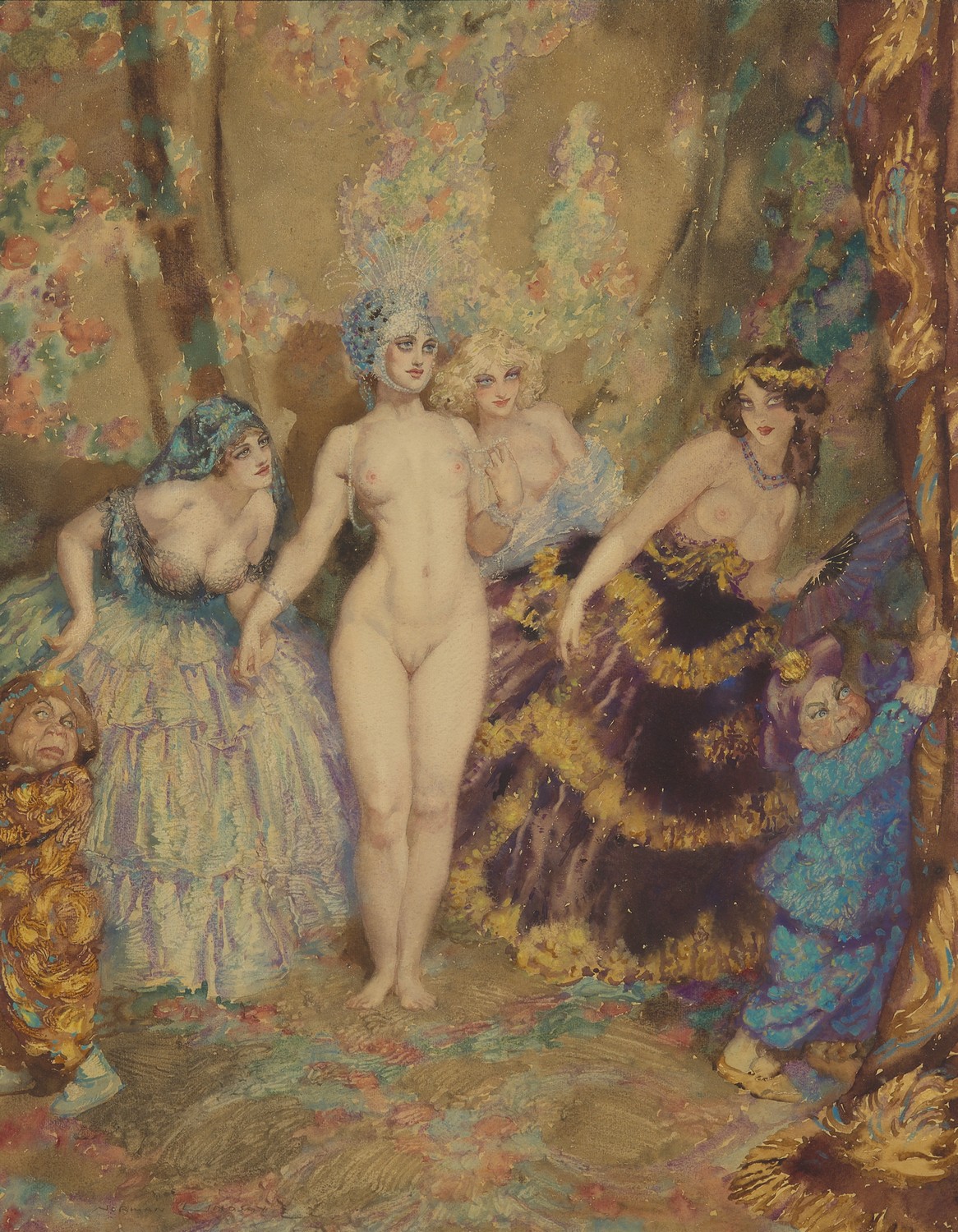
The Curtain 1921
watercolour on paper
signed lower left: NORMAN LINDSAY
65.5 x 51.5cm
Estimate $30,000 - $40,000
The work is in very good condition. There are no apparent areas of concern to report. The paper displays inherent aging through light discolouration. The overall pigment remains strong. The paper displays minor cockling.
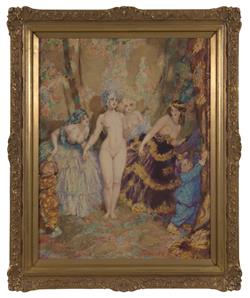
The work is newly framed, in excellent condition.
The opinions expressed in the condition reports are a guide only and should not be treated as a statement of fact. Prospective buyers are encouraged to inspect articles for sale at our pre-sale viewing where Leonard Joel staff are available for advice.
Leonard Joel makes no guarantee of the originality of mechanical or applied components. Absence of reference to such modifications does not imply that a lot is free from modifications.
Estate of the artist, Faulconbridge, New South Wales
Rose Lindsay, New South Wales
Thence by descent
Private collection, Sydney
Deutscher + Hackett, Sydney, 10 May 2017, lot 29
Private collection, Melbourne
Estate of the above
On long term loan to the Norman Lindsay Gallery - Springwood, Faulconbridge, New South Wales
Bloomfield, L., Norman Lindsay: Watercolours 1897 - 1969, Odana Editions, Bungendore, New South Wales, 2003, pp. 62 - 63 (illus.)
Related Works:
The Curtain, 1921, pencil on paper, 53 x 48 cm, Bloomfield, L., Norman Lindsay: Impulse to Draw, Bay Books, Sydney, 1984, p.188 (illus.)
Curtains are suggestive. They hide what is behind them. When drawn, curiosity and expectation are replaced by the excitement of the presentation. In this sparkling watercolour The Curtain, 1921, by Norman Lindsay, a feast of visual beauty is revealed as dwarfs pull aside the heavy drapes. The sense of theatre is palpable as the ladies present themselves on their very private stage. With the performance about to begin, the audience, alias the viewer is invited to join in. Narrative in Lindsay's art unfolds through the eyes and gestures of his players, highlighted by theatrical effects and presentations. Fascinating of eyes, these ladies look outside the picture to fix on members of the audience. Only the dark lady of the far right engages the viewer directly with coquettish look and invitation. This she confirms by her fan and its own flirtatious language. The fan held open in the left hand was an invitation to engagement.
As so often in Lindsay's art, the composition centers on the statuesque nakedness of the single female figure. For The Curtain, the model was Lindsay's wife Rose, his favourite. In recollection, Lindsay wrote of Rose: 'Finally, as the feminine image was the central motif of my work, she dramatized it for me in the flesh under terms which involved me in all its emotional complexities, lyrical and demonical'.1 Rose liked the watercolour so much that she would not let it go. It hung for many years in their home at Springwood.2 In the preliminary compositional drawing, the pencil studies detail Rose's figure, while the others surround her in an embracing curve. This is taken up in the watercolour where curve echoes curve, dominant and in detail. The grouping of the figures, for example, is answered in the semi-circle of the foreground, and replied again in the garments and floral decoration of the curtain behind. As a backdrop, the curtain also provides cleverly contrasting textures to highlight the smoothness of the generous flesh.
Norman's Lindsay's explorations of the femme fatale, the lyrical and the demonical which no mere male can resist, enjoyed numerous manifestations in a varying mix of enticement and the slightly confrontational. The naked centerpiece might be the beautiful Venus, goddess of love, or if of Junoesque proportion, Juno herself, mighty queen and well suited to the all-powerful Zeus. Throughout Lindsay's oils and watercolours, leering buccaneers and bacchanals abound, peopled with buxom beauties and naked ladies plumed with fantastic headdresses. Spring's Innocence, 1937, in the collection of the National Gallery of Victoria, Melbourne, is heavy with erotic fruitfulness. Another major oil, Incantation, 1940, (Deutscher and Hackett, Sydney, 1 September 2010, lot 32) seems to have had its genesis in The Curtain. As in the watercolour La Premiere Danseuse, 1930 (private collection, New South Wales), many of Lindsay's finest early watercolours were inspired by the theatre, especially the ballet and its language of captivating movement. Among these, The Curtain, with its nubile ladies, is one of the best.
1. Lindsay, N., My Mask: For what little I know of the man behind it, an autobiography, Angus and Robertson, Sydney, 1970, p. 176
2. Bloomfield, L., My Mask: For what little I know of the man behind it, an autobiography, Angus and Robertson, Sydney, 1970, p. 62. An etching, The Curtain, 1919, in the collection of the Art Gallery of New South Wales is not related to this watercolour of the same name.
DAVID THOMAS
Fine Art
AUCTION
Sale: LJ8338
6:30pm - 26 November 2019
333 Malvern Rd, South Yarra 3141
VIEWING
Melbourne
Wednesday 20 November, 9am-8pm
Thursday 21 - Sunday 24 November, 10am-4pm
Monday by Appointment Only
CONTACT
Summer Masters
summer.masters@leonardjoel.com.au
SIMILAR ITEMS
Lot 23
NORMAN LINDSAY (1879-1969) The Lute Player c.1924 oil on canvas
Estimate: $120,000-160,000
Lot 21
ARTHUR STREETON (1867-1943) Valley of Sir Richard Arkwright 1911 oil on canvas
Estimate: $70,000-90,000
Lot 38
JOHN COBURN (1925-2006) The Crucifixion 1959 oil on composition board
Estimate: $35,000-45,000
Lot 35
ARTHUR BOYD (1920-1999) Nebuchadnezzar on Fire Fallen on a Field c.1966 oil on canvas
Estimate: $26,000-36,000