
Lot 14
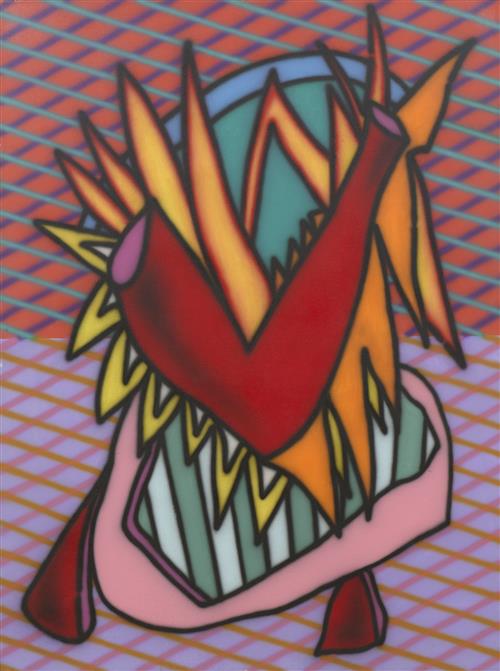
Discocacti 1986
synthetic polymer paint on canvas
signed, dated and inscribed verso: title. Discocati [sic]/ Date. 1986/ size 160 x 120 cm/ Howard Arkley
161 x 120cm
Estimate $75,000 - $95,000
Budget Transport Industries 'Young Australians' Collection
Martin Browne Fine Art, Sydney
Sotheby's, Melbourne, 18 June 1995, lot 279
Private collection, Melbourne
Howard Arkley, Recent Paintings, Tolarno Galleries, Melbourne, 20 September - 8 October 1986, cat. no. 2
Young Australians: The Best of Young Australians, National Gallery of Victoria, Melbourne, 11 August - 9 September 1987, toured nationally 1987-1989, cat. no. 14
Howard Arkley, Monash University Gallery, Melbourne, 18 October - 30 November 1991, cat. no. 56
20th Century Australian and New Zealand Painting, Martin Browne Fine Art at Mary Place Gallery, Sydney, 22 August - 28 September 1991, cat. no. 70
Downtown, Heide Museum of Modern Art, Melbourne, 14 March - 14 May 1995
Engberg, J., Indigenous, Indelible Arkley, Art and Australia, Autumn 1987, vol.24, no.3, p.386
Lindsay, R. (ed.), Young Australians: The Best of Young Australians (Exhibited by Budget Rent A Car), Powell Street Gallery, Melbourne, 1987, p.14 (illus.)
Gregory, J., Carnival in Suburbia: The Art of Howard Arkley, Cambridge University Press, Melbourne, 2006, p.172, cat.6.15 (illus. p.171)
Gregory, J., Arkley Works: Howard Arkley Online Catalogue Raisonne, http://arkleyworks.com/blog/2009/11/18/discocacti-1986/ (illus.)
In Howard Arkley's paintings, suburbia, interiors, faces and plants become larger than life, whilst challenging our notions of art and décor. Extending off his experimentations with portraits, such as lot 13, Arkley began to illustrate cacti in the 1980s furthering his shift towards the figurative.
Howard Arkley collected a plethora of source material that inspired much of his work. His sketchbooks and diaries from the 1970s, show a wide array of plant and human hybrids (some real, some imaginary) with many originating from William and Sybil Harland's book Growing Cacti and Succulents in Australia and New Zealand (Kangaroo Press, 1981). This book provided Arkley with endless visual inspiration, but also verbal, with unfamiliar botanical names of great intrigue for the artist. In Arkley's working notes of the 1980s, he lists these botanical plant names together with terms like "hybradizing; grafting; mutants and propagation" and it is around this time we see stylised cacti apparent in his major works.
Cacti made their first formal appearance in Arkley's Cacti & Succulents show at Roslyn Oxley9, Sydney, in 1984, soon after followed by his Recent Paintings exhibition at Tolarno, Melbourne, in 1986.
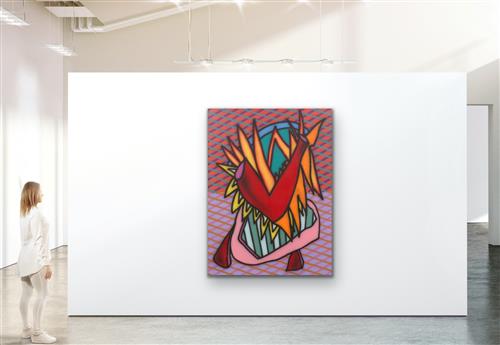
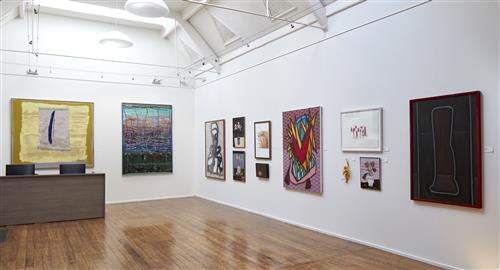
One of three cactus paintings shown in the latter Tolarno exhibition, Discocacti displays the same trellised background seen in the other two examples. Arkley was particularly 'pattern-conscious', with ornate gates and doorways, fabric designs, wallpaper, and tiles a myriad of inspiration for him. Against the formulaic grid of the flat patterned background, the cacti is strange in form with spiky, bulging and unfamiliar shapes. There is a suggestion of teeth with the pointed spikes and arteries and limbs emerge from red shapes. Discocactus comes from the Greek work 'diskos' meaning a flat round shape and is the name of a cacti species orginating in South America. Arkley's representation is hardly true to life - large in scale, Discocacti is akin to a formalised portrait study with its own punkish 'personality'. The sheer scale of the work makes the cacti imposing and unnerving yet the bold bright colours create a hallucinatory impression, with the patterned background displacing us from any familiarity with this hybrid creature. Arkley's continuing use of the aerosol spray gun not only gives his works their iconic aesthetic but also parallels with commercial art practices in Arkley's plight to challenge the art and décor relationship.
By the later 1980s, he revisited the subject of cacti again with another two exhibitions at Roslyn Oxley9 and Bellas Gallery occuring. Whilst his suburban imagery soon dominated his practice, his final focus on the cacti and succulents was in his exhibition Casual Works in 1988 showing in both Melbourne and Brisbane. Installation shots from this exhibition show a black and white work on paper, the monochromatic partner to Discocacti later auctioned by Bonhams USA, 4 May 2009, as 'No To Disco'. The myriad of sources and resulting subject matter in the oeuvre of Howard Arkley makes for an iconic body of work - from head studies to suburban settings and, in this case, stylised cacti. His resulting major cacti works, such as Discocacti, are unmistakably rare, with their significance in his oeuvre strongly valued by key Arkley collectors and institutions.
Olivia Fuller
Head of Art
1. Fitzpatrick, A., Lynn V., Howard Arkley and Friends, Tarrawarra Museum of Art, Victoria, 2015, p. 16
© Courtesy of the artist's estate and Kalli Rolfe Contemporary Art
Fine Art
AUCTION
Sale: LJ8654
6:00pm - 25 October 2022
333 Malvern Rd, South Yarra 3141
VIEWING
Friday 21 - Sunday 23 October, 10am - 4pm
Monday 24 - Tuesday 25 October, by appointment
333 Malvern Road, South Yarra VIC
CONTACT
Olivia Fuller
olivia.fuller@leonardjoel.com.au
SIMILAR ITEMS
Lot 9
JORDY KERWICK (born 1982) Still Life with Books 2019 oil, synthetic polymer paint and collage on canvas
Estimate: $30,000-40,000
Lot 10
JORDY KERWICK (born 1982) Still Life 2018 oil, synthetic polymer paint and collage on canvas
Estimate: $30,000-40,000
Lot 13
HOWARD ARKLEY (1951-1999) Black and White Icon 1995 synthetic polymer paint on paper
Estimate: $30,000-40,000
Lot 49
ALBERT NAMATJIRA (1902-1959) White Gum c.1947 watercolour with pencil outlines
Estimate: $30,000-40,000