Lot 49
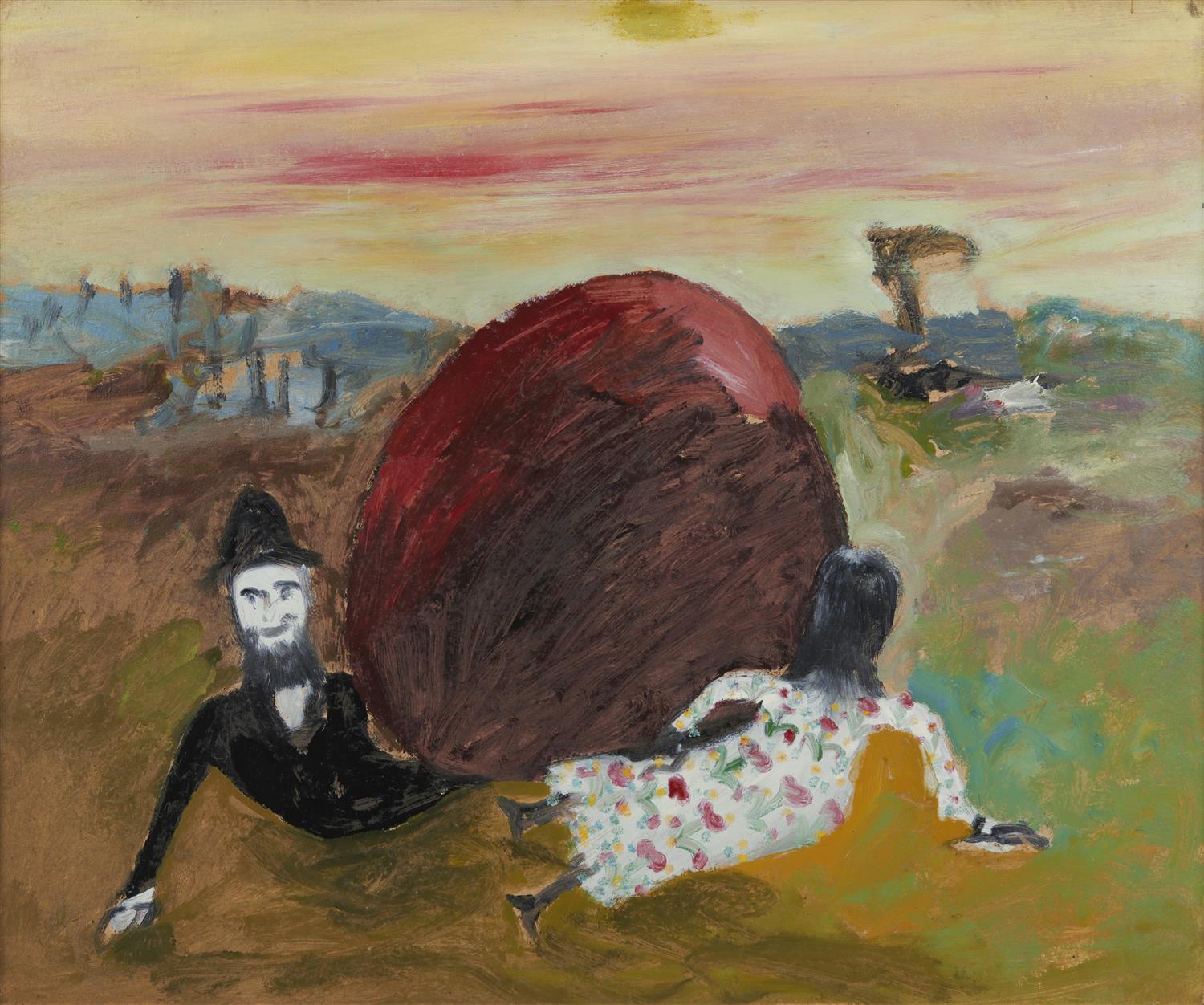
Kate Kelly Pursued by Constable Fitzpatrick c.1945
oil on board
62 x 74.5cm
Estimate $90,000 - $120,000
The artist
Lady Nolan, United Kingdom
Menzies, Melbourne, 23 September 2010, lot 34
Private collection, Melbourne
RELATED WORK:
Constable Fitzpatrick and Kate Kelly 1946, enamel on composition board, 90.5 x 121cm, Collection of the National Gallery of Australia, Canberra
Sidney Nolan is one of Australia's most recognised and revered modern artists. Nolan took the barren Australian landscape and made it the set for his own theatrical imaginations, exploring the human condition in a myriad of ways that we are still decoding. His Ned Kelly paintings are some of the most important works from not only his own oeuvre, but also the broader discourse of Australian art history.
In the early 1940s, Nolan was again a bachelor and living at Heide. His deep relationship with Sunday Reed was burgeoning, with Reed becoming highly influential on his practice. Following her suggestion, he began to focus on a completely modern adaptation of the Australian landscape as a progression from the Heidelberg painters. While the exact instigator to Nolan's Kelly series is often debated, there were two events that appear highly influential. The first was the Ern Malley hoax of 1943-44, which involved the fictional poet poking fun at the standards of modern writing. The hoax gave Nolan the courage to challenge accepted notions of modern art, and demonstrated that fact and fiction, history and lies, could in fact sit side by side. The second event was his desertion of the Army in 1944 amidst the possibility of being sent to the front lines in New Guinea.
Soon after, Nolan began to research the Kelly stories and his iconic 1940s paintings were executed in the dining room at Heide. As 27 of these works were donated by Sunday Reed to the National Gallery of Australia, Canberra, these associated works, such as the present lot, reveal a truly rare opportunity to obtain a piece of Australian art history.
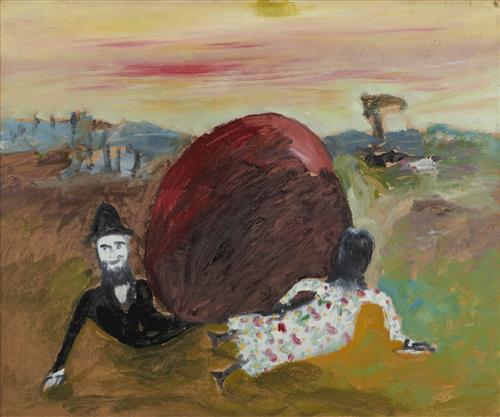
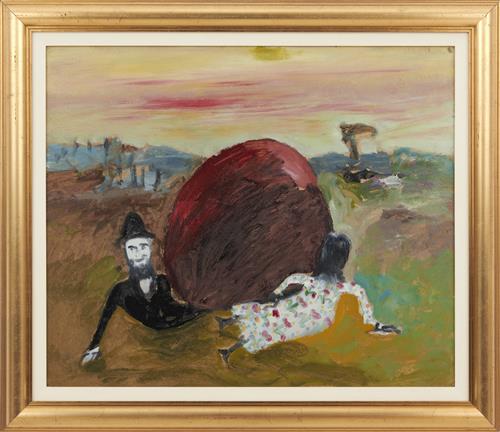
Kate Kelly Pursued by Constable Fitzpatrick was likely painted in 1945, when Nolan was first exploring the Ned Kelly theme and forming his visual devices connected to the series, the most iconic of which became the minimalist black square helmet. Each painting sought to depict an 'episode' in the Kelly drama, and this painting focused on Constable Fitzpatrick's unwelcomed romantic pursuits of Kate Kelly. Fitzpatrick had arrived at the Kelly homestead in 1878 to arrest Dan Kelly for horse stealing. Fitzpatrick is depicted as a grotesque and lecherous being, opposite the young Kate Kelly. Both figures are forcefully separated by a crimson form, thought to be a shrub but perhaps also representative of the emotional turmoil of the scene - the lust being felt by Fitzpatrick, and the anger from Kate and her fellow Kelly members at his untoward actions. The painting is therefore a work of combined visual, historical and psychological importance, demonstrating the very start of Nolan's exploration into the subject, the pivotal moment that drove Ned into outlawry and its parallels with Nolan's own personal torment at the time.
While the 1946 painting of this scene, now in the National Gallery of Australia, brings the moment to the interior of the home, both paintings focus on the abhorrent disapproval of Fitzpatrick and the police as felt by Ned. In Ned Kelly's iconic 8000-word Jerilderie letter, he ranges from well-argued accusations to child-like abuse: "a parcel of big, ugly, fat-necked, wombat-headed, big-bellied, magpie-legged, narrow-hipped, splay-footed sons of Irish Bailiffs or English lords which is better known as officers of Justice of Victoria Police". So, too, the public, specifically the lesser classes at the time, popularised Ned as their hero-figure. "It is this same implacable hero of the common people, natural scourge of the police and inscrutable image of unqualified rightness, that Nolan has so brilliantly and with so disarming an air of simplicity extricated or rather abstracted from the Kelly story. His pictorial treatment of the episodes reflects his response to Kelly's own words".(1) The pace of his response is evident in the immediacy of this painting, an indication of the immense inspiration Nolan was feeling when his exploration of the Kelly story was coming to fruition. As he mused to Edmund Capon, "Five minutes in the making, five years in the thinking, dear boy".
Despite Sidney Nolan achieving such public success, he maintained, "the key purpose of his painting was, in the end, a silent conversation with himself"(2). Even his Kelly series Nolan declared to be the externalisation of an intensely private matter he would never disclose to another soul (3). It is this combination of visual, historical and psychological importance that presents these first Ned Kelly paintings of Nolan's as his most significant, and perhaps, too, the most significant within modern Australian art and national identity.
Olivia Fuller
Head of Art
(1) Melvile, R., "Ned Kelly", Sidney Nolan, The Royal Dublin Society, Dublin, 1973, exhibition catalogue p.8
(2) Pearce, B., Sidney Nolan, The Beagle Press and The Art Gallery of New South Wales, Sydney, 2008, p.17
(3) Ibid.
© The Sidney Nolan Trust. All rights reserved. DACS/Copyright Agency, 2023
Fine Art
AUCTION
Sale: LJ8704
6:00pm - 24 October 2023
333 Malvern Rd, South Yarra 3141
VIEWING
Friday 20 - Sunday 22 October, 10am - 4pm
Monday 23 October, by appointment
333 Malvern Road, South Yarra VIC
CONTACT
Olivia Fuller
olivia.fuller@leonardjoel.com.au
SIMILAR ITEMS
Lot 57
GAETANO CHIERICI (Italian, 1838-1920) (The Happy Family) 1870 oil on canvas 80.5 x 107cm
Estimate: $90,000-120,000
Lot 9
JEFFREY SMART (1921-2013) First Study for Conversation Piece 1997 oil and pastel on canvas 13.5 x 45.5cm
Estimate: $70,000-90,000
Lot 28
TIM STORRIER (born 1949) The Light Line (Evening) oil and rope on canvas 60 x 181.5cm
Estimate: $50,000-70,000
Lot 54
LE PHO (Vietnamese, 1907-2001) Les Amaryllis (Flowers) oil on canvas 26 x 34cm
Estimate: $40,000-60,000