Lot 36
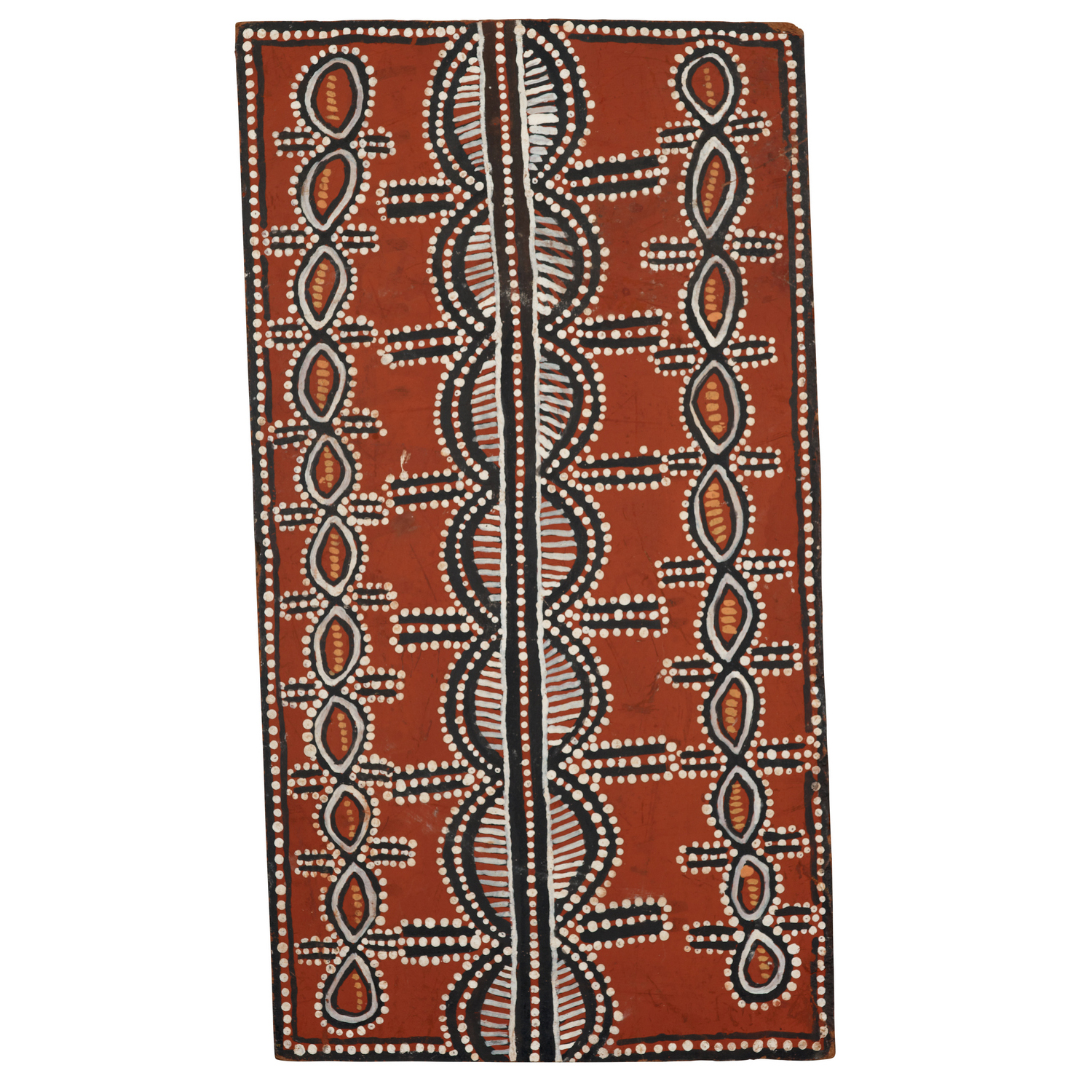
Sandhill Dancing Dreaming - Version 1 1971
synthetic polymer paint on composition board
47 x 25.5cm (irreg)
Estimate $30,000 - $50,000
The Artist
Painted at Papunya 1971
Geoffrey Bardon, Sydney
Bill Ward, Sydney, acquired from the above
Australian, International and Aboriginal Art, Bonhams & Goodman, Melbourne, 23 April 2008, lot 69
The Le Pley Collection, Western Australia, acquired from the above
Bardon, G., & Bardon, J., Papunya A Place Made After the Story, The Miegunyah Press, Melbourne, 2004, p. 117 (illus.)
© Kaapa Tjampitjinpa/Copyright Agency, 2023
The 1970s marked a turning point in the world of Indigenous Australian art, with Kaapa Tjampitjinpa playing a pivotal role in the shaping of the Papunya Tula Artists and the Western Desert Art Movement. Born in the 1920s just west of Napperby Station in the Northern Territory, Kaapa's heritage encompasses the Anmatyerre, Warlpiri and Arrernte cultures.
In his early years, Kaapa worked as a stockman at Riddock Station and later at Haast, but it was his move to Papunya in the 1960s that marked a crucial point in his life. Papunya was a government settlement that became home to various desert groups, after relocating in the 1960s due to the government assimilation policy. Papunya held shared no cultural significance for these diverse groups who found themselves now all living together. For many who had previously lived on their ancestral lands with their own unique cultural identities, the forced settlement saw many severing cultural ties and facing isolation.
Geoffrey Bardon's arrival in 1971 marked a crucial moment in the community's history. After Bardon's quick realisation that the elders were more interested in painting than the children, Kaapa and others enthusiastically began sharing significant stories, carefully selecting elements of their narratives that could be revealed to the public while safeguarding the integrity of the sacred knowledge. This collaborative effort led to the creation of the historical mural on the school building, symbolising the Honey Ant Dreaming, marking the conception of the Papunya movement.
In 1972, the artists of Papunya established Papunya Tula Artists and Kaapa was appointed as its inaugural Chairman. His paintings were not only significant for their artistic value but also for their cultural and historical importance and are still celebrated today as a testament to the profound transformation that occurred during this period.
Kaapa's paintings emerged as some of the earliest creations from Papunya, uniquely blending traditional elements with a touch of Western influence. Like the rare few from this period, Sandhill Dancing Dreaming - Version 1 1971 is a story about a very big dancing ceremony involving a journey across the landscape. The straight lines with half-circles represent sandhill forms. The chain-like looping patterns on either side are dancing men with spears and boomerangs celebrating the commemorative journey. The painting tells of the elation felt for bountiful bush foraging after good rain. All the people are content and dancing ritual is an expression of rapture (1). One distinctive aspect of Kaapa's work was accessibility to a broader audience as his art did not incorporate any secret or sacred symbols.
Prior to the 1970s Kaapa had already been creating art, including wooden cravings and watercolour paintings (2). However it was in 1971 that his work gained broader recognition when one of his paintings shared the first prize at the Alice Springs Caltex Art Award. This momentous occasion marked the first time an Indigenous Australian won a contemporary art award, bringing Papunya Tula art to the forefront of public attention.
Lucy Foster
Senior Specialist, Fine Art
(1) Bardon, G., & Bardon, J., Papunya A Place Made After the Story, The Miegunyah Press, Melbourne, 2004, p.117
(2) "Kaapa Tjampitjinpa (Anmatyerr/Warlpiri c. 1925-1989)". Tjukurrtjanu: Origins of Western Desert Art. National Gallery of Victoria, 2011, retrieved 14 October 2023
The Le Pley Collection of Indigenous Art
AUCTION
Sale: LJ8723
6:00pm - 21 November 2023
333 Malvern Rd, South Yarra 3141
VIEWING
Friday 17 - Sunday 19 November, 10am - 4pm
333 Malvern Road, South Yarra VIC
CONTACT
Lucy Foster
lucy.foster@leonardjoel.com.au
SIMILAR ITEMS
Lot 31
ENA GIMME NUNGURRAYI (born c.1944) (Language group: Kukatja) (Artists Mothers Country) 1991 synthetic polymer paint on canvas 120...
Estimate: $20,000-30,000
Lot 47
JUDY WATSON NAPANGARDI (born 1959) (Language group: Warlpiri) Mina Mina Jukurrpa (Mina Mina Dreaming) - Ngalyipi 2009 synthetic poly...
Estimate: $20,000-30,000
Lot 9
ELIZABETH NYUMI NUNGURRAYI (born 1947) (Language group: Pintupi) Parwalla 1999 synthetic polymer paint on linen 180 x 120cm
Estimate: $15,000-25,000
Lot 53
GLORIA TAMERRE PETYARRE (1945-2021) (Language group: Anmatyerre) Mountain Devil Awelye 1994 synthetic polymer paint on linen 130 x 3...
Estimate: $18,000-25,000