Lot 23
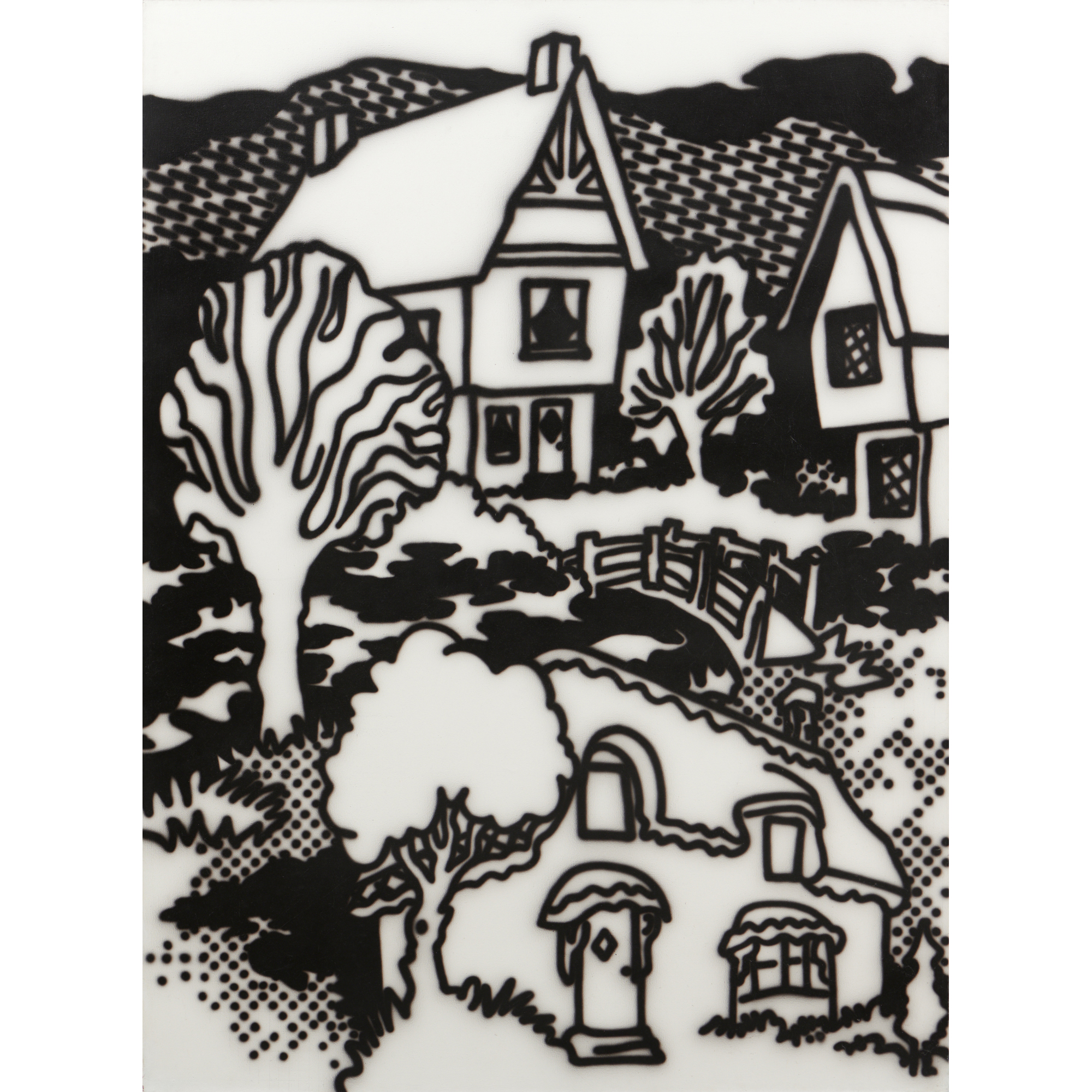
Tudor Village B/W 1994
synthetic polymer paint on canvas
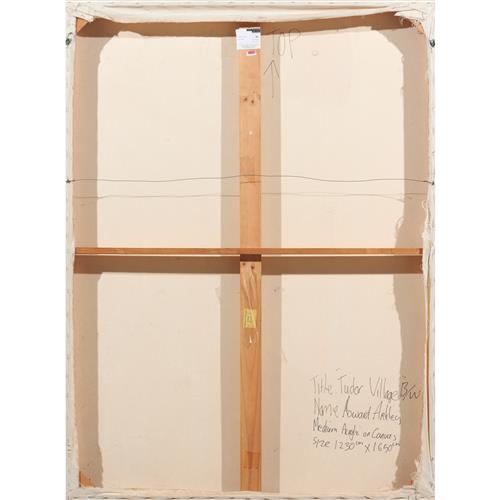
signed, titled, dated and inscribed verso: Title "Tudor Village B/W"/ Name Howard Arkley/ Medium Acrylic on Canvas/ size 1230cm X 1650cm
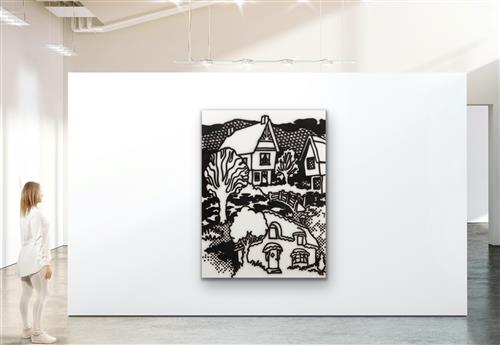
165 x 123cm
Estimate $150,000 - $200,000
Bellas Gallery, Brisbane 1994 (listed thus in Arkley's 1993-6 stock-book)
The Artist's collection
Private collection, Melbourne
Kalli Rolfe Contemporary, Melbourne
Private collection
Deutscher~Menzies, Sydney, 12 September 2007, lot 28 (listed as Tudor Village c.1986)
Private collection, Melbourne
Howard Arkley: "Black and White Paintings" and Works on Paper, Bellas Gallery, Brisbane, 24 May - 11 June 1994, cat. no. 5
Gregory, J., Arkley Works: Howard Arkley Online Catalogue Raisonné, (https://www.arkleyworks.com/blog/2009/12/14/tudor-village-bw-1994/)
RELATED WORK:
Howard Arkley, Model Tudor Village, Fitzroy Gardens 1986, synthetic polymer paint on canvas, 162.5 x 162cm, private collection
Tudor Village B/W 1994 is a key example of a subject only occasionally addressed by Howard Arkley, but one that still summarises many of his formal and thematic concerns. These include direct reference to some of his favourite comic-book and children's picture-book sources, and the discipline of a severely restricted monochrome palette. Above all, the subject seems to deliberately undercut the suburban theme dominating his later oeuvre. (1)
The canvas first appeared in May - June 1994, in a solo exhibition at Bellas Gallery, Brisbane, comprising 19 works on canvas and paper, all black and white, thus prefiguring Arkley's White + Black: 20 Years Work on Paper and Canvas, 1975-1995 at Tolarno Galleries, Melbourne, in September 1995. Like several other works in the Brisbane exhibition, Tudor Village B/W also incorporates stencilled areas suggesting printed or metallic sources, a notable feature of Arkley's 1990s work.
Even before his premature death in July 1999, aged 48, Arkley had become typecast as "the painter of suburbia." A role he had adopted temporarily in the 1980s, it struck a chord with critics and viewers tired of the usual gallery fare - landscapes (of course), abstracts, and obscure conceptual gestures. And so, despite his own best efforts, he had become saddled with the part. Admittedly, he did sometimes play up to the idea in interviews, and the volume of his suburban images ballooned as the 1990s progressed. But throughout his last decade he kept exploring different themes and ideas - urban subjects including factories and freeways, stylised heads, and collaborative work, especially with Juan Davila.
His stylistic range also developed significantly during the second half of his career, often including intricate stencilled patterns (overlaid or in variegated colours), a softer palette, and air-brushed line-work in grey and other hues, rather than his trademark black. Large open fields of colour became a feature of some 1990s works, especially the large-scale freeways, and his magnum opus, Fabricated Rooms 1997-99. In Homezone 1999 he revisited his earlier furniture installations, but in a highly reduced formal manner. In the mid 1990s, he also reprised his youthful taste for a strict monochrome palette, as in Tudor Village B/W.
Another strategy Arkley used to vary and extend his repertoire during his final decade and a half, often specifically to complicate the suburban theme, was to loosen the uniformity of some solo exhibitions by including alternate or contradictory images. For example, in his Pointillist Suburbs show at Tolarno late in 1994, the intricately patterned houses were counterpointed by two large freeway canvases, their sweeping lines and broad fields of blue and green signalling a completely different idea of the modern city.
An earlier instance occurred in 1986, in Arkley's Recent Paintings exhibition at Tolarno (September - October 1986). Here, Tudor Village, a large, square, vividly coloured canvas, contrasted markedly with the general urban/suburban content of the other paintings. On the one hand, its Grimm's fairy-tale imagery struck a fanciful note. Conversely, though, its heavy black shadows hinted at more sinister forces, also lurking in the Australian suburban houses depicted elsewhere in the Tolarno show, especially in the dark recesses of brick, foliage and asphalt in Our Home and Nubrick. For all its bright colour, then, Tudor Village played a subversive role in the Tolarno exhibition, almost that of an anti-suburban image.
The 1986 painting was first exhibited a few months earlier, together with a black and white twin, in a collaborative installation forming part of a show pairing artists and architects (5AR: Artists and Architects, George Paton Gallery).(2) Arkley took his cue from the miniature Tudor Village in the Fitzroy Gardens, donated to Melbourne by England in 1948, in thanks for Australian generosity after the London Blitz. Despite the scorn heaped on "Mock Tudor" by fans of architectural modernism such as Robin Boyd, the Fitzroy Gardens Village proved popular with Melbournian families, and was later fully restored and reopened in 2008. Arkley visited the quaint collection of 1:20 scale Tudor houses on the recommendation of his 1986 architect collaborator, Howard Raggatt (who had been there with his family), and later, in remarks quoted in Spray: The Work of Howard Arkley (1997), recalled his experience:
"I went to see the thing in a taxi at three in the morning It was very windy, and I became aware that there were people in the bushes. It was very gothic. So I tore out of there and when I got out I realised that was how the painting should be - black and white, with dramatic lighting."(3)
Subsequent variants of the Tudor theme included two relatively benign 1987 canvases in toy-town hues, reflecting the source, apparently from a children's colouring-book. But in his 1988 Casual Works exhibition, Arkley showed another black and white version, and associated sources and sketches, including an outline drawing (now in State Library Victoria's Howard Arkley Archive, MS 14217/1/1777). This composition, the basis for the original monochrome painting of 1986, reappears - in more concentrated form - in Tudor Village B/W, and also in a closely related work-on-paper version, also monochrome (Collection of the National Gallery of Australia, Canberra), included in Arkley's 1995 White + Black exhibition. In this last example, the darkest of all, heavily sprayed black clouds add to the atmosphere of gathering gloom.
Arkley's response to the Fitzroy Gardens site as "gothic" is particularly interesting in relation to alternative readings of his oeuvre, especially that of his friend and colleague Tony Clark. In his catalogue essay for the 1991 Monash University survey, Clark described Arkley as a "contemporary goth"(4), noting his references to Dürer, medieval art, and so on. Also relevant here is the emergence of "New Gothic Art" in the 2000s, exemplified locally by the spooky work of David Noonan. Finally, Arkley's insights into the darker aspects of both urban and suburban life should also be mentioned, bringing to mind the Freudian notion of the "uncanny" (Unheimlich: literally, "un-homely").
Tudor Village B/W is a classic example of the work of this "other" Arkley, no mere chronicler of the 'burbs, but a thoughtful artist, finely attuned to both the light and darkness of the modern world.
Dr. John Gregory
(1) Gregory, J., Carnival in Suburbia: The Art of Howard Arkley, Cambridge University Press, Melbourne, 2006
(2) Austin, V., (Ed.) 5AR: Artists and Architects '86 (Special Catalogue Issue of Transition No. 17), Melbourne, George Paton Gallery, 1986
(3) Crawford, A. and Edgar, R., Spray: The work of Howard Arkley, Craftsman House, Sydney, 1997, p. 89
(4) Duncan, J., (Ed.), and Clark, T., "Howard Arkley", HA: Howard Arkley, Monash University Gallery, 1991 pp. 5-6
© The Estate of Howard Arkley. Licensed by Kalli Rolfe Contemporary Art
Centum Contemporary Art
AUCTION
Sale: LJ8734
6:00pm - 20 May 2024
Hawthorn
VIEWING
SYD: Fri 10 - Sun 12 May, 10am - 4pm
The Bond, 36-40 Queen St, Woollahra NSW and Dickerson Gallery, 34 Queen St, Woollahra, NSW
MEL: Fri 17 - Sun 19 May, 10am - 4pm
2 Oxley Rd, Hawthorn VIC
CONTACT
Hannah Ryan
hannah.ryan@leonardjoel.com.au
SIMILAR ITEMS
Lot 18
BRETT WHITELEY (1939-1992) Nude No. I 1974 brush and ink on paper 76 x 50cm
Estimate: $40,000-60,000
Lot 26
JUAN DAVILA (born 1946) Untitled 2003 mixed media on paper 153 x 206cm
Estimate: $40,000-50,000
Lot 35
JOHN KELLY (born 1965) First Past the Post-Modern 1998 oil on linen 136.5 x 182.5cm
Estimate: $30,000-50,000
Lot 33
GODWIN BRADBEER (New Zealander; born 1950) Imago - Point Blank 2012 chinagraph, silver oxide, pastel and acrylic on paper 171 x 130cm
Estimate: $20,000-25,000