Lot 49A
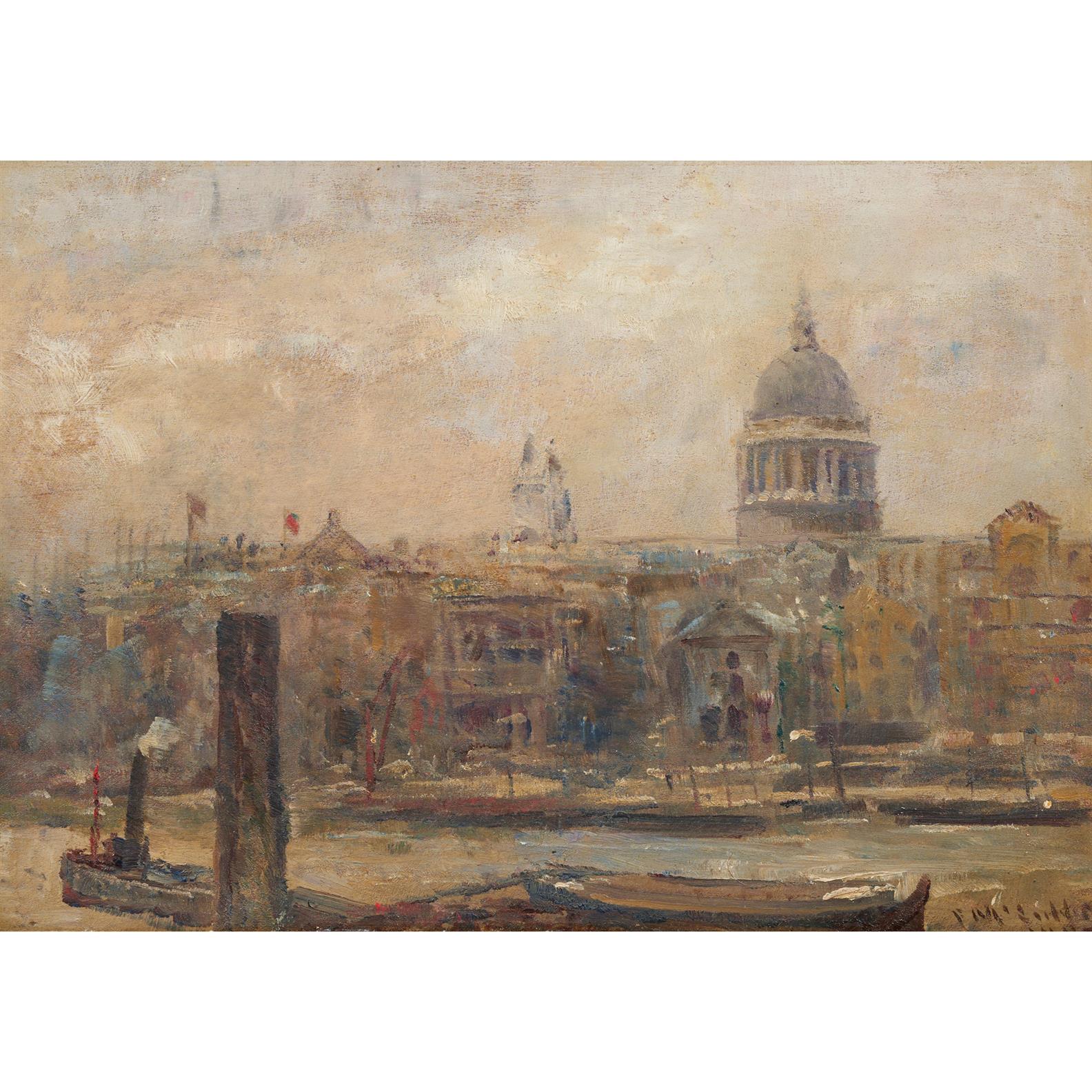
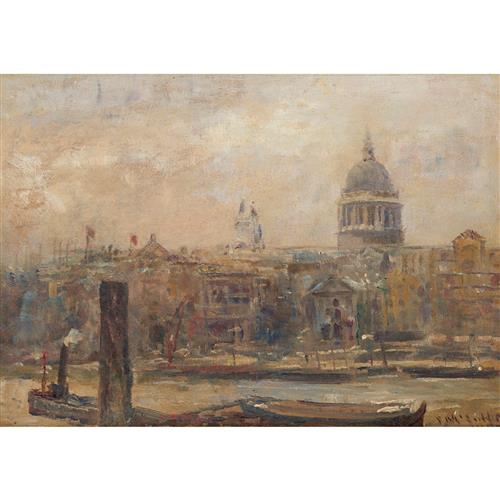
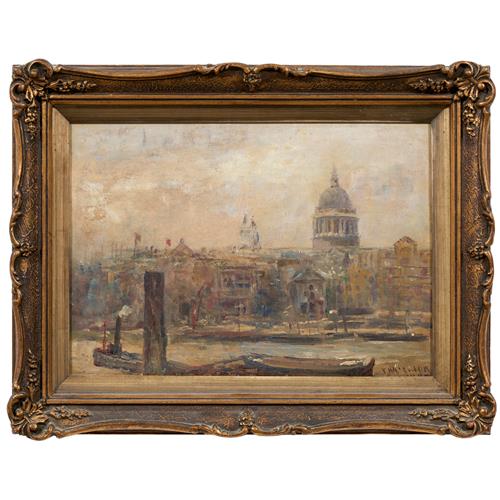
Thames and St Paul's Cathedral 1908
oil on wood panel
signed lower right: F McCubbin/ 1908
signed and dated verso
24 x 34cm
Estimate $20,000 - $30,000
Leonard Joel, Melbourne, 6 November 1974, lot 374
Private collection, Sydney
The Estate of Carol Lynette Crooks, Sydney
In late May 1907, Frederick McCubbin boarded the Prinz Heinrich and set sail for London. At age 52 this was the first time he had left Australia and it was a trip he had long dreamed of but circumstances had prevented. In correspondence with his friend Tom Roberts, affectionately known as Smike, in 1906 he wrote of his fears that he would never make it to Europe. (1) However, the following year he was granted a six month leave of absence from his position as Drawing Master at the National Gallery in Melbourne and an exhibition and sale of his work was held to raise funds for the voyage. This European visit became pivotal to McCubbin's career, it was in London where he first saw the works of J. M. W. Turner in person, in Paris where he acquainted himself further with the paintings of the French Impressionists and at the Royal Academy in London where he met the British artist and Professor of Painting George Clausen (1852-1944). These experiences, amongst others, were to have a profound effect on McCubbin's artistic practice. He returned to Australia in late November exhausted but with a renewed vision. He set out to find new painting grounds, experimented with various painterly techniques, freed himself of the constraints of literal depictions of nature and opened his canvas to the possibilities of light and colour.
McCubbin had been aware of the work of English Romantic painter J. M. W. Turner since his student days, however, poor-quality reproductions in black and white proved no substitute for the real thing. Upon viewing Turner's paintings in person at the Tate Gallery he wrote in a letter to his wife:
I went yesterday…to the Tate Gallery… where the lately found Turners are exhibited… they are mostly unfinished but they are divine - such dreams of colour a dozen of them are like pearls - no theatrical effect but mist and cloud and sea and land drenched in light - no other master like him. They glow with a tender brilliancy that radiates from these canvases - how he loved the dazzling brilliancy of morning or evening - these gems with their opal colour - you feel how he gloried in these tender visions of light and art. (2)
The effect and influence of Turner's painting became immediately visible in the works McCubbin completed during his travels and thereafter. Whilst overseas McCubbin painted numerous small panels and in London he was particularly attracted to the River Thames and the wharf areas between London Bridge and Limehouse. The choice of subject matter alone might draw a reference to the great English painter, however, the stylistic choices in composition, light and atmosphere make it unmistakeable.
Thames and St Paul's Cathedral 1908, Lot 10, is one of a number of paintings McCubbin produced depicting the pool of London, that reach of the River Thames thronged with shipping. Other works of this scene include The Pool of London (Barges, Pool of London) 1907, Private Collection, and The Pool of London 1907, National Gallery of Victoria, Melbourne. In each of these depictions the distant hazy sky carries an opalescent shimmer which sweeps over almost half the composition. In Thames and St Paul's Cathedral the skyline is punctuated with the dome of St Paul's which looms high over the busy city below. McCubbin captures the muted blues, reds, purples and ochres of smoggy industrial London. Painted from the south side of the river at a low vantage point, the sliver of water shows brief glimpses of the sky's reflection. The foreground depicts barges dotted along the banks of the river with one in motion moving toward the left edge of the composition, soon to be out of sight. This series of paintings paid homage to Turner not only through the gentle shimmer of light and the choice of subject matter, but also in composition. The similarity to Turner's Venetian paintings is striking, particularly in the celebration of the waterways and the architecture of the city.
Whilst McCubbin's time in Britain convinced him further of Turner's greatness, he was not the only artist McCubbin admired. He respected the work of Turner's contemporary, John Constable, and Camille Corot was also an important influence. Following a trip to Paris with Emanual Philips Fox he commented on the Impressionists noting that the works of Manet, Monet and Sisley were "very fine". (3) At the Royal Academy he no doubt discussed with George Clausen their equally changing attitudes towards a freer style of painting that favoured colour over tone. In his lectures Clausen had written "the tendency, with increased knowledge, is to broaden and to lighten. Rembrandt himself shows a difference between his earlier and later work. It is the growing perception of the beauty of light." (4) Clausen appeared to anticipate McCubbin's reaction to Turner when he expanded upon this theory by discussing the older painters who gained colour at the expense of light by suggesting sunlight via means of dark shadow. He mentions that Turner was the first to discard these methods and to attempt to gain a higher scale of colour which was truer to nature by incorporating colour in the shadows as well as the light. (5) These sentiments are certainly evident in McCubbin's changed approach to painting upon his return to Australia in late 1907.
This later phase of McCubbin's output was distinct through his new choices of subject matter and his experimental technique. Instead of the narrative bush scenes he had become so well recognised for he chose to paint the places he knew best and where he felt a deep personal attachment. He returned time and time again to the landscape around his homes in South Yarra and Mount Macedon, as well as the industrial docks of Williamstown and the urban inner city. His concern shifted away from literal representations of nature to conveying the varying effects of light and he developed an experimental painting technique which allowed him more freedom to explore atmospheric effects. These later paintings often consisted of smaller landscapes painted primarily using a palette knife on a white primed canvas or on small artists boards. He animated the surface of his pictures with scraped colour which he often let dry before abrading the surface to unevenly reveal the under-colour and white ground.
During this period one of his favourite subjects was the old stone crusher at Burnley quarries in Richmond. This site could be viewed from the bank above the Yarra River at the bottom of the McCubbin property in South Yarra. (6) He made a number of sketches and paintings of this site including Towards Melbourne (The Old Stone Crusher) c.1912, Lot 11, The Old Stone Crusher (The quarry) 1911, Art Gallery of South Australia, Adelaide, The Stone Crusher c.1912, Castlemaine Art Museum, Victoria, and Autumn (Stone Crusher, Richmond Quarry) 1908, Tasmanian Museum and Art Gallery. In Towards Melbourne (The Old Stone Crusher) c.1912 the sky still assumes a large portion of the canvas with a freer and more textural application of paint. The low vantage point from across the river gives the stone crusher a sense of grandeur as it lifts up into the sky breaking the city skyline, not dissimilar in composition from his earlier Thames and St Paul's Cathedral 1908. The middle-ground has been brushed and abraded to reveal glimpses of the white canvas behind in synchronicity with the landscape it depicts. The water in the foreground sparkles and flickers with the effects of sunlight, conveying movement and reflection. Unlike works from his earlier periods there is nothing grey or melancholic about it, the palette combines a myriad of hues blending into the landscape - pinks, purples, blues, greens and yellows create a radiant energy.
In the first half of his career McCubbin's practice had a more academic approach, he typically used small, meticulously applied brushstrokes to create realistic depictions of events entwined with national identity on large scale canvas'. These works presented a way of life unique to Australia and captured the spirit of the bush, his view was of the new settler and someone not yet at home in Australia. (7) Following McCubbin's travels abroad and by the time he begins the later phase of his career his approach and methodology to painting has evolved into a matured style, content with both his surroundings in the Australian landscape and himself as a painter. With a focus on atmospheric painting and a freedom of expression, McCubbin's evocative later works express his delight and comfort within the Australian landscape. (8) This transition in McCubbin's career in many ways was aligned with the evolution of the nation, his later paintings tell us that Australia is no longer a place of pioneers down on their luck, it has modern and established cities where society prospers. (9)
Madeleine Norton
Head of Decorative Arts & Art, Sydney
(1) Galbally, Ann, Frederick McCubbin (Melbourne: Hutchinson Group, 1981), p. 121
(2) Whitelaw, B, The Art of Frederick McCubbin (Melbourne: National Gallery of Victoria, 1991), p. 82
(3) Whitelaw, B, The Art of Frederick McCubbin (Melbourne: National Gallery of Victoria, 1991), p. 17
(4) Galbally, Ann, Frederick McCubbin (Melbourne: Hutchinson Group, 1981), p. 133
(5) Ibid.
(6) Whitelaw, B, The Art of Frederick McCubbin (Melbourne: National Gallery of Victoria, 1991), p. 100
(7) Gray, A, McCubbin: Last Impressions 1907-17 (Canberra: National Gallery of Australia, 2009) p. 43.
(8) Ibid., p. 45.
(9) Ibid., p. 46.
The Art Collector
AUCTION
Sale: LJ8762
6:00pm - 2 December 2024
36-40 Queen Street, Woollahra
VIEWING
Fri 29 Nov - Sun 1 Dec, 10am - 4pm
The Bond, 36-40 Queen St, Woollahra NSW
CONTACT
Madeleine Norton
sydney@leonardjoel.com.au
SIMILAR ITEMS
Lot 29
JOHN OLSEN (1928-2023) Frogs & Banana Leaf II watercolour and pastel on paper 78 x 99cm (96 x 117.5cm framed)
Estimate: $35,000-55,000
Lot 36
JOHN OLSEN (1928-2023) Who Said They Might Assume These Blossoms 1969 oil on board 101 x 75.5cm (105 x 79.5cm framed)
Estimate: $35,000-55,000
Lot 40
ARTHUR BOYD (1920-1999) The Woodsman oil on canvas 75 x 62cm (94.5 x 82cm framed)
Estimate: $35,000-50,000
Lot 23
JOHN OLSEN (1928-2023) Mining Landscape 1986 oil on canvas 76 x 91cm (88 x 103cm framed)
Estimate: $30,000-40,000