Lot 102A
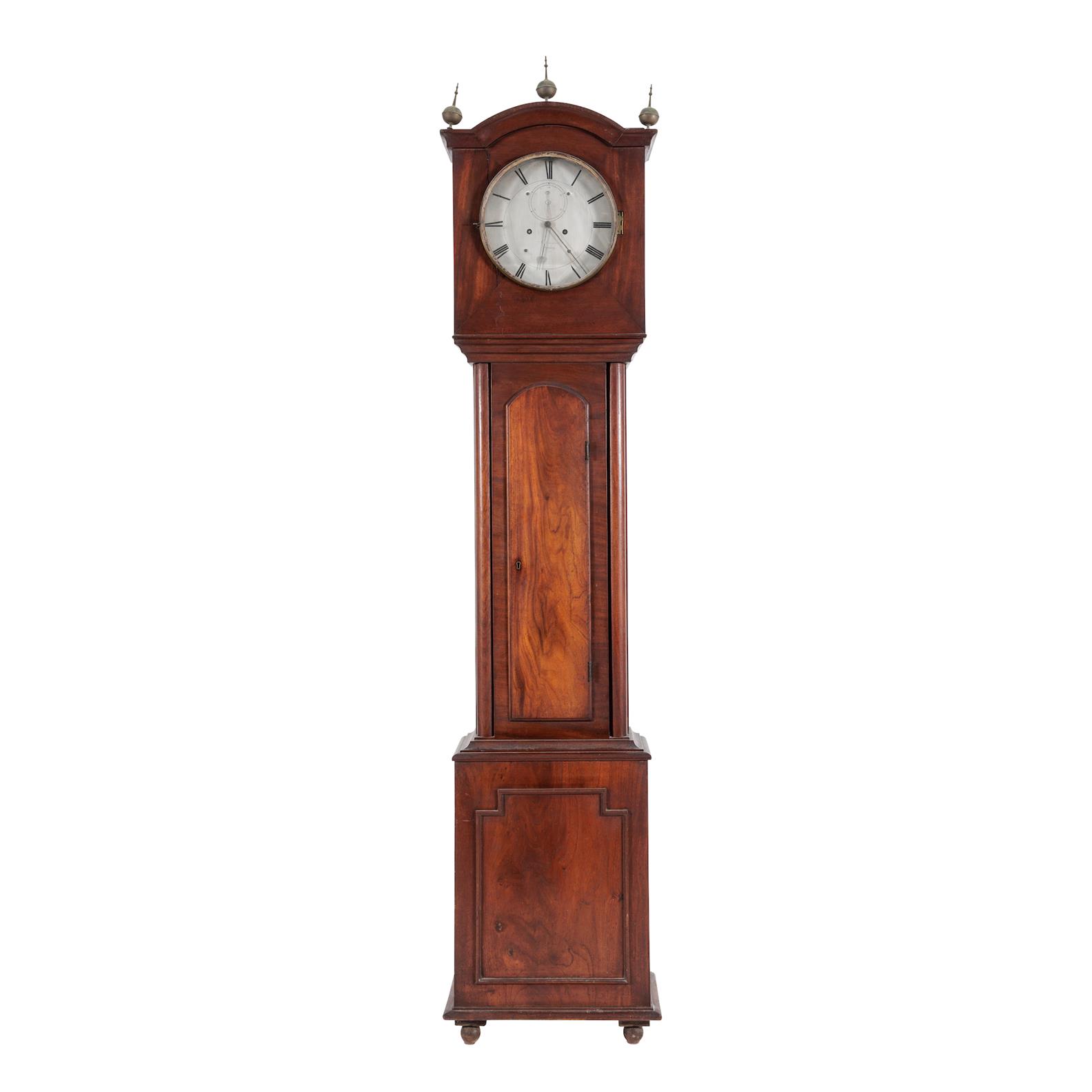
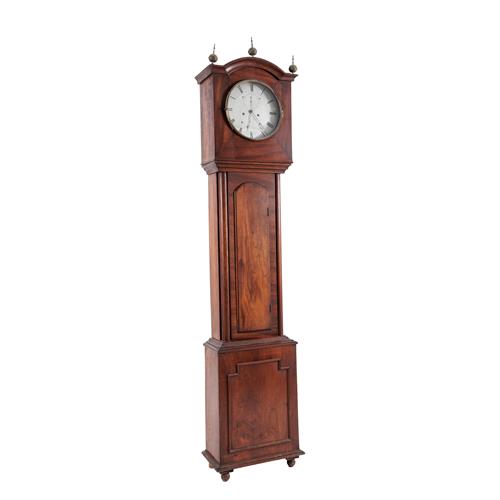
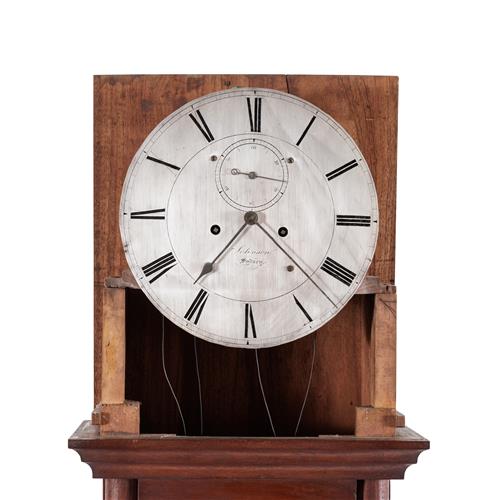
Circa 1835, the arched hood with three brass finials and brass framed door, the arched trunk door flanked by simple turned columns on a base with moulded applied panel on turned front ball feet, the silvered dial with roman numerals and subsidiary seconds dial inscribed 'Johnson Sydney', having blued steel hands and English eight-day movement.
Height 224cm
Estimate $10,000 - $15,000
- Engraving and dial in keeping of time and style
- Wear consistent with age
- brass finials likely modern
- expansion cracks to veneer on hood, gouge on side panel
- small crack on top of plinth left hand side
- overall nice untouched dry condition, original glass to dial
- silvered dial with slight creas across from VIII to IV but this may be in making.
- Not tested for time, with trunk key, winder pendulum and weights
The opinions expressed in the condition reports are a guide only and should not be treated as a statement of fact. Prospective buyers are encouraged to seek further information or request additional images during our pre-sale period where Leonard Joel staff are available for advice. Please note condition reports can be amended during the pre-sale period, so we strongly suggest any interested bidders check the published condition report available on the website before the auction commences. Leonard Joel makes no guarantee of the originality of mechanical or applied components. Absence of reference to such modifications does not imply that a lot is free from modifications.
Commissioned by Major-General J. M. Antill, Jarvisfield NSW (by repute)
Thence by descent to Julia Campbell Antill via marriage in Picton to John Weston Perry of Horsley Estate, Smithfield, May 1898
Retained by the family of Mr D.K.W. Perry, Sydney
Richard Johnson (1770-1844) was born in London where he trained as a chronometer, watch and clock maker. He emigrated to Australia with his wife Elizabeth on the 15th of August 1833 and they lived in Newtown. Soon after arriving he opened a watchmaker's shop in George St, Sydney. On the 18th of August 1835 he was made Superintendent of Government Clocks, a position he held until the early 1840's when he moved to Maitland to establish his business there.
Scarcity of materials during this period led to copper instead of the traditional brass being used for the clock face. It is thought this copper was sourced from excess material used in the manufacture of the Hyde Park Barracks clock.
The Collector's Auction
AUCTION
Sale: LJ8751
2:00pm - 17 September 2024
36-40 Queen Street, Woollahra
VIEWING
Fri 13 - Sun 15 Sep, 10am - 4pm
The Bond, 36-40 Queen St, Woollahra NSW
CONTACT
Madeleine Norton
sydney@leonardjoel.com.au
SIMILAR ITEMS
Lot 130
A FABERGÉ GUILLOCHÉ ENAMEL AND SILVER DESK CLOCK AND FRAME, WORKMASTER VIKTOR AARNE, CIRCA 1900
Estimate: $40,000-50,000
Lot 129
A RUSSIAN SILVER, GILT AND ENAMELLED KOVSH, MAKER’S MARK OF OREST KURLYUKOV, MOSCOW CIRCA 1910
Estimate: $30,000-40,000
Lot 26
ARTHUR STREETON (1867-1943) Bridges Over the River Thames, London watercolour on paper 33 x 48cm (60 x 75cm framed)
Estimate: $12,000-18,000
Lot 37
RAY CROOKE (1922-2015) Men Resting, Normanton, Queensland oil on canvas 76 x 99cm (88 x 110.5cm framed)
Estimate: $10,000-15,000