Lot 80
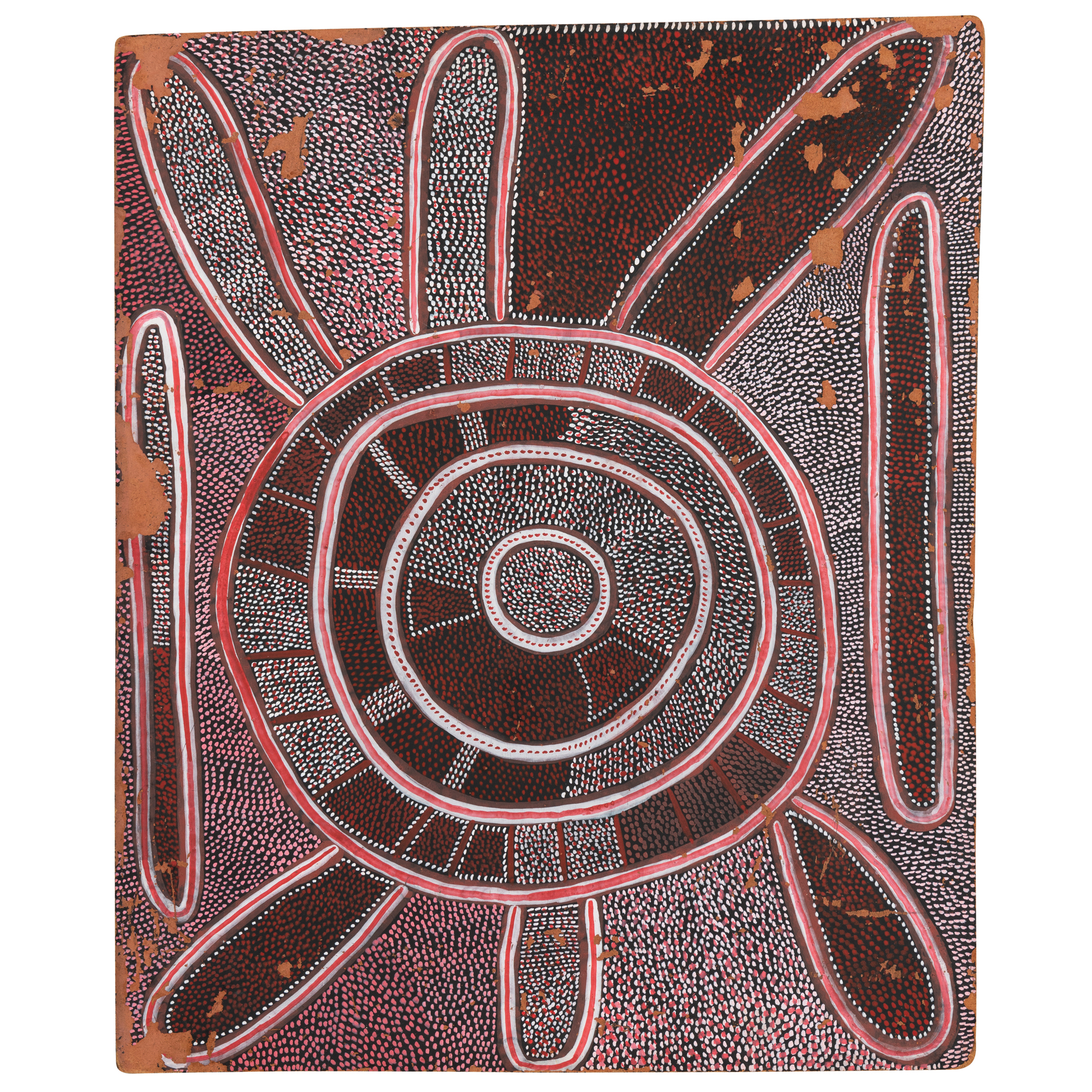
Untitled 1972
synthetic polymer paint on composition board
inscribed verso with artist's name and Stuart Art Centre cat. no. 19200 (concealed)
69.5 x 57.5cm
Estimate $50,000 - $70,000
The Artist, acquired at Papunya 1972-73
Stuart Art Centre, Alice Springs
Laurie Owens, Sydney
This work by one of Papunya's most celebrated artists, Mick Namarari Tjapaltjarri, was purchased in 1972 by the outgoing superintendent of Papunya, Laurie Owens. Hard working and empathetic, Owens was responsible for the administration and function of the Papunya community. Despite his immense workload, Owens was drawn into the orbit of the Papunya painting men and quickly became an important advocate for their fledgling painting enterprise.
Upon his arrival at Papunya in August 1971, Owens immediately saw great potential in art and craft activity at Papunya. Mary White, an adviser on Aboriginal projects to the Craft Council of Australia, described Owens as a 'very sympathetic Superintendent' and 'an exceptional person' who was 'doing his best to de-institutionalise the settlement'. White was particularly impressed to discover that Owens was 'full of ideas for a craft complex' similar to what he had observed operating in Ernabella under the guidance of Winifred Hilliard.
For decades, Owens' role in the fragile months leading up to the establishment of Papunya Tula Artists remained unappreciated. However, research now confirms that Owens was intimately involved in its administration and governance. He drafted its articles of association, consulting directly with the artists throughout the process. He applied for vital funding to install the artists' friend and facilitator, Geoffrey Bardon, as artistic director, ordered vital materials and acted as an empathetic conduit between the artists and the Welfare Division of the Northern Territory.
When Bardon had to abruptly depart his role as artistic director of Papunya Tula Artists in July 1972, it was Owens who was left to assist the painters in his absence. At this time, hundreds of paintings had accumulated in the Men's Painting Room, including Namarari's Untitled 1972. Records show that Owens occasionally provided upfront payments to select artists who were suffering financial hardship, later to be reimbursed by the artists' representative, Pat Hogan. He facilitated the sale of paintings to visitors to the community and oversaw the dispersal of artists' payments from the Stuart Art Centre.
When interviewed about the sale of this work recently, Owens, now in his mid-eighties, remembered:
'I used to go to the shed and watch him painting. There was something very thought provoking about Mick.
If I may say, God lived in that man. You looked in his eyes and there was tragedy and a depth of reflection in the way that he would look at you. And that really touched me quite a lot. I just felt that there was something spiritual about Mick. What more can I say?'
Born in sandhill country at Marnpi, south-east of present-day Kintore (Walungurru), Mick Namarari Tjapaltjarri's first years were spent in the bush. Due to drought and the infringement of pastoral activity on his homelands, as a young boy Namarari and his extended family group journeyed to the ration station at Haasts Bluff. As a teenager, he was persuaded to work with his relative Charlie Tjaruru Tjungurrayi in the cattle industry in the Areyonga region. Namarari settled at Papunya in the late 1950s, where he served as one of several councillors. It was in this role that Owens first encountered Namarari. Soon after, Owens would discover that Mick was an emerging artist among Papunya's painting men. Namarari was a significant contributor to the first consignments of paintings to leave Papunya for sale in Alice Springs. As time passed, he revealed himself to be an incessant innovator, unbound by social, cultural or market expectations.
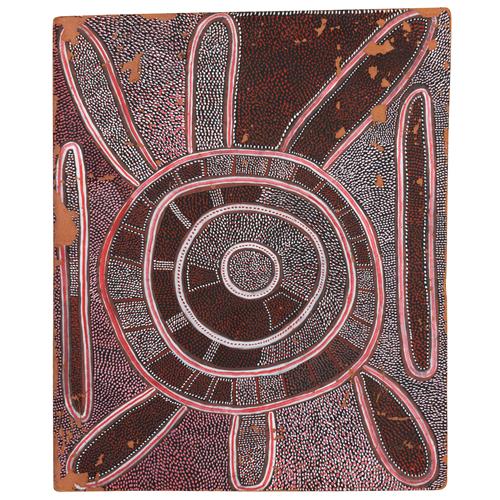
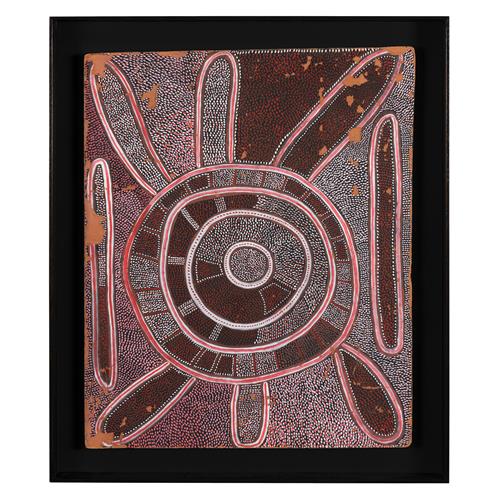
Untitled 1972 is adorned with Namarari's finely stippled dotting, which playfully segments its concentric circles. The fine orange linework is used to punctuate his bold design. It is difficult to propose the subject matter of Untitled 1972 given that Namarari deployed such imagery to symbolically depict a broad range of places and things. The looped 'U' shapes may possibly depict the seated presence of ancestral figures. The concentric circle can represent any number of things, from campfires, hills and water sources to ceremonial grounds. The elongated forms that frame each side of the picture may depict sacred objects in the possession of those seated.
The disclosure of previously unknown pictures from this unique moment in Australian art history is becoming increasingly rare. It is equally rare to encounter items with such fascinating provenance. The time has come for Owens and his family to part with this extraordinary painting and for it to enter the discourse surrounding Papunya and the art movement that came from it. Much more than an extraordinary work of art, it is an object that binds two men and speaks to the remarkable history of contemporary painting at Papunya.
Luke Scholes
© Mick Namarari Tjapaltjarri/Copyright Agency, 2024
Fine Art
AUCTION
Sale: LJ8755
6:00pm - 22 October 2024
Hawthorn
VIEWING
Fri 18 - Sun 20 Oct, 10am - 4pm
Mon 21 Oct, by appointment
2 Oxley Rd, Hawthorn VIC
CONTACT
Wiebke Brix
wiebke.brix@leonardjoel.com.au
SIMILAR ITEMS
Lot 18
JEFFREY SMART (1921-2013) Study II for Bus Terminus 1972-73 synthetic polymer paint and oil on canvasboard 60 x 50cm
Estimate: $140,000-160,000
Lot 33
LI CHEN (Taiwanese, born 1963) Visiting Fairyland 2004 bronze, ed. 8/8 117 x 96 x 60cm
Estimate: $130,000-160,000
Lot 41
TIM STORRIER (born 1949) (Evening Fire and Shooting Star) oil on canvas 91 x 152cm
Estimate: $70,000-90,000
Lot 36
XUE SONG (Chinese, born 1965) Racing Horses 2010 mixed media on canvas 180 x 250cm
Estimate: $50,000-70,000