Lot 21
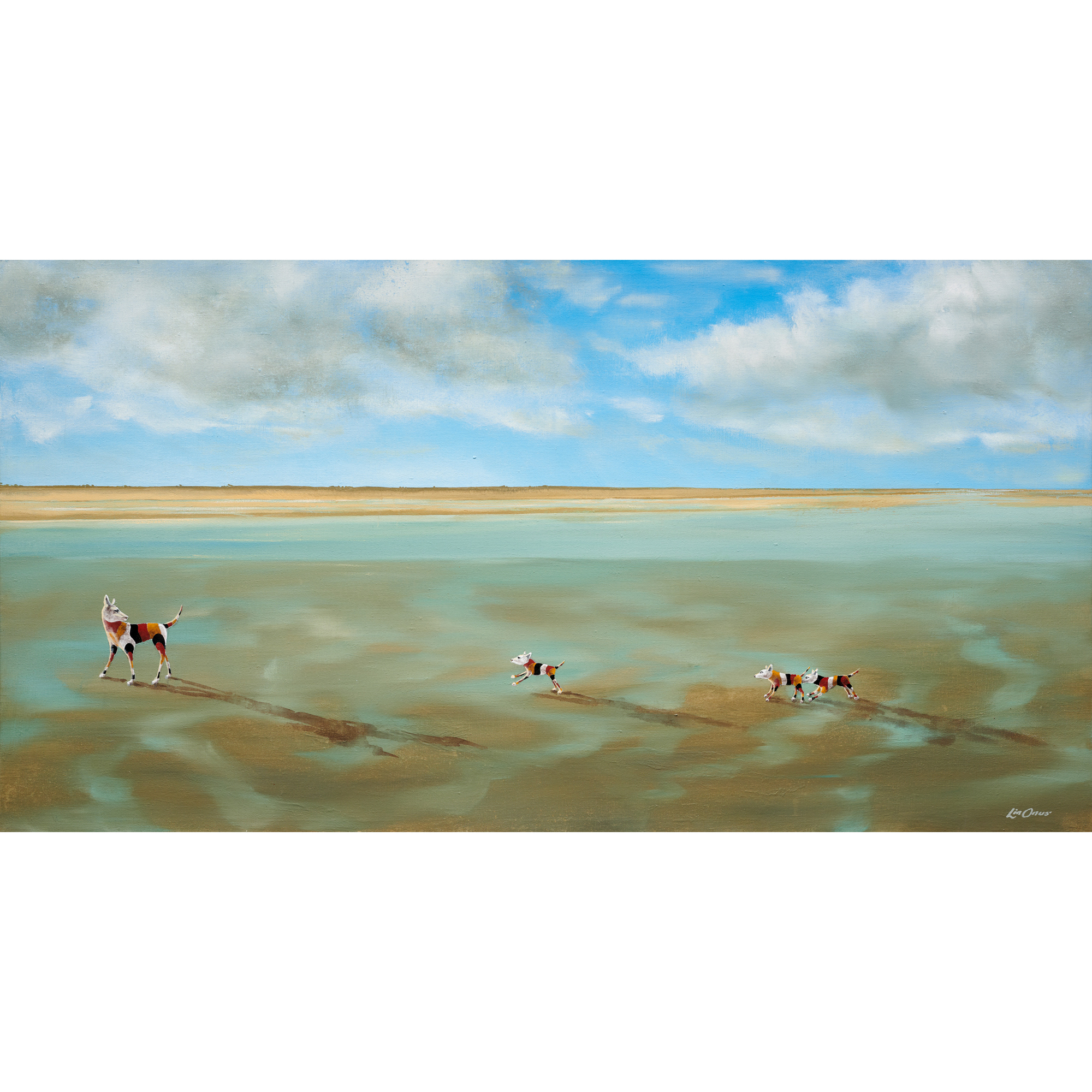
Wax Dogs on Lake Eyre 1989
synthetic polymer paint on canvas
signed lower right: Lin Onus
titled on gallery label verso
61 x 114cm
Estimate $45,000 - $65,000
Gallery Gabrielle Pizzi, Melbourne (label verso)
Private collection, Melbourne
Lin Onus, Gallery Gabrielle Pizzi, Melbourne, 11 - 28 October 1989, cat. no. 11
Urban Dingo: The Art and Life of Lin Onus 1948-1996, Museum of Contemporary Art, Sydney, 11 August - 30 October 2000; then touring Queensland Art Gallery, Brisbane, 24 November - 4 March 2001; Melbourne Museum, Melbourne, 6 April - 29 July 2001, loan no. 37 (label verso)
Neale, M., Urban Dingo: The Art and Life of Lin Onus 1948-1996, Queensland Art Gallery, Brisbane, 2000, pl. 40, p. 92 (illus.)
"I kind of hope that history may see me as some sort of bridge between cultures…" (1)
Lin Onus, 1990
Lin Onus (1948-1996) was a groundbreaking Australian artist whose work bridged cultural divides, blending Western artistic traditions with Indigenous perspectives. From Yorta Yorta and Scottish descent, Onus was deeply committed to highlighting Indigenous narratives through visual language, often employing humour, irony, and meticulous craftsmanship to challenge colonial representations of Indigenous identity. His wax dogs, also known as dingoes, stand as a compelling example of this approach-an enigmatic body of work that disrupts expectations and offers a nuanced reflection on cultural displacement, survival, and transformation.
Onus was an artist of remarkable versatility, moving between painting, sculpture, and installation. His ability to integrate Indigenous iconography with European artistic techniques, linking his dual ancestry, resulted in a unique visual lexicon that spoke across cultural boundaries. Throughout his career, he engaged with pressing social issues, including land rights, environmental concerns, and the resilience of Indigenous culture. The wax dog series, produced in the final years of his life, encapsulates these themes, while adding a layer of surrealist wit that is characteristic of his oeuvre.
Lin Onus was a self-taught artist, who forged an exceptional career and held exhibitions across Australia and internationally. Following his premature death in 1996 at the age of forty-seven, a touring retrospective, Urban Dingo: The Art and Life of Lin Onus 1948-1996, opened in 2000 at the Museum of Contemporary Art in Sydney, coinciding with the Sydney Olympics, before touring to Brisbane and Melbourne. This artwork, 'Wax Dogs on Lake Eyre' 1989, was included in the selection of works by Lin Onus, to be part of this significant retrospective exhibition.
Whilst Onus often identified as a landscape artist in his early career, from 1986 following his time in Maningrida, he began to include titles for his artworks using the language of his adoptive family. (2) From this moment, his art developed into an amalgamation of photorealist depictions of landscapes, with Indigenous imagery and stories. This was inspired by his time in Maningrida with the Djinang artist, Djiwul 'Jack' Wunuwun and other central Arnhem Land artists, which offered Onus the opportunity to learn Aboriginal traditional knowledge and where he was given creation stories that he was permitted to paint. (3)
Inspired by his journeys north, Onus passed Lake Eyre where he first encountered the dingo; an animal for which he developed an influential kinship that led to the creation of artworks such as, 'Wax Dogs on Lake Eyre' 1989. To Onus, the dingo was not the demeaned dingo of recent colonial history, "…the dingo in the paintings is a survivor, an animal of supreme adaptability: a figure for Aboriginal subjects themselves in their oneness with the land". (4) This view of the dingo as a survivor, led to the adoption of the dingo as the persona for the character X, who engages in adventures with his friend Ray, the stingray; characters that formed an enduring comic myth in Onus's artworks. These totemic animals perform both moral and political roles as they travel across landscapes. (5)
In this artwork, 'Wax Dogs on Lake Eyre' 1989, the wax dogs are set against the vast landscape of Lake Eyre, positioned in the foreground, capturing the viewer's immediate gaze. Onus has politicised the wax dogs by colouring their coats with bands of red, black and yellow - telluric colours reminiscent of the Aboriginal flag and culture. (6) A larger, parent figure who is leading the group, is depicted turning their gaze back towards the three following pups. With the parallel drawn between the wax dog or dingo as a survivor, revered for its adaptability to the land and environment, this imagery of kinship gives a sense of hope for the unity and bonds formed when faced with adversity. Onus's use of tonality in this work, evident in the clouds, the glistening water of the salt lake and the shadows against the bodies of the wax dogs, creates movement and emulates the heat of the sun against the harsh landscape of the salt lake. This further suggests the resilience of the dingo, a symbolic figure to the resilience of the Indigenous culture when faced with issues of representation, dispossession, cultural displacement, and marginality.
Onus left an indelible mark on the Australian art world and his legacy endures today. 'Wax Dogs on Lake Eyre' 1989 stands as a testament to Onus's ability to weave layered narratives within his imagery. As with much of his work, these pieces operate on multiple levels-formally compelling, conceptually rich, and emotionally resonant. They demand engagement, inviting viewers to reconsider their own positions within Australia's complex cultural landscape and history.
Amanda North
Senior Fine Art Specialist
(1) Lin Onus, artist statement, cited in Neale, M. et al., Urban Dingo: the art and life of Lin Onus 1948- 1996, Craftsman House in association with the Queensland Art Gallery, South Brisbane, 2000, p.21
(2) Neale, M. et al., Urban Dingo: the art and life of Lin Onus 1948-1996, Craftsman House in association with the Queensland Art Gallery, South Brisbane, 2000, pp. 19-20
(3) Ibid.
(4) Ashcroft, B., Hybridity and Transformation: The Art of Lin Onus, University of New South Wales, Postcolonial Text, vol. 8, no. 1, 2013, p. 10
(5) Neale, M. et al., Urban Dingo: the art and life of Lin Onus 1948- 1996, Craftsman House in association with the Queensland Art Gallery, South Brisbane, 2000, pp. 19-20
(6) Ibid.
© Lin Onus/Copyright Agency, 2025
Fine Art
AUCTION
Sale: LJ8773
6:00pm - 18 March 2025
Hawthorn
VIEWING
Fri 14 - Sun 16 Mar, 10am - 4pm
2 Oxley Rd, Hawthorn VIC
Lot 9, George Baldessin's Emblems will be on view by appointment only, at the following location.
Meridian Sculpture
8 Spring St, Fitzroy, VIC 3065
CONTACT
Wiebke Brix
wiebke.brix@leonardjoel.com.au
SIMILAR ITEMS
Lot 9
GEORGE BALDESSIN (1939-1978) Emblems 1973 Emblem I, Emblem II, Emblem III i. cast bronze ii. rusted steel iii. rusted steel 480cm he...
Estimate: $100,000-150,000
Lot 45
JOHN PERCEVAL (1923-2000) Yellow Tug Boat oil on canvas 81 x 102cm
Estimate: $60,000-80,000
Lot 48
ROBERT DICKERSON (1924-2015) Waiting, Mother and Child 1991 acrylic on canvas 120 x 150cm
Estimate: $50,000-80,000
Lot 36
ARTHUR BOYD (1920-1999) Landscape with Rainbow 1973 oil on canvas 97 x 89cm
Estimate: $50,000-60,000