Lot 8
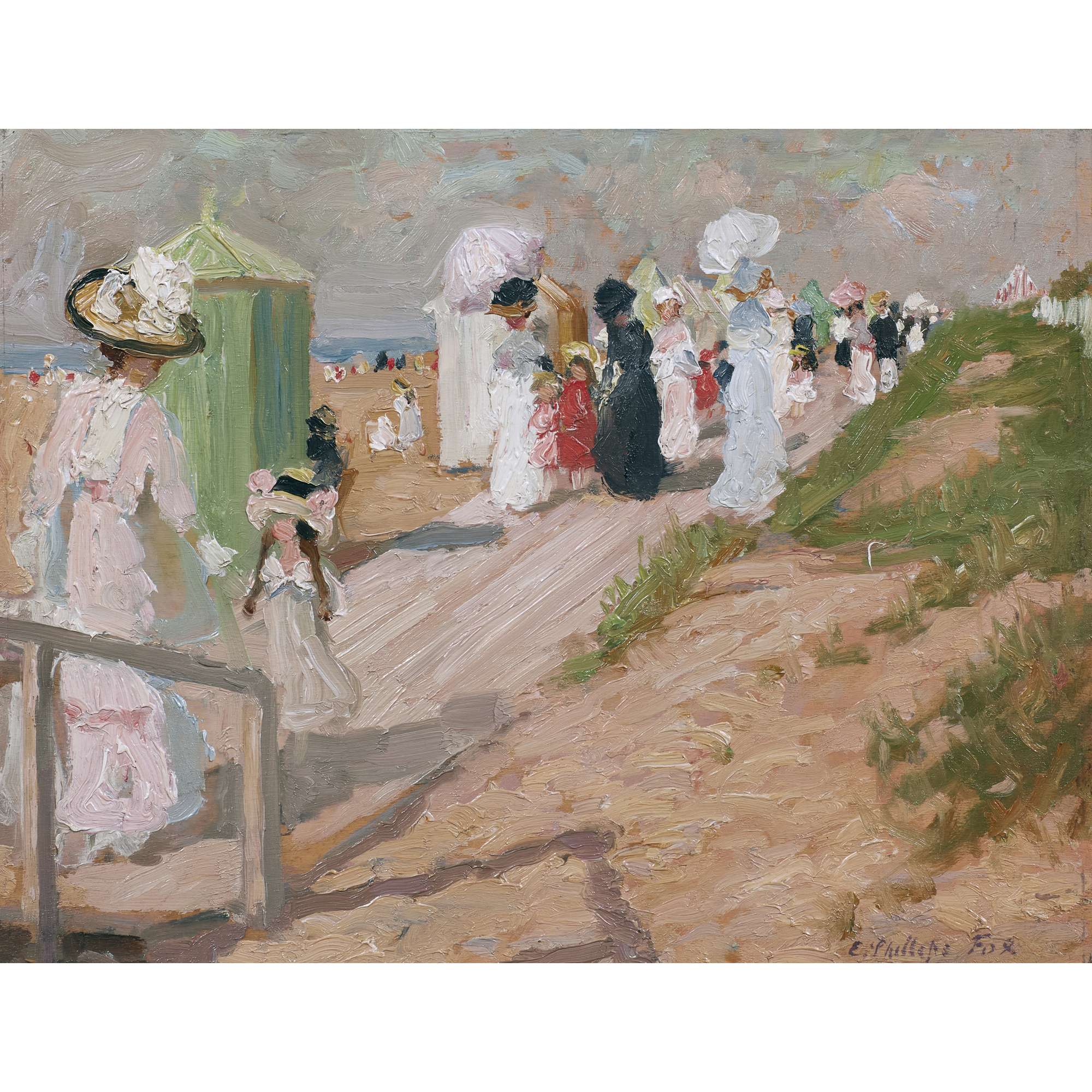
(Promenade on the Beach) c.1909
oil on panel
signed lower right: E. Phillips Fox
26 x 34cm
Estimate $80,000 - $120,000
GFL Fine Art, Perth, 27 July 1999, lot 16
Private collection
GFL Fine Art, Perth, 26 June 2001, lot 37
Private collection, Western Australia
Painted Women: Australian Artists in Europe at the Turn of the Century, Lawrence Wilson Art Gallery, The University of Western Australia, Perth, 24 July - 13 September 1998, cat. no. 30
Grey, A. (ed.), Zubans, R., Images of Women in the Work of Emanuel Phillips Fox and Ethel Carrick Fox, Painted Women: Australian Artists in Europe at the Turn of the Century, The University of Western Australia, Perth, 1998, pp. 14 (illus.), 16, 40, cat. no. 30
After their marriage in London in 1905, Ethel Carrick Fox (1872-1952) and Emanuel Phillips Fox (1865-1915) settled into a routine of summers spent following the sunlight to crowded French sea resorts, painting and sketching the leisurely crowds on small boards or canvases, then returning to their studio apartment in Paris to paint larger works.
Their influence on each other was apparent from their honeymoon. Fox's style loosened when working on smaller boards, and his great facility with oil paint, honed by years of academic training and teaching, became truly virtuosic in capturing light effects on dresses, sands and figures. His studio practice remained quite focused on a variation of the French intimiste painters, Pierre Bonnard and Édouard Vuillard, with large-scale studies of languorous women in gardens or private interior spaces, as well as commissioned portraits for necessary income. Fox's academic training led him to separate these two modes of working; his oil sketches were not generally exhibited in Paris, whilst Carrick, less attentive to highly finished studio production, regularly exhibited her rapidly executed sketches in major exhibitions such as the annual Salon d'Automne.
In 1908, Fox visited Australia to see his family and introduce them to his new wife. The couple kept working during the trip, seeking out the leisure pursuits of family picnics and days at the beach as subjects. (1) Whilst sea bathing had been popular since the 1840s around Melbourne, in 1908, mixed ocean bathing in daylight hours was still a very new phenomenon. In '(Port Phillip, Melbourne)' c.1908 (Lot 2), we see the elegant Edwardian silhouette of a woman in a long voluminous skirt, white shirt and pink picture hat observing two swimmers in the shallows, their clothing casually piled next to her on the sand. Underneath a wide, pink-tinged cloud-scumbled sky, a small sailboat bobs further out at a distance, close to the other side of the bay. This work demonstrates Fox's ability to adapt his plein air technique to the more relaxed social conventions of Australian beach culture, where the emphasis was on leisure rather than formal promenading.
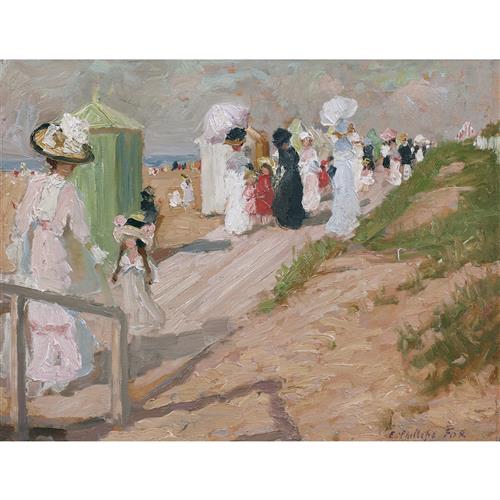
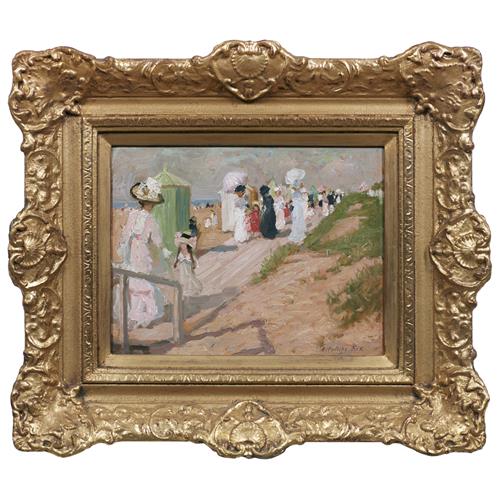
In contrast to the casualness of beach crowds in Australia, '(Promenade on the Beach)' c.1909 (Lot 8) depicts a crowded afternoon by the beach at a fashionable French sea resort. We see bathing boxes, but our focus is not on swimmers or those lounging on the sands. Instead, we observe the stylish upper bourgeoisie classes en promenade along the planches or timber boardwalk, suggesting they are probably at Trouville or Deauville. Dressed in long flowing dresses replete with ribbons, ruffles, picture hats and parasols, these figures are captured in lusciously applied thick, sweeping strokes of paint, the impasto itself reflecting light and creating movement. Juliette Peers has pointed out that Fox was an accurate recorder of fashion, and the Foxes kept a shared garment collection that appears in many of the couple's paintings. (2) Peers notes that the selection and observation of dress and styling were intrinsic to making Fox's ideal women and imagined muses tangible. (3) As Ruth Zubans has noted, 'one of Fox's favourite themes was women in the familial role of mother', (4) and the mother in a pink ruffled gown elegantly reaching for her pigtailed daughter's hand in the foreground suggest a graceful ease and tender refinement. Indeed, in '(Promenade on the Beach)' c.1909, the subjects are observably all women - mothers and children, as well as the nannies tending to them.
In contrast to the public, clothed figures of these beach scenes, Fox's more intimate, private world is depicted in 'Nu En Plein Air' c.1911 (Lot 11). Whilst initially seeming to be a very simple subject, Fox has set himself considerable challenges in the work's composition and the application of paint. In the privacy of the garden of the Foxes' Boulevard Arago apartment in Paris, this flame-haired sensuous nude (one of many red-haired models preferred by Fox, which included the Australian artist Edith Susan Gerard Anderson) lounges diagonally across a bed of bright green, light-flecked grass, with Fox leaving areas of the light brown bare canvas to aid the delicate effect. As Fox described in a letter to his friend Hans Heysen: 'Since we have been in Paris, painting nudes out of doors, in our garden-we have fixed things up so that no one can see, & we are not disturbed-very interesting work, but mighty difficult'. (5) The foreshortened model's pose is contemplative, deep in thought and less aware of the viewer than many of the other nudes in this series. Her translucent skin is highlighted by dappling flecks of lighter paint suggestive of flickering sunlight through a tree canopy, conveying something of the swiftness and dexterity that Fox had to employ to capture the scene.
The atmosphere of ease and wellbeing radiating from many of Fox's paintings of the Edwardian period recalls a way of life that would disappear forever upon the onset of the First World War. During this period, the French resort towns including Trouville and Deauville were transformed into military hospitals and convalescent homes for wounded soldiers. After losing E. Phillips Fox to cancer in 1915, Carrick would return to these resorts and document new fashions and social mores as the crowds returned in the interwar years.
Angela Gooddard
Angela Goddard is former curator of Australian Art at Queensland Art Gallery | Gallery of Modern Art, Brisbane where she curated 'Art, Love and Life: Ethel Carrick and E. Phillips Fox' in 2011.
(1) See the photograph by David Fox on p.148 of Art, Love & Life catalogue for Fox and Carrick at a family picnic on Chelsea Beach, Port Phillip Bay.
(2)Peers, J., 'Tall, graceful women sweep by': Fashion and dress in the work of the Foxes', in Art, Love & Life: Ethel Carrick and E. Phillips Fox, Queensland Art Gallery | Gallery of Modern Art, Brisbane, 2011, p.96.
(3) Ibid, p.100.
(4) Zubans, R., 'Images of Women in the Work of Emanuel Phillips Fox and Ethel Carrick Fox', Painted Women: Australian Artists in Europe at the Turn of the Century, The University of Western Australia, Perth, 1998, p.16.
(5) Fox to Heysen, September 1911, quoted in Zubans, R., E. Phillips Fox, His Life and Art, Melbourne University Press, Melbourne, 1995, pp.155-56.
RELATED WORK:
Emanuel Phillips Fox, Promenade c.1909, oil on wood panel, 26.6 x 35cm, The Collection of the National Gallery of Australia, Canberra
A Private Collection of Important Australian Art
AUCTION
Sale: LJ8793
6:00pm - 25 August 2025
Hawthorn
VIEWING
SYD: Thur 14 - Sun 17 Aug, 10am - 4pm
The Bond, 36-40 Queen St, Woollahra, NSW
MELB: Thur 21 - Sun 24 Aug, 10am - 4pm
2 Oxley Rd, Hawthorn, VIC
CONTACT
Wiebke Brix
wiebke.brix@leonardjoel.com.au
SIMILAR ITEMS
Lot 10
FREDERICK MCCUBBIN (1855-1917) The Lime Tree (Yarra River from Kensington Road, South Yarra) 1917 oil on canvas 97 x 110cm
Estimate: $600,000-800,000
Lot 20
RUPERT BUNNY (1864-1947) Portrait de Mme B... c.1914 (also known as Portrait of the Artists Wife) oil on canvas 217 x 107.5cm
Estimate: $300,000-400,000
Lot 17
RUPERT BUNNY (1864-1947) The Sonata c.1910 (also known as La Sonate) oil on canvas 80 x 64cm
Estimate: $200,000-300,000
Lot 22
ARTHUR STREETON (1867-1943) Ramparts Face the Ocean 1932 (also known as Southern Ocean) oil on canvas 50 x 75cm
Estimate: $150,000-200,000