Lot 28
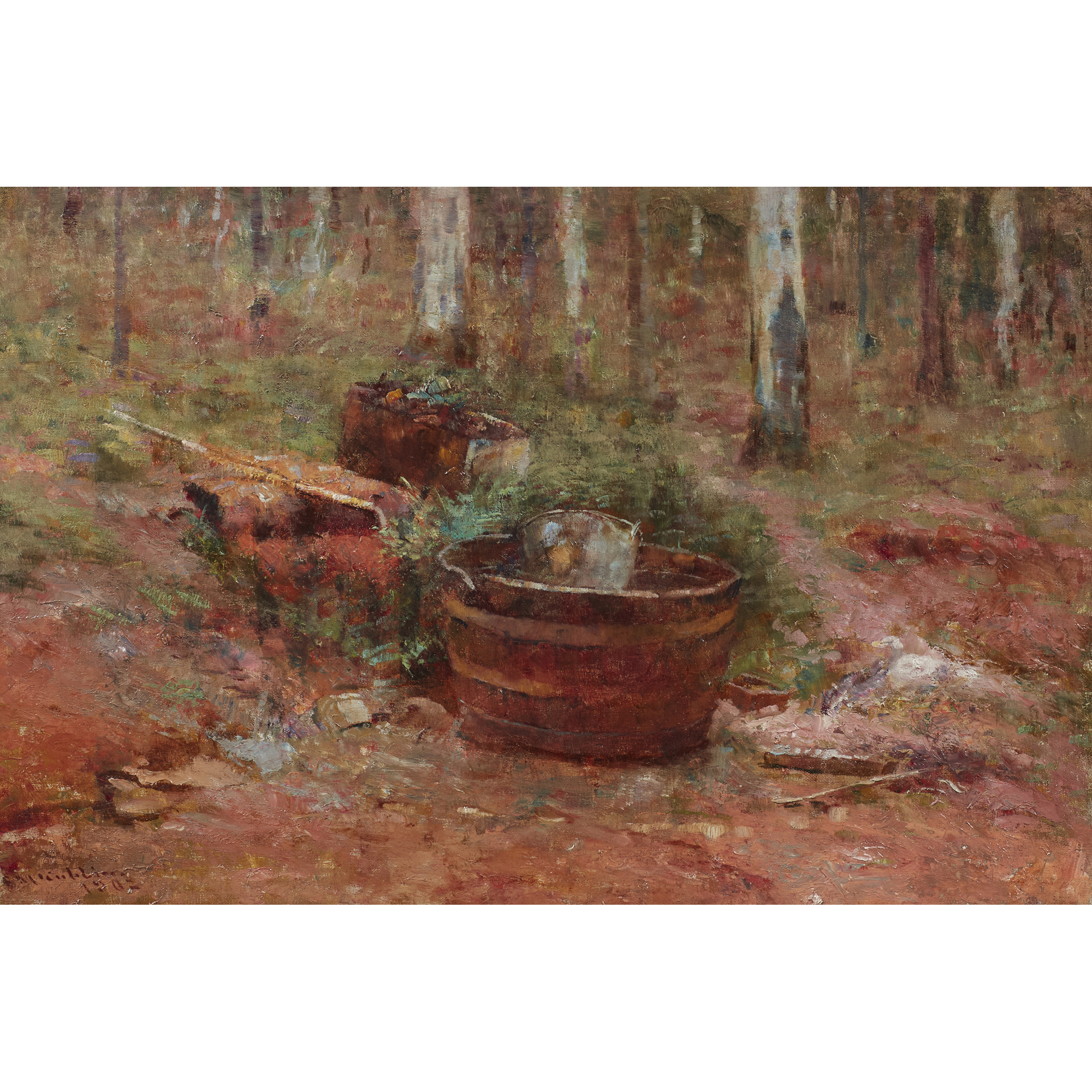
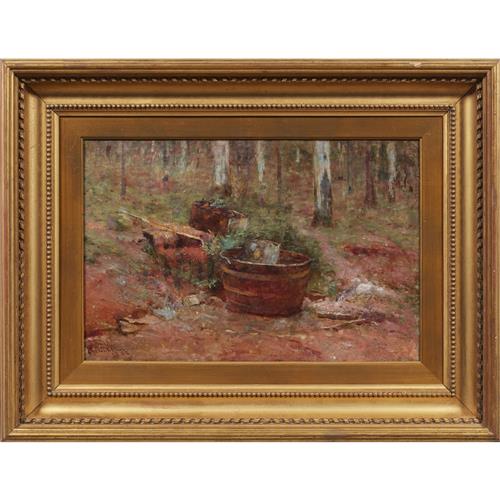
(Bush Setting, Mount Macedon) 1902
oil on canvas
signed and dated lower left: F.McCubbin/ 1902
artist's name and title on gallery label verso
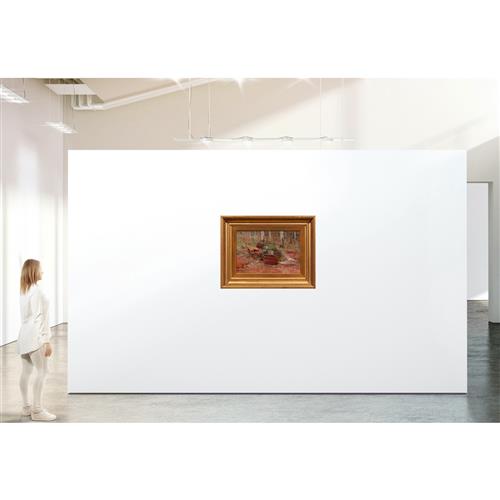
39.5 x 60cm
Estimate $40,000 - $60,000
Leonard Joel, Melbourne, 28 July 1998, lot 55A (as "Water Barrel")
Private collection, Melbourne
Kozminsky Gallery, Melbourne (as "Bush Setting, Mount Macedon") (label verso)
Private collection, Western Australia
Spring Exhibition, Kozminsky Galleries, Melbourne, 1998, cat. no. 9 (as "Bush Setting, Mount Macedon") (label verso)
Spring Exhibition, Kozminsky Galleries, Melbourne, 2000 (as "Bush Setting, Mount Macedon") (label verso)
Frederick McCubbin's deep connection to Mount Macedon is evident in the number of works he produced in and around the area from the early 1900s until his death in 1917.
In 1901, McCubbin purchased a cottage named 'Fontainebleau' in the Macedon Ranges, which became a retreat for the artist and his family. The name 'Fontainebleau' was influenced by the forest near Paris where the Barbizon School painters had worked and sought inspiration in the mid nineteenth century. This French school of painting was part of the larger European movement towards naturalism in art which led to the establishment of Realism and influenced the young Impressionist artists.
Surrounded by dense bushland, towering gums trees and dappled sunlight, the region provided McCubbin with a new sense of tranquillity and inspiration, shifting his palette towards more atmospheric and impressionistic tones. The Macedon Ranges became an importance place to the McCubbin family and a source of great inspiration to Frederick. McCubbin's daughter Kathleen, wrote that her father's 'greatest love was the bushland at Mt Macedon. The mystique of the Australian bushland intrigued him: the sunlight glinting through the tall timbers, the secret colours in the abundant undergrowth, the call of the birds, and the whispering breeze'. (1)
At Mount Macedon, McCubbin moved away from the narrative compositions of his early career and embraced a more introspective and expressive response to the landscape. These later works are characterised by loose brushwork, a softened palette, and a poetic evocation of the Australian bush. Macedon offered McCubbin not only a physical escape from the city but also a profound emotional and spiritual connection to nature; a space where he could reflect, observe, and create.
Paintings from this period, often depicting the surrounding forests, ferns, and mountain air including one of his most famous works, the triptych The Pioneer 1904, mark a distinct chapter in McCubbin's oeuvre and underscore his enduring legacy as a founding figure of Australian Impressionism.
(1) Mangan, K., Daisy chains, war, the jazz, Hutchison, Melbourne, 1984, p. 70
A Private Collection of Important Australian Art
AUCTION
Sale: LJ8793
6:00pm - 25 August 2025
Hawthorn
VIEWING
SYD: Thur 14 - Sun 17 Aug, 10am - 4pm
The Bond, 36-40 Queen St, Woollahra, NSW
MELB: Thur 21 - Sun 24 Aug, 10am - 4pm
2 Oxley Rd, Hawthorn, VIC
CONTACT
Wiebke Brix
wiebke.brix@leonardjoel.com.au
SIMILAR ITEMS
Lot 10
FREDERICK MCCUBBIN (1855-1917) The Lime Tree (Yarra River from Kensington Road, South Yarra) 1917 oil on canvas 97 x 110cm
Estimate: $600,000-800,000
Lot 20
RUPERT BUNNY (1864-1947) Portrait de Mme B... c.1914 (also known as Portrait of the Artists Wife) oil on canvas 217 x 107.5cm
Estimate: $300,000-400,000
Lot 17
RUPERT BUNNY (1864-1947) The Sonata c.1910 (also known as La Sonate) oil on canvas 80 x 64cm
Estimate: $200,000-300,000
Lot 22
ARTHUR STREETON (1867-1943) Ramparts Face the Ocean 1932 (also known as Southern Ocean) oil on canvas 50 x 75cm
Estimate: $150,000-200,000