Lot 61
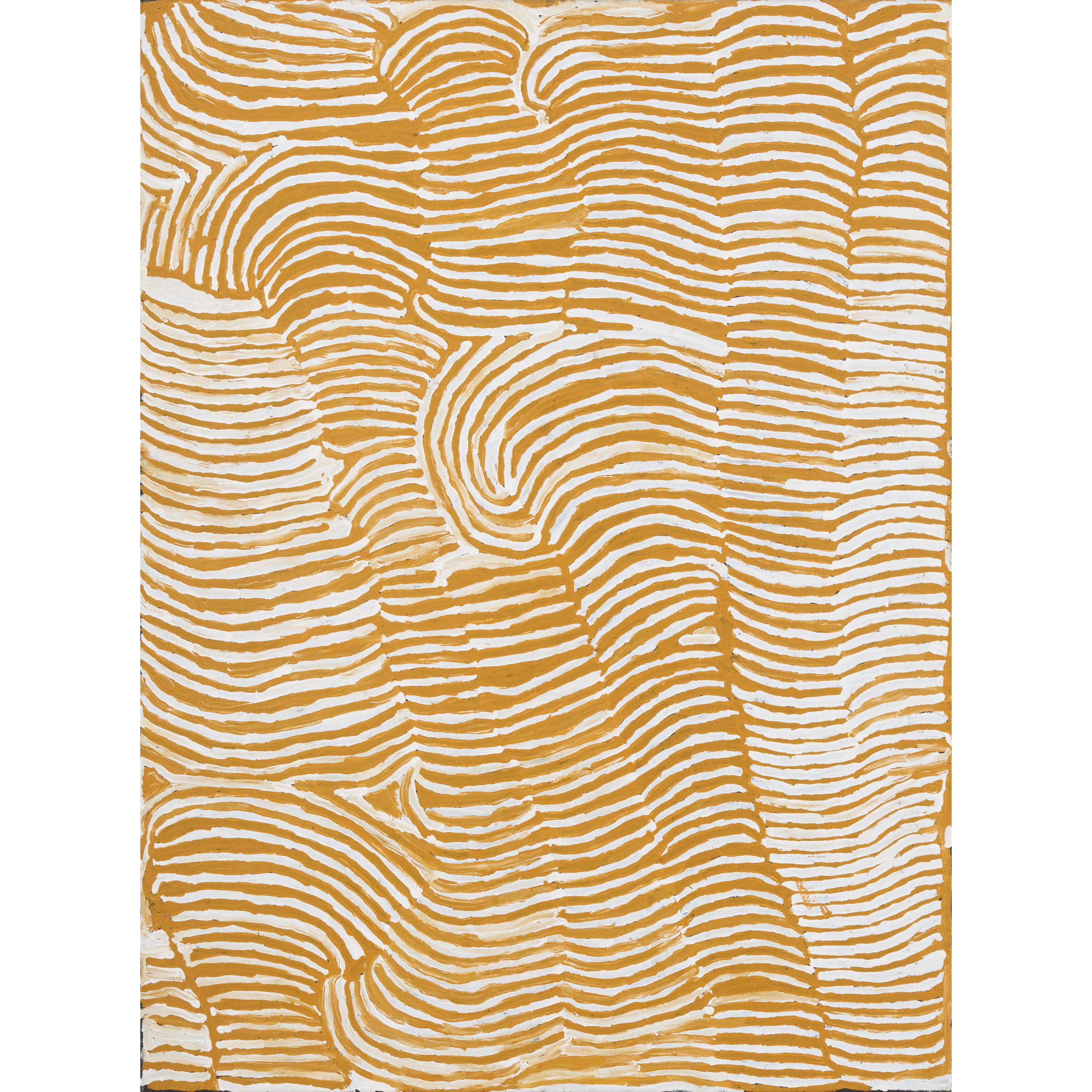
Untitled - The Travels of Kungka Kutjarra (Two Women) 2001
synthetic polymer paint on linen
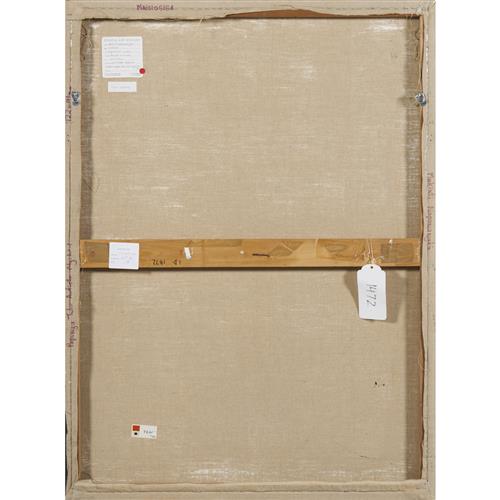
inscribed verso with artist's name and Papunya Tula Artists cat. no. MN0105154
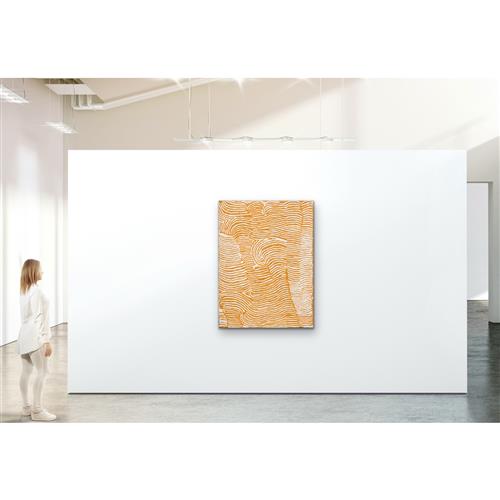
122 x 90cm
Estimate $18,000 - $24,000
Painted at Kintore, Northern Territory
Papunya Tula Artists, Alice Springs, Northern Territory (accompanied by a copy of the certificate of authenticity)
Utopia Art Sydney, Sydney 2001 (exhibition label verso)
The Laverty Collection, Sydney
Private collection, Sydney
Makinti Napanangka - New Paintings, Utopia Art Sydney, Sydney 10 November - 5 December 2001, cat. no. 23
Makinti Napanangka (c.1930-2011) stands among the most influential painters of the Western Desert movement and the Papunya Tula Artists cooperative. A senior Pintupi woman, she was central to the mid-1990s surge of women artist's painting from Kintore and Kiwirrkura; momentum catalysed by the Haasts Bluff and Kintore women's collaborative painting project of 1994. This significant project which included a series of major paintings that were exhibited at the Tandanya National Aboriginal Cultural Institute in Adelaide, represents the beginning of Pintupi women's participation as independent artists in the Western Desert art movement. (1)
Makinti's practice, grounded in ceremonial design and Women's Law, redirected awareness to the aesthetics and authority of Pintupi women's cultural narratives within Papunya Tula. Makinti refined a pictorial language that conveyed ceremonial motion as rhythm and colour, layering the canvases with paint, creating a sense of movement. This painting style is a contrast to the detailed and precise dotting that is typical of men's traditional painting of Dreaming Law.
Makinti's paintings centre on two related Dreamtime stories, the journeys of Kungka Kutjarra, the two ancestral women, and the rockhole site of Lupulnga, South of Kintore. The Kungka Kutjarra story is the focus for this 2001 artwork. This work is rich in colour and texture, the pale swirling lines represent the handspan hair string skirts worn by women in ceremonial dance. These skirts, woven from human hair and spindle sticks, animate the canvas with looping banded forms applied over the orange ochre toned background. Makinti's approach to painting is looser and more gestural than many of her contemporaries, offering a tactile and sensual experience that is immediate and energetic. The emphasis is on movement and cultural presence, differing to the precision of the dot-work and geometric lines seen in traditional men's paintings.
The Kungka Kutjarra narrative is significant to Makinti's oeuvre, often entwined with sites around Lake MacDonald (Kaakuratintja) and the ceremonial rockhole of Lupulnga, over which she held custodial rights. Her paintings from the late 1990s through to the 2000s, pursue this story with increasing visual confidence. The concentric rockhole motifs from earlier works, give way to expanses of undulating lines, representing the string of the skirts worn in ceremonial dance. These flowing lines, which appear to extend beyond the edges of the canvas, create a sense of dynamism, emulating the movement of the dance. This repeated thematic focus, anchored in knowledge of the place and performed ritual, is central to Makinti's authority as a cultural custodian, as well as to the artwork's visual power.
In the early 2000s, Makinti began to experience greater recognition for her innovative and energetic artworks. In 2000, one of her works was included in the major retrospective exhibition 'Papunya Tula: Genesis and Genius' at the Art Gallery of New South Wales, Sydney, and in 2003, in the Clemenger Contemporary Art Award at the National Gallery of Victoria. In 2008, Makinti won the National Aboriginal and Torres Strait Islander Art Award with an untitled painting of Lupulnga which was an acknowledgement of both artistic achievement and cultural leadership. The career defining prize helped spotlight Papunya Tula women artists within national narratives of contemporary art, not merely as an adjunct to the creation stories of men.
The growing attention to Papunya Tula women artists over the past few decades is visible in exhibition programming and secondary market activity. Institutional and commercial art shows continue to spotlight Pintupi women's painting as an evolving intergenerational practice; recent exhibitions have explicitly named these women as a 'next generation' which builds on the legacies of artists such as Makinti Napanangka and Wintjiya Napaltjarri. Meanwhile, auction results for key Kungka Kutjarra and Lupulnga works by Makinti from the early 2000s, demonstrate steady demand. These curatorial and commercial trends, reflect a broader reassessment of women's contributions to Papunya Tula's history and its present.
Artworks such as Untitled - The Travels of Kungka Kutjarra (Two Women), embody Makinti Napanangka's synthesis of ceremonial design, narrative and a distinctive painterly language. The sweeping lines of the hair string forms in the painting do more than describe ceremonial adornment; they enact movement, combining place, ancestry and performance within a single canvas. In doing so, the artwork, like Makinti's practice at large, illustrates why the paintings of Papunya Tula women artists have become a locus of sustained scholarly, curatorial and collector interest.
Amanda North
Senior Fine Art Specialist
(1) Perkins, H., 'Tradition today: Indigenous art in Australia', Art Gallery of New South Wales, Sydney, 2014
"This painting depicts designs associated with the travels of the Kungka Kutjan'a (Two Women) to a site on the south side of Lake MacDonald. The two women were digging for the small animal Kuningka (Western Quoll). These animals usually live in burrows which were dug by other animals such as the Burrowing Bettong or Rabbits and occasionally in hollow logs. The lines in the work represent spun hair which is made into hair-string skirts worn by the women during ceremonies associated with the site. The women later continued their travels to the east."
As stated on a copy of the Papunya Tula Artists certificate of authenticity.
© Makinti Napanangka/Copyright Agency, 2025
Fine Art
AUCTION
Sale: LJ8795
6:00pm - 21 October 2025
Hawthorn
VIEWING
SYD: Highlight lot 13
Fri 10 - Sun 12 Oct, 10am - 4pm, The Bond, 36-40 Queen Street, Woollahra
MEL: Fri 17 Oct - Sun 19 Oct, 10am - 4pm
2 Oxley Rd, Hawthorn VIC
CONTACT
Wiebke Brix
wiebke.brix@leonardjoel.com.au
SIMILAR ITEMS
Lot 21
ROBERT JUNIPER (1929-2012) (Landscape with Figures) 1973 oil on canvas 172.5 x 180cm
Estimate: $50,000-70,000
Lot 29
DAVID LARWILL (1956-2011) Games 1998 oil on linen, diptych 152.5 x 244cm (overall)
Estimate: $40,000-50,000
Lot 36
CHARLES BLACKMAN (1928-2018) Nights Dream Celestial Mirror c.1984 oil on canvas 122 x 183cm
Estimate: $30,000-50,000
Lot 12
CHARLES BLACKMAN (1928-2018) The Garden of Carnavalet 1970 mixed media and collage on paper 90 x 188cm
Estimate: $20,000-40,000