Lot 16
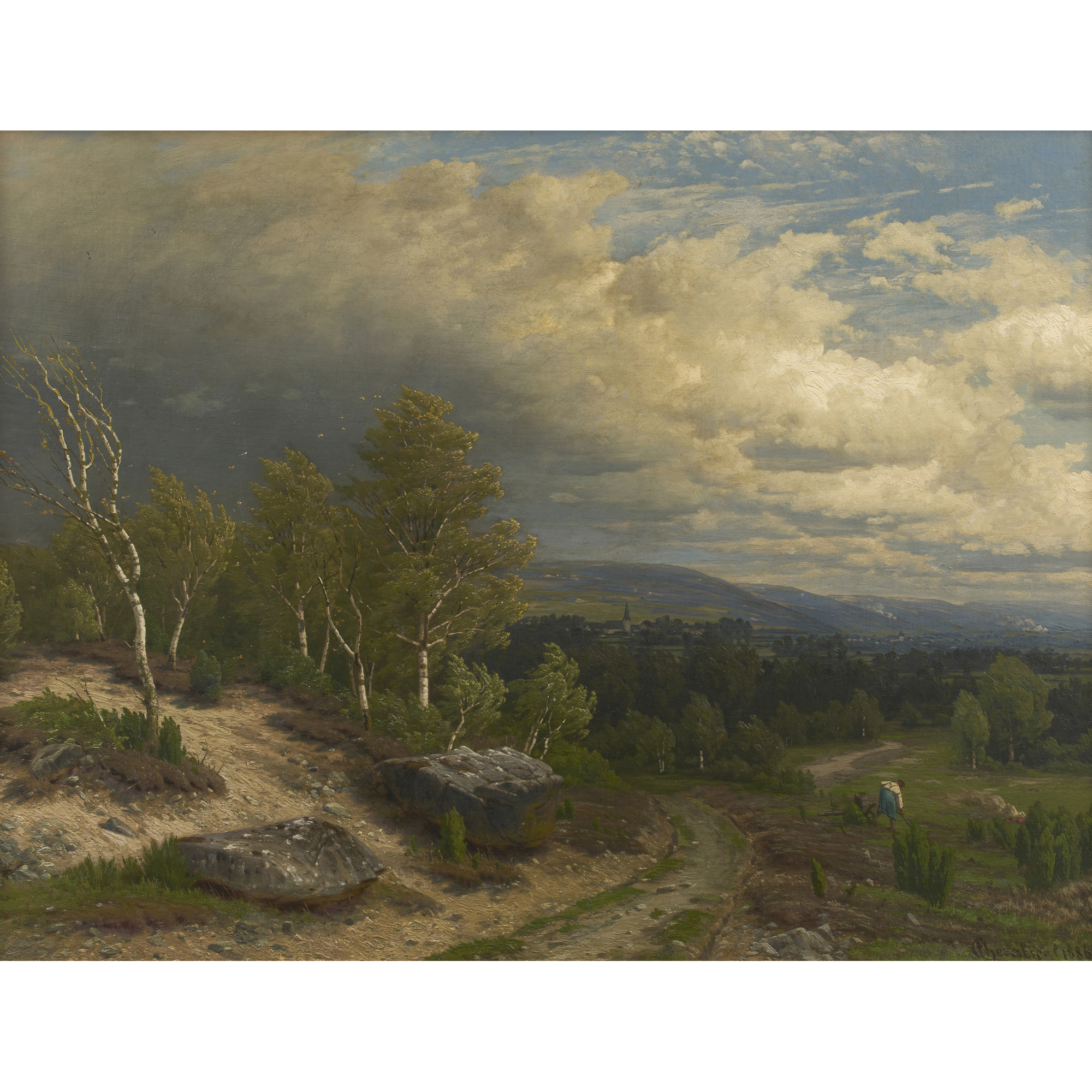
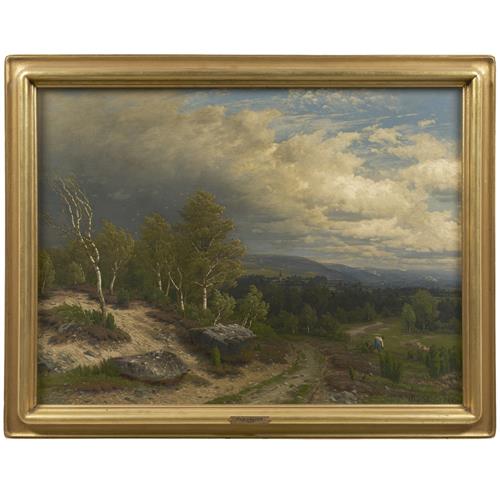
Tilling Fields before the Storm 1886
(also known as Storm Clouds Over the Ruhr Valley)
oil on canvas
signed and dated lower right: Chevalier 1886.
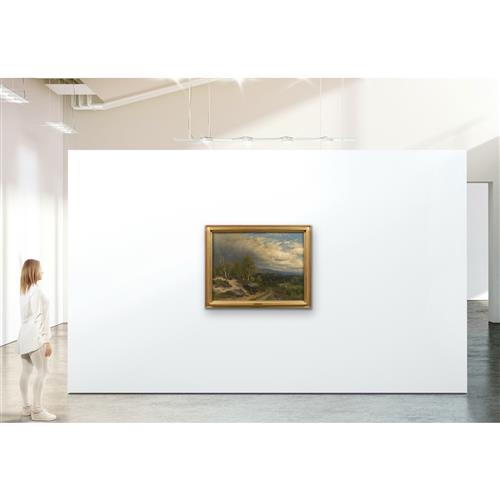
66 x 88cm
Estimate $50,000 - $70,000
Schweitzer Galleries, New York (stamp incised verso)
Leonard Joel, Melbourne, 25 August 1993, lot 261 (as "Tilling the Field Before the Storm")
Private collection, Melbourne
Gregg, S., Nicholas Chevalier: Australian Odyssey, Gippsland Art Gallery, Victoria, 2011, p. 248
"Laurenson, has compared the present work with a similar landscape subject known variously as 'Tilling Fields; After the Storm' and 'Storm Clouds over the River Valley'. Painted in London, it was possibly inspired by a scene from the Island of Bute in Scotland, home to Edward LaTrobe Bateman, and a frequent holiday destination of the Chevaliers. The work is of particular interest, however, as Chevalier's last known original landscape subject. He would have become very familiar with the characteristics of approaching storms on his travels through remote Victoria.
The two works are unique within Chevalier's oeuvre in their focus on atmospheric conditions, rather than on a specific material subject. Other artists of this time used the storm as a metaphor for social or economic upheavals, such as Martin Johnson Heade (1819-1904) of America's Hudson River School, and retrospectively Chevalier's 'Approaching Storm' could be viewed as a progenitor of Australia's economic crash of 1891. It is also possible this work explores Chevalier's growing awareness of his own mortality, as encroaching illness forced him to be housebound for extended periods. In any event, 'Approaching Storm' documents the artist's fine ability to describe the dread of looming dark clouds, with the foliage in the foreground seemingly scrambling to escape. It is unlikely that the work was commissioned or produced with a particular patron in mind, as Chevalier already enjoyed the illustrious patronage of Queen Victoria. Instead 'Approaching Storm' would have been paintined for Chevalier's own enjoyment, and is indicative of his then state of mind."
RELATED WORK:
Nicholas Chevalier, Approaching Storm c.1884-6, oil on canvas, 62 x 91cm, Sotheby's, Sydney, 25 August 2002, lot 245
Nicholas Chevalier was presumably a fascinating character, fluent in several languages, well-travelled, connected and an extraordinary painter. His painting 'The Buffalo Ranges, Victoria' was the first ever locally produced painting to be acquired by the National Gallery of Victoria (1865). Works by the artist are rare to come to auction and 'Tilling Fields before the Storm' 1886 (also known as 'Storm Clouds Over the Ruhr Valley') was "Chevalier's last known original landscape subject" (1) and it is an extraordinary example of his ability to capture atmosphere.
Chevalier was born in in St Petersburg, Russia, to Louis Chevalier and his Russian-born wife. His father, originally from Switzerland, had relocated to Russia to manage the estate of Prince Wittgenstein, a key military leader, trusted confidant to the Tsar, and powerful aristocrat. In 1845, the family returned to Switzerland, where Chevalier's artistic training began.
Over the following years, he studied painting in Lausanne before moving to Munich to train in architecture. During this period, he contributed to architectural plans for King Ludwig I's palace at Berchtesgaden. In 1851 Chevalier settled in London, where he developed a successful practice in lithography and watercolour. He exhibited at the Royal Academy in 1852 and undertook several high-profile commissions, including book illustrations.
After spending time in Rome refining his skills in watercolour and drawing, Chevalier's career took an unexpected turn. With his father's wealth declining, Chevalier was sent to Australia to assist family affairs and join his brother Louis, who was working on the goldfields. Arriving in Melbourne in 1854, Chevalier initially intended his stay to be brief. However, the demand for his artistic talents particularly from the Melbourne Punch encouraged him to stay. The Punch was an influential illustrated periodical in colonial Australia, combining satire, political commentary, social observation and with that forming an essential record of Victorian social life. His decision to settle in Australia was further shaped by his marriage to Caroline Wilkie, herself an artist and the daughter of a close family friend. (2)
Alongside his artistic practice, Chevalier was actively engaged in Melbourne's emerging art institutions and was instrumental in the formation of the Victorian Society of Fine Arts. In the mid-1860s Chevalier travelled extensively in New Zealand, producing a substantial body of work that was later shown internationally, including at the Paris Salon. After relocating permanently to London in 1870, Chevalier undertook royal commissions and continued to work across Europe.
Chevalier's connection to Australia remained significant, most notably through his long service on the London Selection Committee for the Art Gallery of New South Wales. Declining health eventually curtailed his practice, and his final years were spent largely in Madeira. (3)
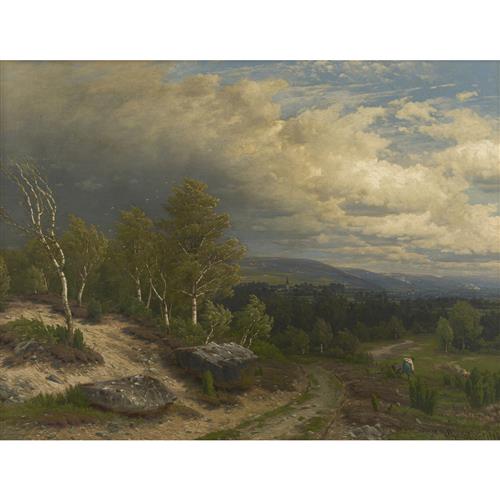
'Tilling Fields before the Storm' 1886, also known as 'Storm Clouds Over the Ruhr Valley', was painted in London and is thought to have been inspired by a scene on the Isle of Bute in Scotland, a destination frequently visited by the Chevalier family. Through extensive travel in remote parts of Victoria, Chevalier had become familiar with the visual language of approaching storms, a sensibility that clearly informs this work. (4) In my opinion, the scene is more reminiscent of the Swiss and German Alps; however, the painting occupies a distinctive place within Chevalier's practice for its emphasis on shifting atmosphere rather than a clearly defined topographical or narrative subject, and it is therefore not relevant to its impact which of the many countries he travelled to is being depicted here. The painting demonstrates Chevalier's gift to express mood and movement, darkening clouds press in, while the vegetation in the foreground is moving in the wind.
The painting shows expressive handling of paint. Brushstrokes are largely subordinated to the illusion of natural movement rather than calling attention to themselves, particularly in the sky, where soft, layered passages of paint are built up through subtle tonal modulation. In contrast, the foreground vegetation and earth are rendered with firmer, more descriptive strokes. Here the brushwork becomes slightly more tactile, anchoring the composition. While storms were often used by 19th-century artists as metaphors for social or economic instability, the work may also reflect a more personal reflection, suggesting Chevalier's increasing confrontation with his own fragility.
Wiebke Brix
Head of Art
1. Gregg, S., Nicholas Chevalier: Australian Odyssey, Gippsland Art Gallery, Sale, 2011, p.248
2. Tipping, M. J., Chevalier, Nicholas (1828-1902)', Australian Dictionary of Biography, National Centre of Biography, Australian National University, 1969, accessed online, adb.anu.edu.au/biography/chevalier-nicholas-3200, 7 February 2026
3. www.artgallery.nsw.gov.au/collection/artists/chevalier-nicholas/
4. Gregg, Nicholas Chevalier: Australian Odyssey, Gippsland Art Gallery, Sale, 2011
Fine Art
AUCTION
Sale: LJ8806
6:00pm - 17 March 2026
Hawthorn
VIEWING
Fri 13 - Sun 15 March, 11am - 5pm
2 Oxley Rd, Hawthorn VIC
CONTACT
Wiebke Brix
wiebke.brix@leonardjoel.com.au
SIMILAR ITEMS
Lot 12
ARTHUR STREETON (1867-1943) Harvest and Mt. William 1926 oil on canvas 50 x 75cm
Estimate: $200,000-300,000
Lot 30
RUPERT BUNNY (1864-1947) Portrait of Mme B c.1903 oil on canvas 79.5 x 63.5cm
Estimate: $70,000-90,000
Lot 18
HENRI-EDMOND CROSS (French, 1856-1910) The Bay of Saint-Tropez oil on panel 14 x 23.5cm
Estimate: $50,000-70,000
Lot 27
JOHN OLSEN (1928-2023) Landscape with Lake Rydal 2001 watercolour, pastel and synthetic polymer paint on paper 84 x 95cm
Estimate: $50,000-70,000