Back
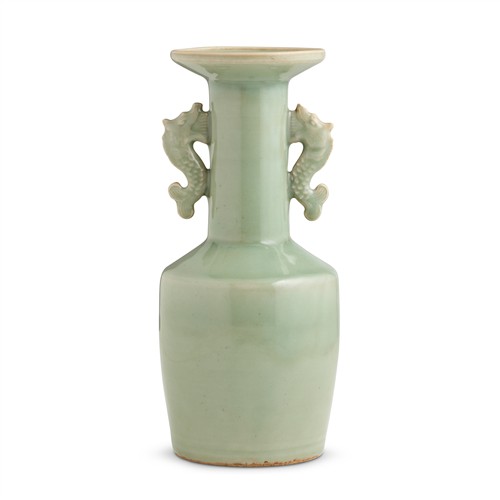
A FINE CHINESE LONGQUAN MALLET VASE, SOUTHERN SONG DYNASTY (1127 - 1279)
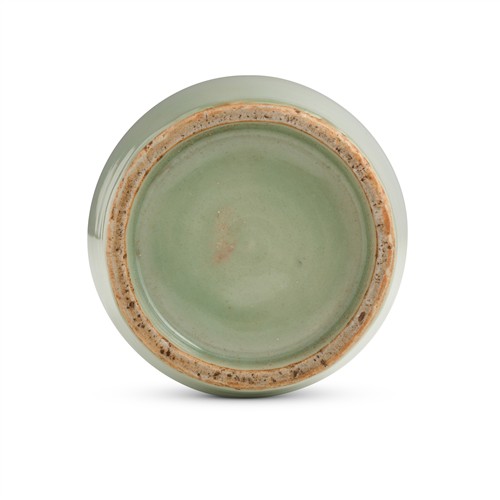
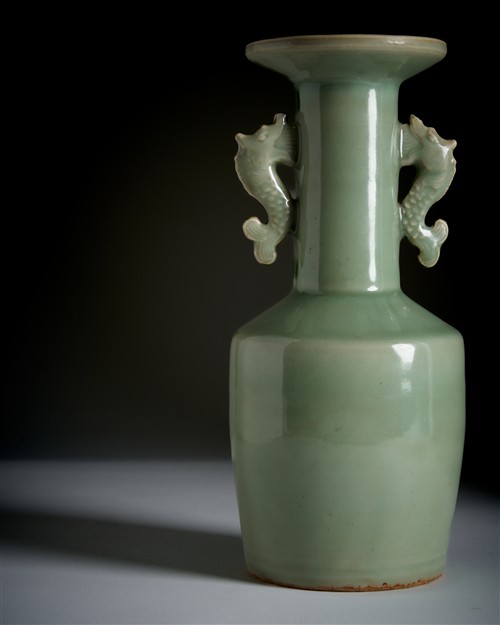
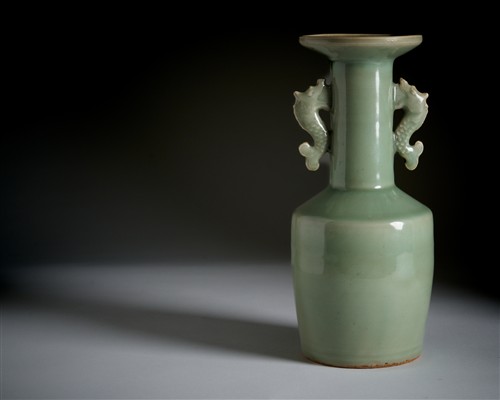
The vase is of mallet form, with sides tapering gently from the canted shoulder towards the foot. The tall neck is flanked by a pair of dragon-fish handles below a widely flared mouth with an upturned rim. It is covered overall in an even glaze of soft sea-green tone, the foot ring left unglazed.
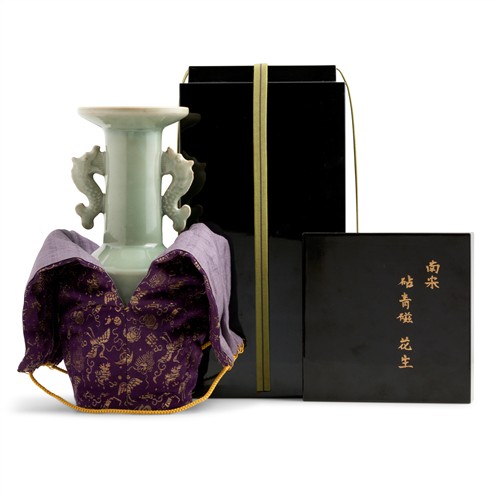
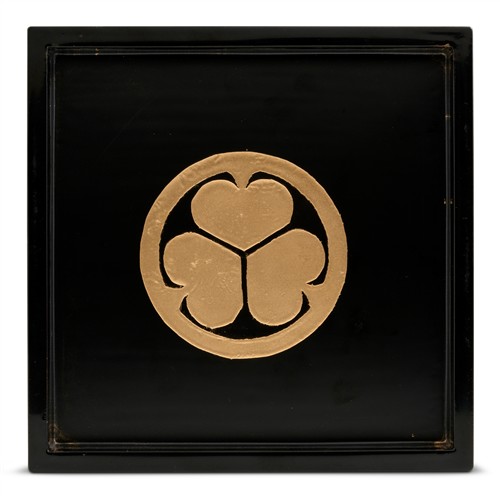
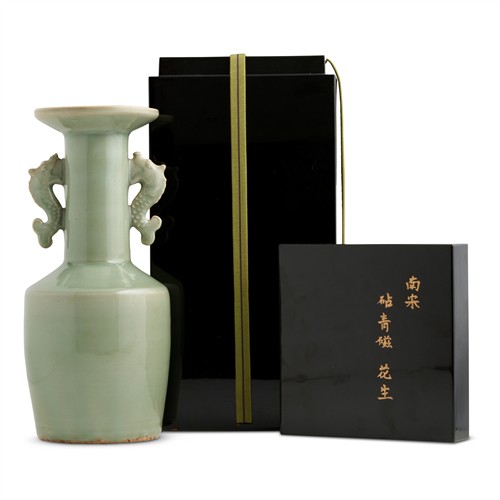
The vase is accompanied by an old brocade wrap and a gilt-lacquer inscribed black lacquer box, the reverse of the cover bearing the Tokugawa hollyhock crest.
Celadon vases of this mallet form, known in Japan as kinuta, rank among the most prized Longquan wares. Scholars have suggested that the shape, though resembling a paper mallet, may ultimately derive from imported Islamic glass vessels introduced to China during the Song period. Examples of related forms have been excavated from archaeological sites and shipwrecks, attesting to their early circulation and popularity.
Large kinuta vases with dragon-fish (feiyu) handles are particularly rare. The auspicious feiyu motif was favoured during the Yuan dynasty and reflects the broad cultural exchanges of the period. Closely comparable examples are preserved in important collections, including the Tokugawa Art Museum, Nagoya; the Freer Gallery of Art, Washington, D.C.; and the Palace Museum, Beijing.
Comparable examples have appeared at auction, including Christie's Hong Kong, 4 October 2018, lot 30, and 1 December 2010, lot 3103; and Sotheby's Hong Kong, 1 April 2019, lot 3028.
南宋 龍泉窯飛魚耳紙槌瓶
此瓶呈紙槌形,肩部折角,腹壁自肩向下微斂至足。長頸高挺,頸部兩側飾一對飛魚耳,口沿外撇寬闊,唇口微微上折。通體施勻淨柔和海棠青釉,足圈露胎無釉。
此瓶附舊錦套及黑漆描金題字箱,箱蓋背面飾德川家葵紋。
此類紙槌形青瓷瓶,在日本稱為「砧青瓷」(kinuta),為龍泉窯器中最受珍視之品類之一。學者認為,此式樣雖形似紙槌,其原型或源自宋代傳入中國之伊斯蘭玻璃瓶器。相關器形曾見於考古遺址及沉船出土,足證其早期流通與廣受珍愛。
帶飛魚耳之大型砧形瓶尤為罕見。飛魚紋飾寓意吉祥,於元代尤為流行,亦反映當時廣泛的文化交流。與本器相近之例,現藏於名古屋德川美術館、華盛頓弗利爾美術館及北京故宮博物院等重要機構。
拍賣市場可參考相類例子:香港佳士得,2018年10月4日,拍品30號;香港佳士得,2010年12月1日,拍品3103號;以及香港蘇富比,2019年4月1日,拍品3028號。
26.3cm high
Unsold
Lot 245
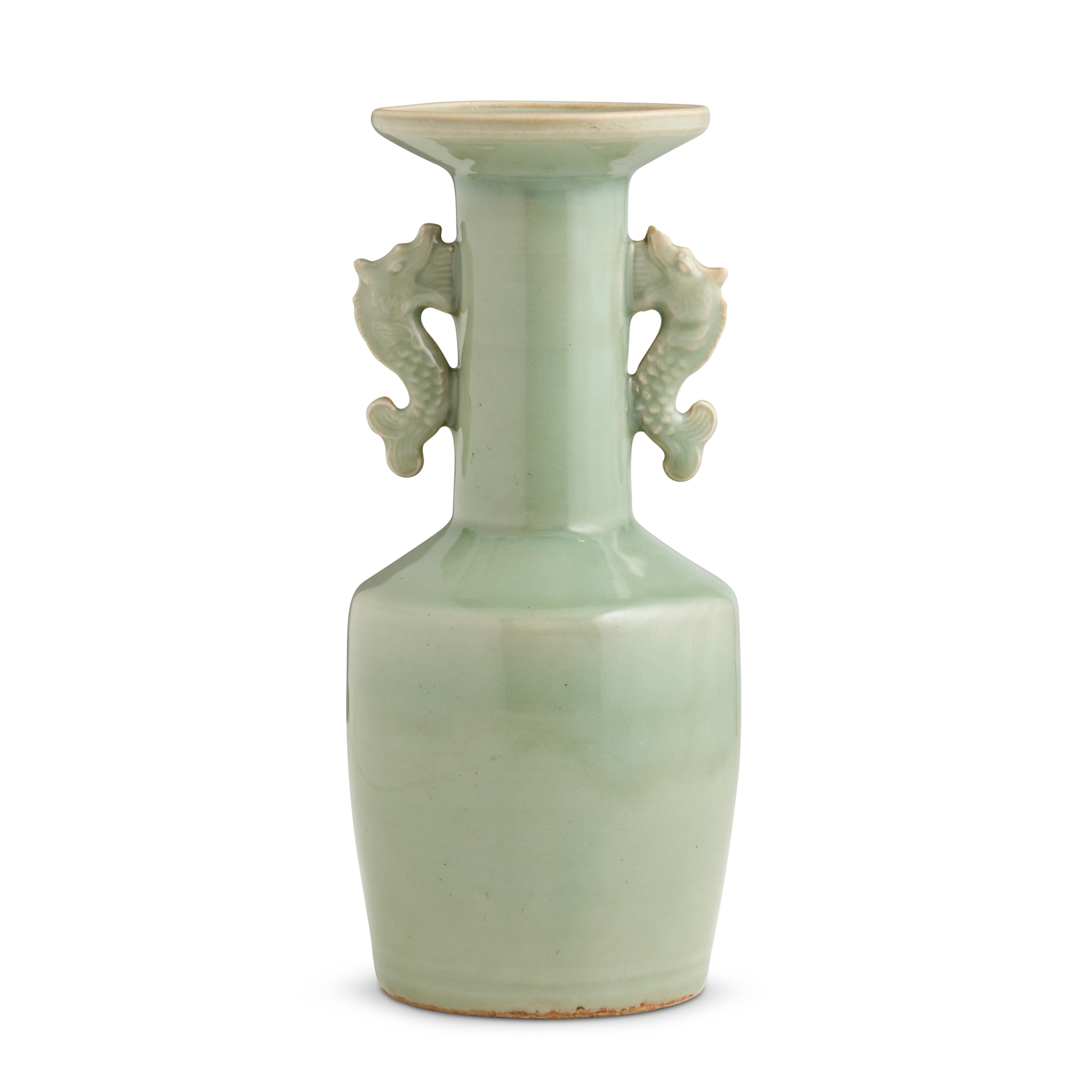
The vase is of mallet form, with sides tapering gently from the canted shoulder towards the foot. The tall neck is flanked by a pair of dragon-fish handles below a widely flared mouth with an upturned rim. It is covered overall in an even glaze of soft sea-green tone, the foot ring left unglazed.
The vase is accompanied by an old brocade wrap and a gilt-lacquer inscribed black lacquer box, the reverse of the cover bearing the Tokugawa hollyhock crest.
Celadon vases of this mallet form, known in Japan as kinuta, rank among the most prized Longquan wares. Scholars have suggested that the shape, though resembling a paper mallet, may ultimately derive from imported Islamic glass vessels introduced to China during the Song period. Examples of related forms have been excavated from archaeological sites and shipwrecks, attesting to their early circulation and popularity.
Large kinuta vases with dragon-fish (feiyu) handles are particularly rare. The auspicious feiyu motif was favoured during the Yuan dynasty and reflects the broad cultural exchanges of the period. Closely comparable examples are preserved in important collections, including the Tokugawa Art Museum, Nagoya; the Freer Gallery of Art, Washington, D.C.; and the Palace Museum, Beijing.
Comparable examples have appeared at auction, including Christie's Hong Kong, 4 October 2018, lot 30, and 1 December 2010, lot 3103; and Sotheby's Hong Kong, 1 April 2019, lot 3028.
南宋 龍泉窯飛魚耳紙槌瓶
此瓶呈紙槌形,肩部折角,腹壁自肩向下微斂至足。長頸高挺,頸部兩側飾一對飛魚耳,口沿外撇寬闊,唇口微微上折。通體施勻淨柔和海棠青釉,足圈露胎無釉。
此瓶附舊錦套及黑漆描金題字箱,箱蓋背面飾德川家葵紋。
此類紙槌形青瓷瓶,在日本稱為「砧青瓷」(kinuta),為龍泉窯器中最受珍視之品類之一。學者認為,此式樣雖形似紙槌,其原型或源自宋代傳入中國之伊斯蘭玻璃瓶器。相關器形曾見於考古遺址及沉船出土,足證其早期流通與廣受珍愛。
帶飛魚耳之大型砧形瓶尤為罕見。飛魚紋飾寓意吉祥,於元代尤為流行,亦反映當時廣泛的文化交流。與本器相近之例,現藏於名古屋德川美術館、華盛頓弗利爾美術館及北京故宮博物院等重要機構。
拍賣市場可參考相類例子:香港佳士得,2018年10月4日,拍品30號;香港佳士得,2010年12月1日,拍品3103號;以及香港蘇富比,2019年4月1日,拍品3028號。
26.3cm high
Estimate $40,000 - $60,000
Overall in a good condition.
CLICK TO SEE DETAIL PHOTOS OF THE WHOLE AUCTION