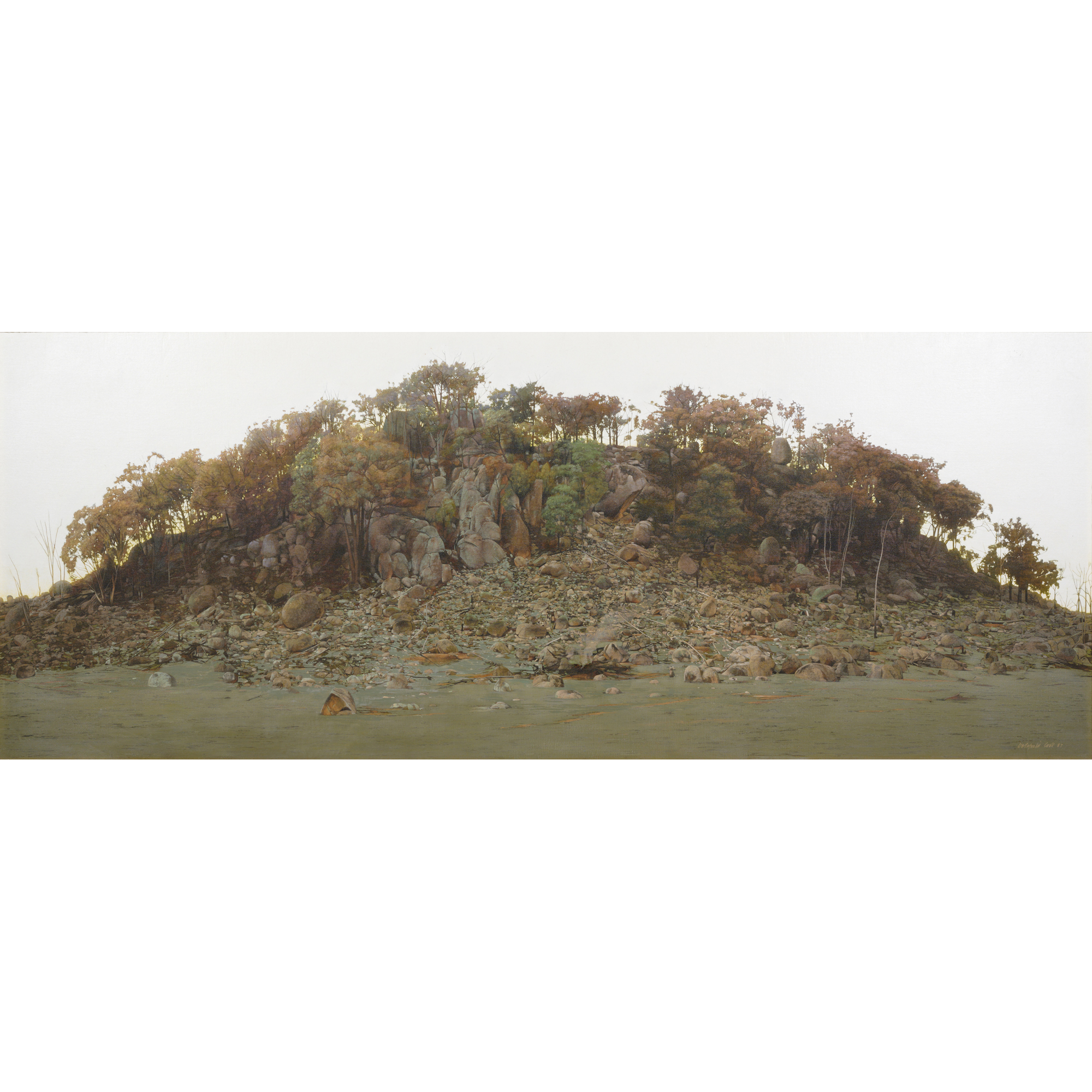
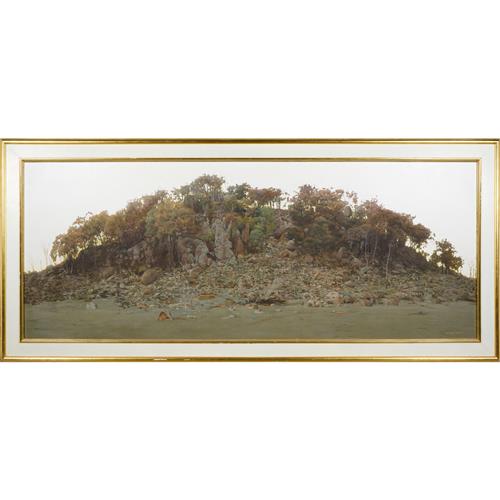
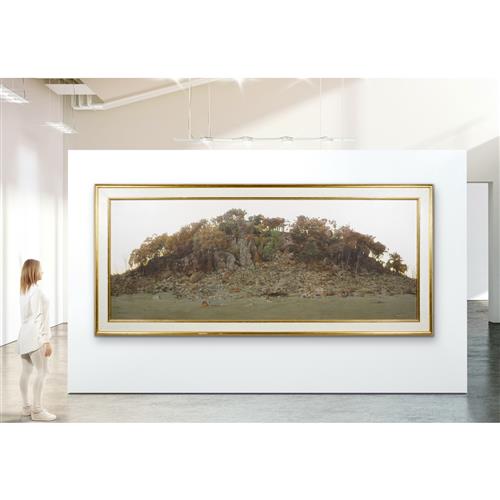
Hillside, Euroa 1987
synthetic polymer paint on canvas
signed and dated lower right: Delafield Cook 87
artist's name and title on gallery label verso
111 x 281.5cm
Estimate $200,000 - $300,000
Art Galleries Schubert, Queensland (label verso)
Private collection, Queensland
Hart D., William Delafield Cook, Sydney, Craftsman House, 1998, p.167 (illus.)
Painting the Australian landscape resonated for William Delafield Cook as a timeless musing on beauty, memory, love and loss. He chose photographic realism as his style. To look at his work is to both absorb a view of a world held within replications of the intricacies, grandeur and diversity of a particular landscape and one that, through his meticulous approach, he constructed and contrived. 'Hillside, Euroa' (1987) is a very fine example of his painterly fascination with the landscape.
Born in Caulfield in 1936 it did not take Delafield Cook long to acknowledge his desire to pursue life as an artist. He followed in the footsteps of his grandfather, the artist William Delafield Cook (1861-1931), a painter of soft glowing views of Heidelberg, the Dandenong Ranges and the coast, exhibiting at the Victorian Artists Society alongside Tom Roberts. Yet Delafield Cook, like many others, left Australia in the fifties and journeyed overseas to pursue an artistic career.
After a period of study and lengthy stay in England, a marriage and family with the inimitable Sally Bovington, Delafield Cook's home became London, and he enjoyed a burgeoning career as an artist as well as teaching positions. Despite the contentment of domestic life, it was to Australia that the family regularly travelled, at one point purchasing a Sydney home, regularly driving across the nation, Delafield Cook photographing, documenting, sketching and searching for views that ignited his imagination.
He commented on the personal nature of his landscapes as being "not just "landscape", they are a part of my life. If I'm painting Australia (and for some reason I've never really had any interest in painting the English landscape) I'm painting, among other things, my thoughts, my childhood, my sense of place, where I belong."(1)
Delafield Cook developed an intense style of painting, often reducing the evidence of his brushstrokes by sanding and smoothing the painted surface. The realism of his studies ignites a desire to probe, inspect and explore. He often constructed his vast works from views of a centrally located organic entity. He favoured haystacks, clumps of trees seemingly majestically rising from the depths of a lake, appearing like a mirage, or a barren clump of rocks, archaic and desperately ancient.
A canvas such as 'Hillside, Euroa' required the commitment of several months of drawing and painting. Delafield Cook gathered his source material of photographs and sketches and pinned them on boards in his London studio so that he might dissect, filter and refine the images into his final work, memory of his visits equally as active. Despite the activity required to make the picture, the result is one of quiet contemplation, and stillness.
Euroa, a town in northern Victoria, is perhaps best known for its association with the mythology of Ned Kelly's gang who roamed its countryside. It is typical of Delafield Cook to choose locations that are not without a colourful history (he also painted Hanging Rock), his somewhat muted colouring belying that which simmers within the shadows or fallen leaves and crusted dirt as though he searches for the very footprints of Ned Kelly, however the depiction of any human or animal is not to be found. Indeed, the landscape of Euroa, once he became acquainted with the formations of its earth, developed into an obsession for Delafield Cook and resulted in one of his most significant series.
Repeated visits in the late eighties and early nineties inspired him to centre his focus upon the rocky and vegetated mounds, some exposed as quarried rock faces, others naturally occurring. Two similar and equally fine examples are held in the collection of the Art Gallery of New South Wales. In 'The Quarry, Euroa' (1989-90) and 'Rocky Hillside, Euroa' (1990) Delafield Cook has chosen views sparse and stripped of vegetation, his colouring subdued against a pale incipient sky bereft of clouds. In both works, either through quarrying of the land or an unforgiving expanse of dry earth sporadically populated with smoothed emerging rocks, there is little to suggest plant-life will spring forth.
In 'Hillside, Euroa' his approach is subtly different; he depicts a jutting rock formation discovered on private property. The mound appears to have existed for thousands of years, the symmetry held in the enduring patterns, time's erosion evidenced in smaller rocks distributed in a formation around the base, the foreground of cleared land providing the viewpoint for the hill's majesty.
Spindly trunks of trees cling to patches of available earth amongst the harsh rock environment, leaves a fertile green, lit by the remnants of a golden sunset on the horizon while others appear unable to survive, tree branches bare and relegated to the fringes of the vegetation's central core. It is tempting to suggest Delafield Cook is critiquing society and its ruthless structure that assigns the vulnerable to its fringes, just as the unforgiving Australian climate is too overwhelming for a young defenceless tree, fallen branches scattered like lances in Paolo Uccello's 'The Battle of San Romano'.
Rock after rock, scattered with smaller stones, is detailed as though to forsake one would disrupt the balance of the painting, each rock contributing to the overall composition. A photograph cannot bring such gravitas, such meaning to a work. Delafield Cook spells out each component of his composition asking us to linger and contemplate his perspective, a parting of the vegetation just beyond the centre of the painting a possible trail that delineates the darker side of the hill.
Delafield Cook's Australian influences are many; the silvery grey-green colouring of gum trees painted by Tom Roberts, the horizontal vistas and mounds that populate the work of John Glover and the expansive views by Eugene von Guérard. These artists also journeyed, searching for motifs and expressions of their artistic traditions and a national identity. Nature and its many manifestations dominated their work just as Delafield Cook immersed his practice in the impact the environment could have upon his very being.
A winner of the Wynne (1980) and Sulman (1981) prizes, the uncompromising brilliance of Delafield Cook's body of work locates him as one of Australia's great artists, works on the scale and significance of 'Hillside, Euroa' rarely available. It is the intimacy and grandeur of the landscape that captured the artist and permeates the space of the viewer. Looking elsewhere is almost impossible.
Dr Julie Cotter
Dr Julie Cotter is the author of three books, has worked as a lecturer and in public policy roles, written and presented documentaries, is widely published in a range of journals, magazines and catalogues and has been a member of many public art and grant committees. Her book, 'Tom Roberts and the Art of Portraiture' (Thames & Hudson 2015), was shortlisted for the 2016 Prime Minister's Literary Award for nonfiction. Her most recent book is 'Portia Geach: Portrait of an Activist' (Joyce Press 2024). It tells the story of the first Australian woman to be admitted to the Royal Academy of the Arts.
(1) Hart D., William Delafield Cook, Sydney, Craftsman House, 1998, p.167.
RELATED WORKS:
William Delafield Cook, The Quarry, Euroa 1989-90, synthetic polymer paint on canvas, 162 x 294.5cm, Art Gallery of New South Wales, Sydney
William Delafield Cook, Rocky Hillside, Euroa 1990, synthetic polymer paint on canvas, 88.8 x 300cm, Art Gallery of New South Wales, Sydney
Fine Art
AUCTION
Sale: LJ8822
6:00pm - 6 October 2026
Hawthorn
VIEWING
Friday 2 - Sunday 4 October, 11am - 5pm, 2 Oxley Rd, Hawthorn
CONTACT
Wiebke Brix
wiebke.brix@leonardjoel.com.au
SIMILAR ITEMS
Lot 13
RUSSELL DRYSDALE (1912-1981) The White Blow 1967 oil on canvas 49 x 75cm
Estimate: $180,000-220,000
Lot 25
MARC CHAGALL (Russian-French, 1887-1985) L'Animal Aile 1974 monotype in colours on Japon nacré paper, unique 42 x 32cm (plate); 67 x..
Estimate: $40,000-60,000
Lot 1
ELIOTH GRUNER (1882-1939) She-oaks in France 1924 oil on panel 36 x 44.5cm
Estimate: $30,000-50,000
Lot 14
WILLIAM DOBELL (1899-1970) Creek at Lake Macquarie c.1949 oil on board 24 x 29cm
Estimate: $15,000-25,000